
Chess
Chess: What makes the 2025 FIDE World Cup unforgiving and hard to predict
In the high-stake world of elite chess, one bad day is all it takes to end nearly a month’s hard work.
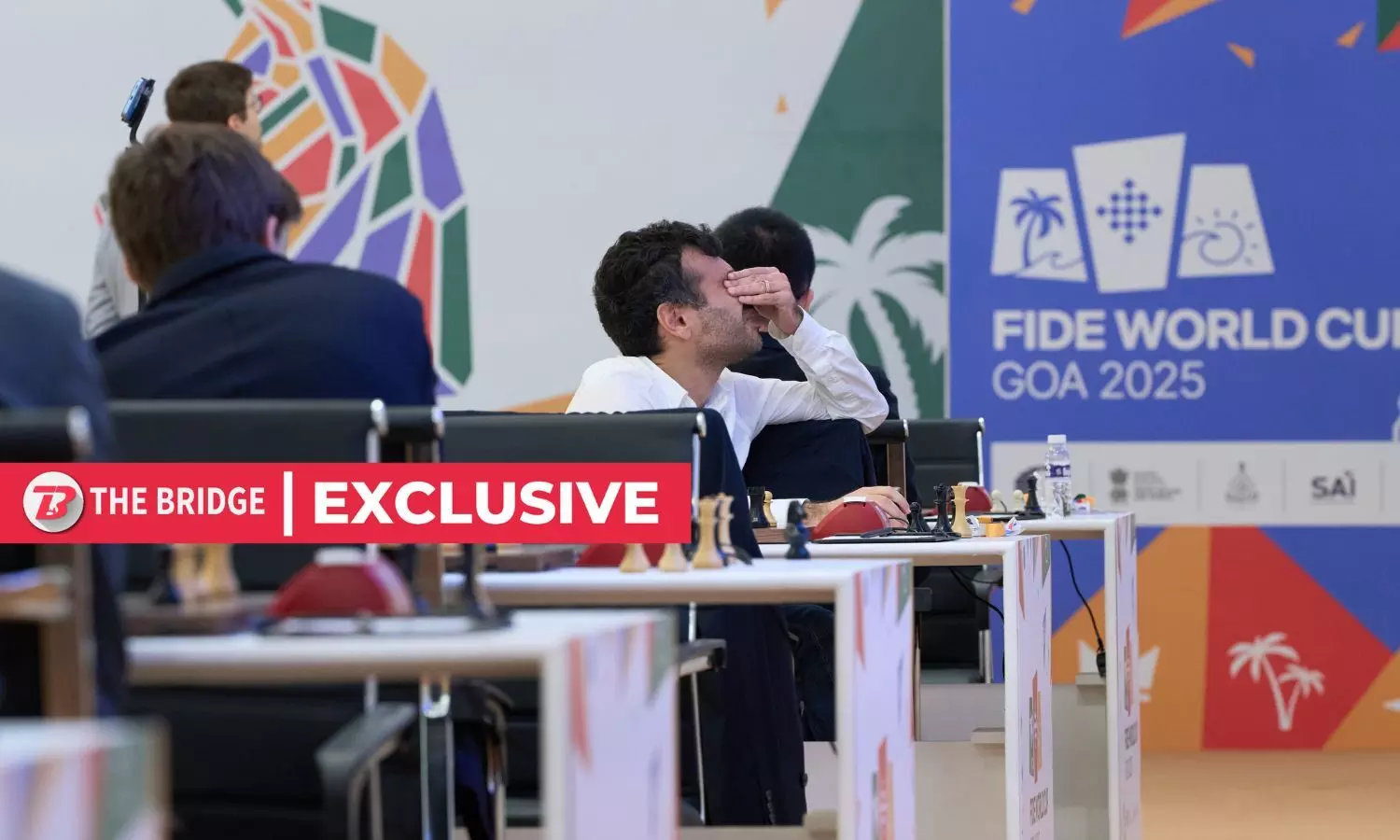
GM Gabriel Sargissian reacts after bowing out of 2025 FIDE World Cup (Photo credit: Eteri Kublashvili/FIDE)
Goa: "It is very hard to predict. This format is such that the youngsters will always have the advantage."
Those were the reigning women’s world rapid chess champion Koneru Humpy’s words during Round 5 of the 2025 FIDE World Cup at the Rio Resort here in Arpora last week.
Just a few months ago, Humpy was in the final of the 2025 Women’s FIDE World Cup. It was a brutal tournament, where she had to stretch herself to the limit only to lose out to the young 19-year-old Divya Deshmukh in the title clash.
"It is quite tough for the top-seeded players and most of the time I’ve seen them get eliminated quite early because the format is quite tricky," said Humpy.
This is exactly what has transpired in Goa with all the top seeds sent packing early. China’s Wei Yi is the only one among the top ten seeds to reach the semi-finals at the time of publishing this.
The reigning world champion and top seeded Gukesh Dommaraju was knocked out in just the third round. Two-time world championship challenger Ian Nepomniachtchi was shown the door even earlier by India’s GM Diptayan Ghosh.
Other title contenders like GM Praggnanandhaa Rameshbabu, GM Arjun Erigaisi, and GM Vincent Keymer were also taken down in tie-breaks.
Tricky format
The format of the World Cup is such that players are forced to switch between the classical format and time-control again and again. If two classical games end in a draw, players are forced into rapid tiebreaks. If those end with no decisive result, a player heads towards blitz games until a winner emerges. And the following day, they are back playing classical games in the next round yet again.
Humpy attributes this as a major reason as to why the World Cup is known for 'upset results.'
"You need to have lots of energy and you need to convert quite fast from classical to rapid and from rapid to blitz within a shorter span of time. These factors actually benefit the youngsters," said Humpy.
Srinath Narayanan, the Indian national coach who was in Goa helping the 24 GMs from the country on demand for the tournament, concurs.
"It is definitely a challenge to adapt from one format to the other," Srinath told The Bridge. "But, in general, your mind and body also recognises and automatically switches to a different faster mode of thinking."
On the other hand, two-time World Cup winner Levon Aronian feels preparation is the key. According to the Armenian Grand Master, the prep does not have to be tailored to the World Cup format, but the general rapid and blitz games help in switching the manner a player thinks.
"We are playing so much rapid and blitz nowadays that we are kind of used to switching the thinking mode," Aronian, who did not play a single short format tiebreak game in this tournament until his Round 5 exit, told this publication.
"But when you are playing the first rapid game, it is generally tough," he added.
This is where Srinath draws a tech-savvy analogy to further decode how players manage to switch between formats so easily.
"It is like how you build certain profiles on your phone and you switch between those profiles as per requirements," explained Srinath. "It works in a similar way.
"There are maps in the brain and when you get to a different format or time control, that part of the brain or that map takes over and you start executing the things you practiced," he added.
Mental fatigue
Despite the auto-pilot mode the players are usually in, all of them are bound to have limitations. Recalling her own campaign at the 2025 FIDE Women’s World Cup, Humpy stressed on how tired she was playing long tie-breaks in the semi-final against top seed Lie Tingjie of China, which she won 5-3.
"I was mentally prepared for every round that I might get eliminated. The only thing I told myself was to give the best I could on that particular day," Humpy told this website.
"Of course as a player, I do have certain limitations and energy also matters a lot in this format. Going towards the end after playing the semi-final tiebreaks, I also lost a lot of energy," she added.
The loss of energy is not solely due to the long games played over the board. The meticulous preparations for each opponent also drains out a player, Humpy argued.
"If you are playing a Swiss tournament, you could just stick on to your preparations. You don’t need to spend so much time changing the opening repertoire for just one particular game," she said.
"But here, when you have a different opponent, you are forced to look into different things. You have to spend quality time, preparing new ideas and other stuff and that actually makes you lose energy.
"That’s why I feel like this format is more suitable for youngsters. People might think it’s an indoor sport, how does energy matter? But at the end of the day, your brain needs rest and you have to be fresh enough to play practically over the board. Especially in rapid and blitz formats, those small things matter a lot," she added.
At the 2025 FIDE World Cup in Goa, four players – Javokhir Sindarov, Nodirbek Yakubboev, Wei Yi, and Andrey Esipenko – excelled despite these challenges to make the semi-finals.
And yet, like most elite chess players, the quartet would know that one bad day is all it takes to end nearly a month’s hard work and return empty handed.