
Winter Sports
India's gold medals at Winter Olympics you probably haven't heard about
Seven Indian members of the 1922 Mount Everest expedition who died were awarded gold medals at the the closing ceremony of the 1924 Winter Olympics.
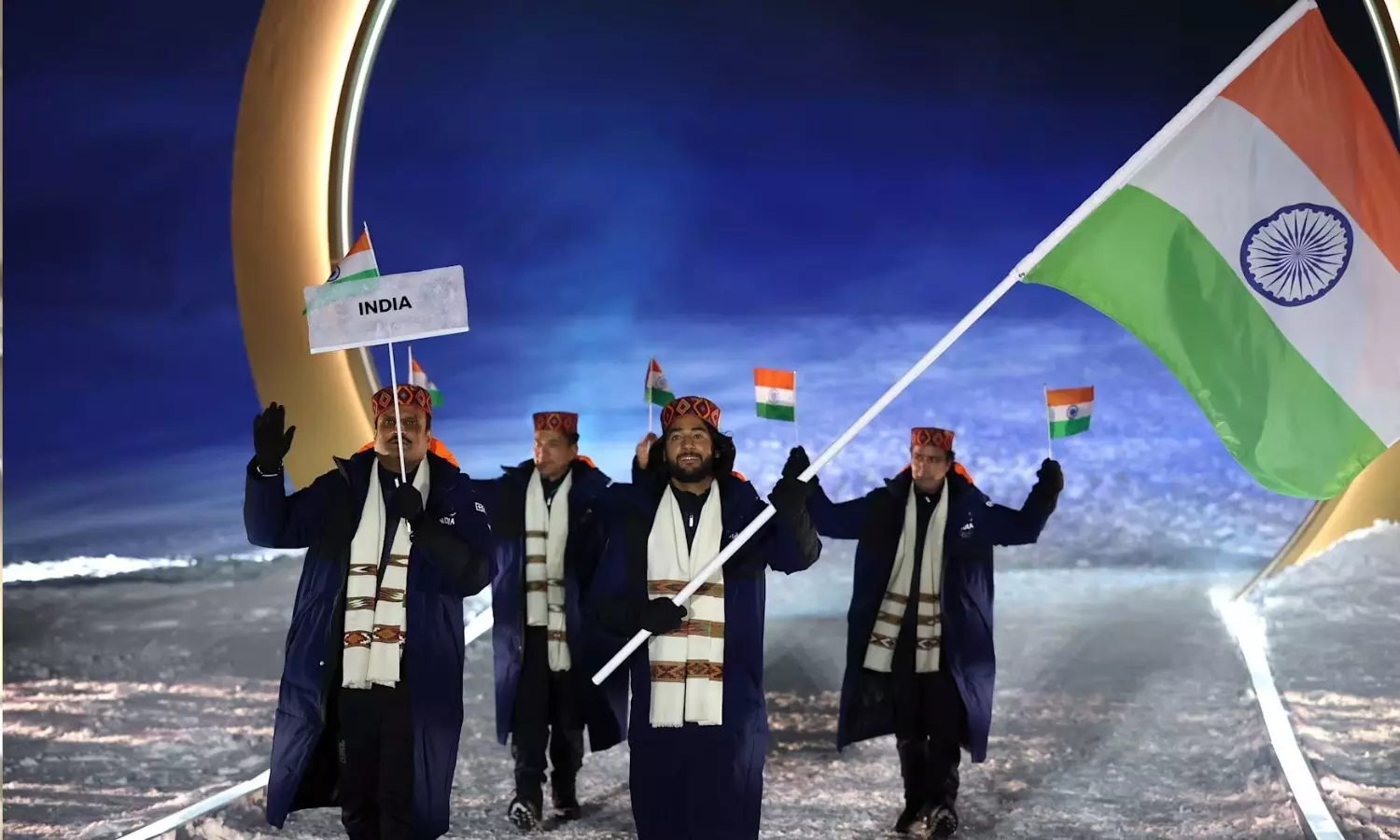
Indian contingent at 2026 Winter Olympics opening ceremony (Photo credit: Getty)
This may sound like a glitch in the matrix but India, a subtropical nation with a nascent winter sports culture, has seven gold medallists at the Winter Olympics. Hard to believe for a country that has a two-member squad at the 2026 Milano Cortina Games?
India’s history at the Olympics is largely well documented. The country dominated the hockey fields in the 1900s, before coming of age in shooting, wrestling in the 21st century — all at the Summer Games. Albeit just 41 medals since debut, all of it remembered fondly by sports enthusiasts and experts in the country.
Then how do seven medallists; let alone gold medallists at the Winter Olympics, completely go missing from the nation’s collective consciousness?
It was the exact reaction the writer had when one stumbled on to the little-known fact during a good ol' doomscrolling session.
Gold for Mountaineering?
In 1922, a British expedition team set out to scale Mount Everest — a feat unheard of back then. It was the first expedition to carry bottled oxygen, with the attempt being made from the northern side of Everest out of Tibet.
Climbing from the south side of the mountain range was not possible with Nepal yet to open it for westerners, let alone an entire 21-member expedition led by British nationals.
The expedition made three separate attempts to reach the pinnacle. They reached a height of 7,620m in the first attempt, before improving it to a then world record of 8,225m in the second attempt.
The third attempt ended on a tragic note, with seven members of the expedition losing their lives to an avalanche. These were the first recorded deaths at Mount Everest in history, bringing an abrupt end to a spirited expedition.
A few members of the 1922 British Mount Everest Expedition (Photo credit: Wikipedia)
The seven members, who perished during the attempt were: Narbu Sherpa, Lhakpa Sherpa, Pasang Sherpa, Pembra Sherpa, Antarge Sherpa, Temba Sherpa, and Sange Sherpa.
These are not names you would have heard of. But these seven gentlemen hold a special place in Indian sports history – something which even the writer was oblivious of until last week.
The Olympic gold medal
The expedition piqued interest of the commoners across the globe. After returning to England, George Mallory, the leader of the third attempt where seven sherpas laid their lives, and Australian national George Finch travelled across England making presentations on their courageous expedition.
The idea was not just to share the tales from their endeavor with the mountaineering community but also to raise funds for yet another expedition. The latter seemed to have been largely unsuccessful with an expedition planned for 1923 delayed by a year.
It was under such circumstances that Mallory received an unexpected telegraph, asking him if he could attempt the closing ceremony of the 1924 Winter Olympics. It was from none other than Baron Pieree de Coubertin — the co-founder of International Olympic Committee (IOC) and the father of modern Olympics.
Preoccupied with his preparations for the 1924 expedition, Mallory politely declined the invitation.
In February 1924, Coubertin still went ahead and awarded gold medals for "alpinism" to each member of the expedition, including the seven Indian sherpas during the closing ceremony of the Games which was later recognised as the first Winter Olympics.
"For the first time a gold medal is awarded for alpinism, and it is awarded to the glorious expedition to Mount Everest. Not content with having almost succeeded, they are preparing a renewed effort to finish the ascent," Coubertin reportedly said, while awarding the medals.
"At the foot of the highest mountain in Europe, we present you and your wonderful companions with this small testimony of the admiration with which all nations have followed your journey towards the untouched peaks of the highest mountain in the world. We accompany this gesture by prayers for the completion of a work that will honor not only your country but all humanity," he added.
In Mallory’s absence, deputy leader of the expedition Edward Strutt received the medals on behalf of the entire team. He pledged to take the medals to the summit of Mount Everest as he received them.
1924 Winter Olympics gold medal (Photo credit: Olympic Channel)
Around four months later, Mallroy was declared dead during his 1924 expedition. His body won’t be found until 75 years later in 1999.
To this day, the world doesn’t know if Mallroy indeed did reach the summit. The distinction of being the first humans to scale Mount Everest belongs to Sir Edmund Hillary and Nepali-Indo sherpa Tenzing Norgay in a feat achieved in 1953.
Strutt could never fulfill his pledge to take the medals to the summit until his death in 1948 – less than a year after India gained independence.
Medal reaches the summit
Nearly 90 years after Pierre de Coubertin awarded the medals to the expedition, one of the medals was finally taken to the summit of Mount Everest, fulfilling Strutt’s pledge.
It was completed by British mountaineer Kelton Cool in May 2012. He spent about 30 minutes at the summit before descending in what was his tenth successful climb.
The medal taken to the summit belonged to Arthur Wakefield – a doctor, who was a part of the 1922 expedition.
As per the International Olympic Committee rules, the gold medal awarded is recognised under the banner of "Mixed Team" and not any specific National Olympic Committee (NOC) with multiple nationalities forming the team.
It is also not known if the families of the seven Indian sherpas, who sacrificed their lives, ever got their hands on the Olympic medal.
Whether it's a glitch in the matrix or not, the contributions and sacrifice of Narbu, Lhakpa, Pasang, Pembra, Antarge, Temba, and Sange to expand human boundaries are worth remembering for generations to come.