
Tennis
After a cricket ball claimed his sight, Nibin finds purpose in tennis
Despite being ranked World No. 5, paucity of funds could derail Nibin Mathew's goal of playing in the 2026 World Blind Tennis Championships.
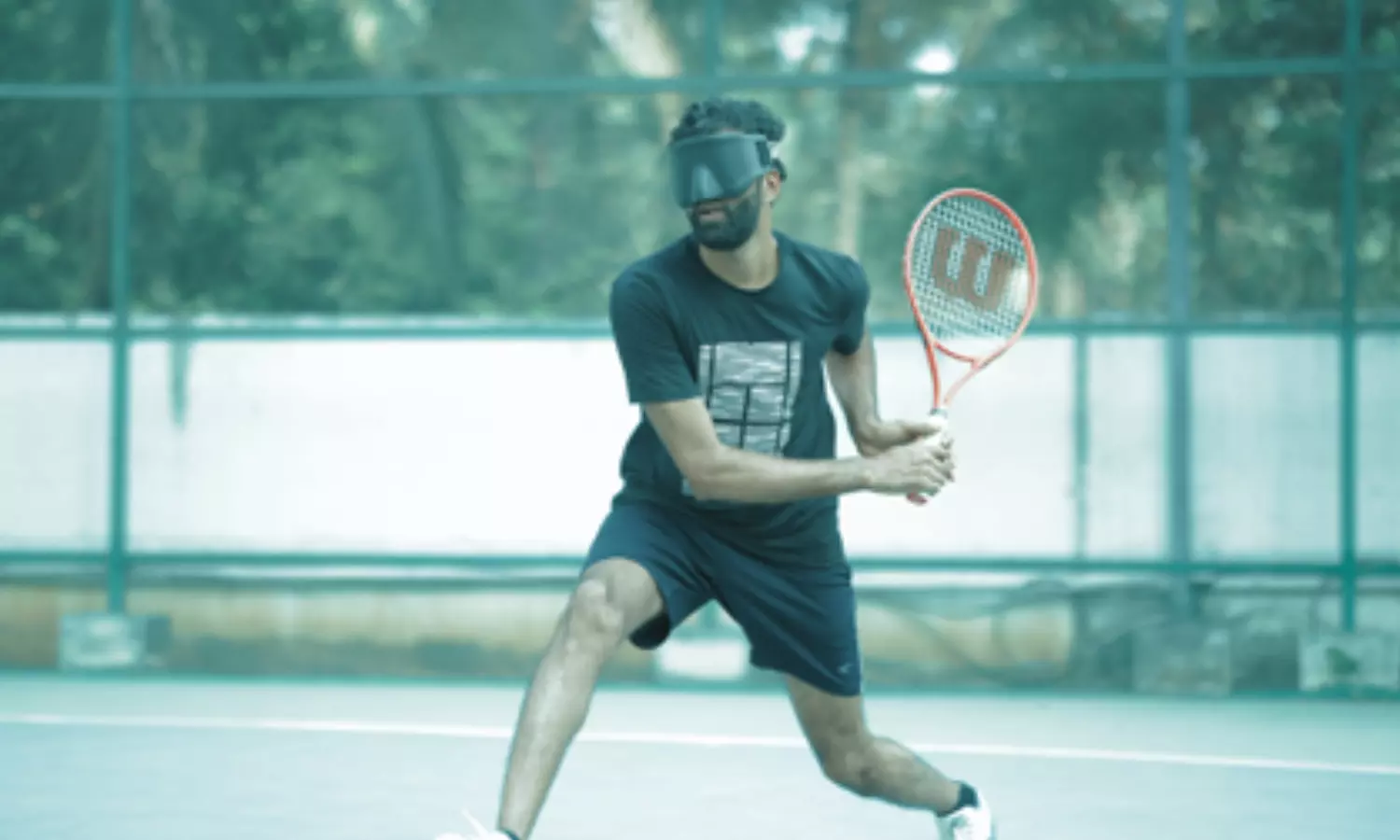
"I want blind tennis to become a sport that more people in India know exists," Says Nibin. (Photo credit: nibinvitennis/ Instagram)
The sound arrives first: a rattle, faint and metallic, bouncing across a a tennis court.
Then the swing. Thereafter, and more often than not these days, the clean crack of a racquet finding a ball that Nibin Mathew has never once seen coming.
Blind since he was in 11th grade, Nibin is now ranked fifth in the world on the official International Blind Tennis Association (IBTA) charts.
In under two weeks, the 29-year old is scheduled to fly to Vilnius, Lithuania, to compete in the 2026 World Blind Tennis Championships, a tournament that will decide, in part, whether India's best-kept sporting secret gets to keep competing at all.
He does not yet know if he can afford to go.
Darkness and hope
Nibin grew up in a village in Wayanad, Kerala, where cricket, not tennis, filled every courtyard and side street.
At the age of nine, a cricket ball struck his already-weak left eye and destroyed what vision remained in it. He kept playing with his right eye for years, until glaucoma crept in.
By the 11th grade, the darkness was total.
"Cricket was also connected to one of the most difficult turning points of my childhood," he says. His parents, having already watched one sport take his sight, steered him toward books instead.
He did try blind cricket, but never quite found his place in it. "For several years after that," he recalls, "sport was something I loved from a distance."
Then he moved to Mumbai for work and wandered into a training camp for blind tennis players, largely out of curiosity.
What he heard resonated with him almost instantly: a specially weighted ball that rattles as it rolls and, remarkably, as it flies.
"Suddenly, there was a ball somewhere in three-dimensional space," he says. "I had to listen, predict its direction, understand its speed, position my body, time the swing and connect the racquet with it. It was difficult. That was exactly why I loved it."
His coach, he says, "often tells me that tennis is fundamentally a mind game. The longer I play, the more I understand what he means."
Enrolling for a Masters program at the International Institute of Information Technology in Bangalore infused new life. The institution gave him court access and sourced the balls he could not otherwise find.
In February 2020, at India's national championship in Patiala, Punjab, he beat eleven opponents to become the country's first Men's National Blind Tennis Champion. But just when he was building momentum, the pandemic put the breaks on his shot at an international debut in Italy that year.
Nibin kept training anyway, on concrete near his house in Wayanad, alongside neighborhood children, because no tennis court existed there. "I had already waited years to discover tennis," he said. "I was not ready to let the absence of a conventional court end the journey."
The breakthrough came in 2023, when he won bronze at the IBSA World Games in Birmingham — India's first blind tennis medal.
"I was no longer simply trying to prove something to myself," he said. "I was representing India."
Nibin Mathew's story matters because it refuses to be only about disability, or only about medals. (Photo credit: nibinvitennis/ Instagram)
Speedbumps ahead
Soon, however, delight gave way to agony: a severe injury rendered him largely bedridden. With recovery spanning almost a year, an entire championship in Poland was lost.
"For an athlete," he has said, "recovery can be psychologically harder than competition. You watch the months pass. You know other athletes are training. Championships continue without you."
The resilient Nibin, rebuilt from near zero.
He found a full-time coach in Prem Roy George in 2025, absorbed a canceled tournament in India and the financial loss that came with it, then flew to France anyway, without a sponsor, and returned with silver from the IBTA Burgundy Grand Prix — the result that pushed him to World No. 5.
Off the court, Nibin works as a Senior Accessibility Specialist at a major bank, building technology for people who, like him, cannot see.
It is the same instinct now driving him beyond his own matches.
Alongside Sunil Jain of NGO Astha's Deuce Tennis Center, he has begun running workshops for other visually impaired players.
"I also want the next blind athlete in India to have an easier beginning than I did," says Nibin. "They should not have to wonder where to find a court. They should not have to struggle to locate a blind tennis ball."
That mission now runs up against a hard number. The trip to Lithuania for the 2026 IBTA World Blind Tennis Championships — flights, accommodation and his coach's travel — costs an estimated ₹5,50,000.
At the time of publishing this report, well-wishers have raised less than half.
Nibin Mathew's story matters because it refuses to be only about disability, or only about medals.
"I want blind tennis to become a sport that more people in India know exists," he says. "I want young blind and visually impaired athletes to hear the sound of that ball and understand immediately that the court can belong to them too."
Nibin does not need sympathy. He needs a plane ticket.
Note: To support Nibin Mathew's campaign for the 2026 World Blind Tennis Championships, click here
For more, contact CA Sunil Jain, Chairman, IWTT / Founder, Deuce Tennis Center (an initiative of NGO Astha): +91 98450 63334 or [email protected].