
Tennis
Beaten but not undone: How India’s Billie Jean King Cup Playoffs run instilled purpose
India’s gritty run enthused sponsors and restored belief in Indian tennis.
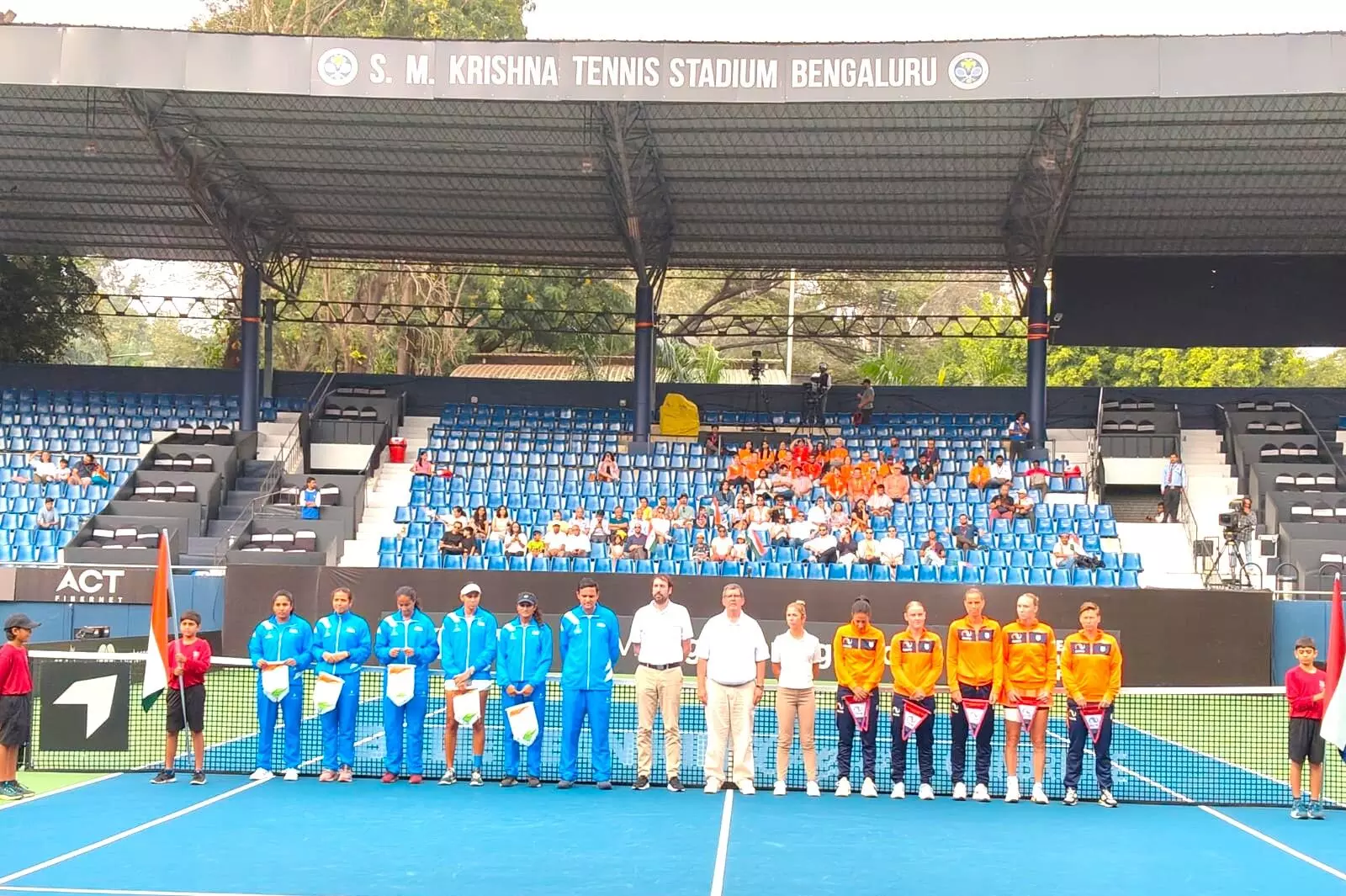
The Karnataka State Lawn Tennis Association (KSLTA) swooped down swiftly and decided to make a dash for the bidding rights. (Photo credit: Rahul Kargal/ The Bridge)
“We belong here.”
Every Indian player that turned up at the press conference at Bengaluru during the Billie Jean King Cup Playoffs repeated that statement more than just once.
It was almost a mantra that Vishal Uppal’s squad chanted before, during and after every match. The reiteration was understandable. After all, their presence in the playoff was only the second such instance in the history of the storied tournament that is often touted as the women’s world cup of tennis.
Having battled their way through a competitive Asia-Oceania group earlier this year, they set out to make history with the odds stacked against them. While they did come up short and progression to the qualifiers will have to wait for another season, the exploits of the squad this year instilled belief that Indian women’s tennis is ready for the next big leap.
The winning bid
At the outset, India’s progression to the playoffs triggered several firsts: the possibility of hosting a playoff for the first time and thereafter, progressing to a first ever qualifiers. To give themselves a chance for the latter, the administrators of the game in India recognized that home crowd advantage would come in handy.
The Karnataka State Lawn Tennis Association (KSLTA) swooped down swiftly and decided to make a dash for the bidding rights.
“We were motivated by the girls qualifying for the playoffs,” said Sunil Yajam, the Hon. Jt. Secretary of the KSLTA, in a conversation with The Bridge.
“It is the 2nd time in history, and a young bunch of girls did well in Pune to qualify. That encouraged us to go out and bid for this event,” he said.
KSLTA’s presentation to the International Tennis Federation (ITF) was elaborate and outlined all the execution details – infrastructure, hotels and the onsite planning. With 7 playoff ties taking place in parallel and 20 countries bidding, the competition was intense and yet, KSLTA earned the right to host the Group G playoffs.
The next task, however, was to mobilize sponsors.
The selling point
Tennis is not the most popular sport in India by any measure. Despite Rohan Bopanna and several doubles players experiencing success in recent times, the country has not had a big star in the game – not since Sania Mirza, Leander Paes and Mahesh Bhupathi hung up their boots.
So, what then was the selling message to mobilize sponsors to aid the hosting of the Billie Jean King Cup Playoffs?
“It was the Indian team,” Yajaman said with a smile.
“What the girls did by qualifying for the playoffs, that was the selling point. We had to tell them that it was an opportunity to create history and qualify, they need that home advantage to them,” he added.
Soon enough, the corporates understood what was at stake and were more than happy to join hands and mobilize all that was necessary to give India a shot at making the qualifiers.
This development is an indication of just how the sponsors recognize and are willing to partake in a movement when the tailwinds are strong.
That said, players in the India squad felt that more support is needed to sustain the momentum.
Mobilizing the ecosystem
Sahaja Yamalapalli, India’s top ranked women’s singles player, who despite putting her best foot forward, failed to win a set against higher ranked opponents in Bangalore feels, “The whole system can be better.”
Her call, in the post-match press conferences, was directed towards more exposure for players across levels.
“We need more support, financial, more tournaments, from grassroots try to build a player. The system has got better and that has helped us get this far, if it keep getting better, we will also do better for Indian tennis,” she said.
And Yajaman, as an administrator, recognizes this aspect more than anyone else, especially the spend a player incurs on the pro-circuit.
For instance, if a player were to travel across Asia for a two-week period to play ranking events, the expense incurred amounts to roughly two lakh rupees. According to Yajaman, if those two-week’s worth of tournaments were to take place in India, the same (if not more) ranking points could potentially be accumulated against a spend of as less as twenty-five thousand rupees.
“We need to have about 10 weeks of challengers and 25 weeks of world tour events for men and women, that’ll be good to get players to top 100. Once that happens, everything around it will improve, the coaching, more players will be coming in, our coaches will improve and they can travel with the players,” he said, indicating that more tournaments would quite simply transform the Indian tennis ecosystem.
While work needs to be done, there is no denying that the needle is moving in the right direction.
More exposure needed
In the Group G playoffs fixtures in Bangalore, veterans Ankita Raina and Prarthana Thombare posted the lone victory in the doubles fixture over Slovenia. That said the bright spot of the playoffs campaign was the manner in which Shrivalli Bhamidipaty played.
The 23-year-old took a set off Slovenia’s Tamara Zidanšek, who at one point was ranked as high as 22 in the world and had reached the French Open singles semifinal in 2021. And against the Dutch player Anouk Koevermans, Shrivalli had her moments and it all came down clutch moments: the closing out of game points and break points, which the inexperienced Indian was unable to do.
“We need a lot more exposure and maturity at this stage to play at these higher levels of tournament,” she would acknowledge later.
And yet, the knowledgeable crowd that turned up at Bangalore recognized this fact.
“Bhamidipaty was my favourite. I loved how she played and how she fought,” said a young Meera, who had accompanied her mother to watch the playoffs in Bangalore.
Others, like JD, who brought his two young daughters along, felt that the women’s tennis in India is moving in the right direction.
“I think we’ve got to give ourselves a shot and keep playing these tournaments to make ourselves better. I think we’ve got to encourage our players. Women’s tennis and tennis as a sport is going to go up in India. We’ve got to keep watching and keep supporting our players.”
Having to get past the fancied Netherlands and Slovenia was always going to be a tough ask for India. That said, the squad’s run in 2025 and their on-court grit in Bangalore was proof enough for all to witness that the ingredients are there, it is the blend that needs refining.