
Swimming
‘We’re losing potential champions’: Sajan Prakash on burnout and the state of Indian Swimming
Two-time Olympian Sajan Prakash calls for science-backed programs and athlete welfare while reflecting on burnout and the next phase of his journey.
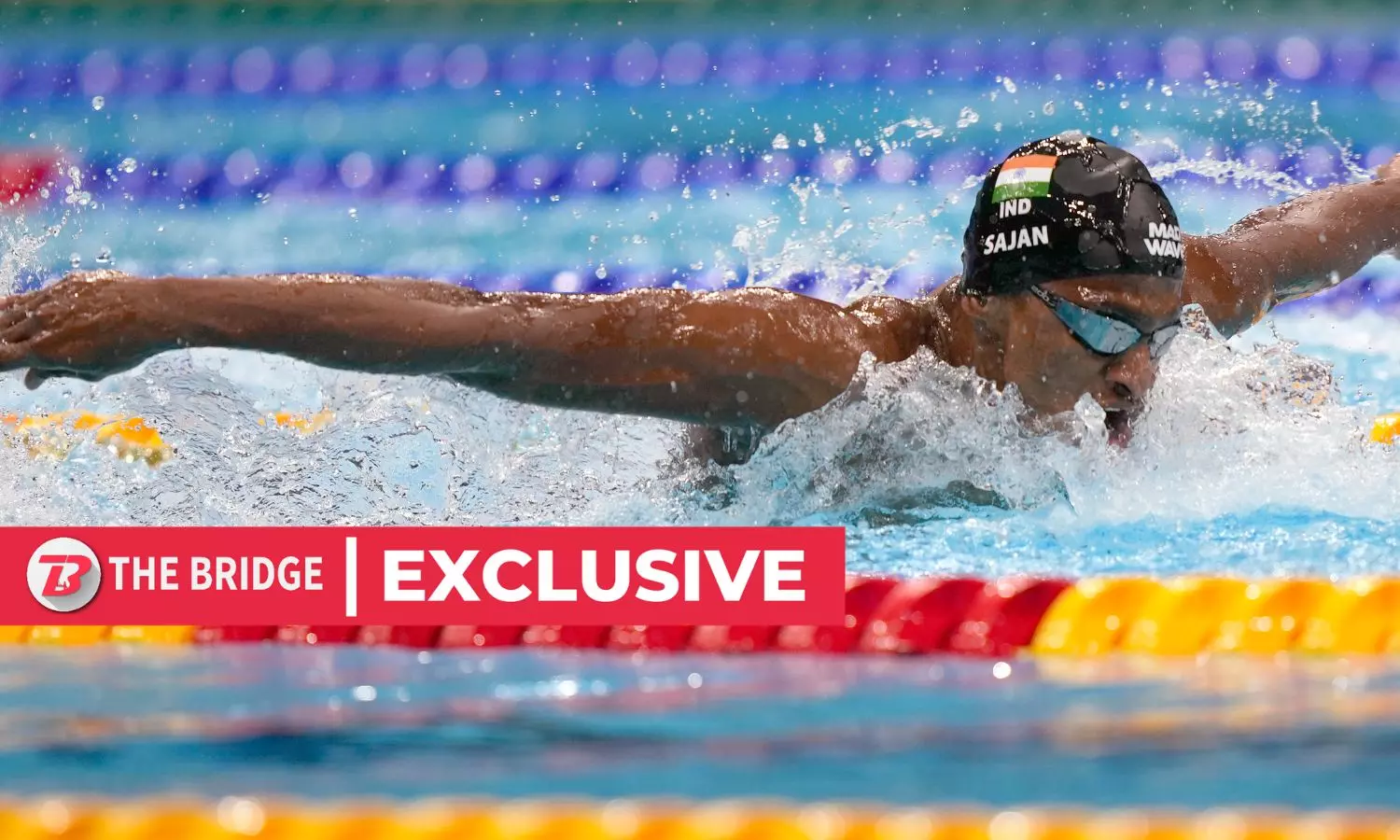
'We’re losing potential champions’: Sajan Prakash on burnout and the state of Indian Swimming (Photo credit: AP)
Burnout. Financial strain. Lack of structure.
Behind every Indian swimmer chasing an international medal lies a system stretched thin.
Few know that better than Sajan Prakash, one of India’s most consistent performers for over a decade.
In 2025, fresh off an Arjuna Award and podium finishes at the Asian Aquatic Championships, Sajan took to social media, urging Indian swimming to take athlete welfare seriously.
In an exclusive conversation with The Bridge, he opens up about why that message was so important.
“I wasn’t taking a dig at anyone,” he says. “I just wanted to say loud and clear that India has immense talent. But unless we channel it properly, we will keep losing potential champions.”
The cost of greatness
For Sajan, the lack of the right support has been a personal challenge.
He has been vocal about the importance of rest and recovery, especially after a phase during Tokyo 2020 when he almost wanted to give up. “It was burnout,” he admits.
"Training continuously without the right support takes a toll. Recovery isn’t just physical, it’s mental too.”
Back in 2015, the story was very different. From bustling streets and serene backwaters to freshly decked stadiums, Kerala carried a festive spirit as the 35th National Games kicked off.
Amid the whirl of events, one name echoed louder than the rest: Kerala’s own Sajan Prakash. With six golds and three silvers, he became a hometown hero whose triumphs traveled faster than official announcements.
Between matches, groups of budding athletes and wide-eyed spectators doubled as storytellers, carrying tales of Sajan’s feats across venues, ensuring that even those who had never seen him swim left Kerala knowing who made waves at the Games.
A glance at 2015’s Best Male Athlete award leaves little doubt about the scale of his dominance.
Ten years later, that champion still swims, but now with a mission far bigger than medals.
“There are centres like JSW that are starting to get it right. They bring athletes under one roof with nutritionists, physiotherapists, strength coaches, and mental health support. They are not perfect, but they show what’s possible when athlete care is designed.”
Sajan Prakash via Instagram
Unstable foundation
While speaking about international standards, his tone shifts into realism.
"Swimmers abroad progress through carefully designed pipelines that start young,” he explains. “They are supported by data, long-term athlete development models, and coaches who specialize in sub-disciplines. The transition from junior to senior is gradual and protected. In India, young swimmers give everything early, burn fast, and usually fade before reaching their peak.”
However, Sajan is quick to point out that bringing international programs to India isn’t a complete solution.
“Many foreign coaches come here with their programs. That’s good, but it doesn’t always fit with Indian swimmers. You can’t just implement a USA or China program here. We need science-backed, individualized programs that consider our genetics and environment, he says.”
He adds that other countries with similar builds have figured it out. “Countries like India aren’t naturally built like Western swimmers. But with proper sports science, technical coaching, and structured programs, they’ve found their rhythm. We need to do the same.”
Cracks in the system
While high-performance centres are improving, systemic gaps remain. Funding is inconsistent, particularly when athletes don’t make qualification cuts.
Sajan explains without pinning responsibility on anyone in particular, “The authorities don’t fund swimmers if they don’t qualify for key tournaments because they think the standard isn’t there yet. Often, we end up paying out of our own pockets. It puts athletes in deep financial stress.”
Sajan credits organizations like GoSports for some support, but laments the lack of a proper safety net.
“Whatever we earn, we spend it on swimming - travel, training, competitions. There’s no buffer,” he says.
The final lap
As the conversation winds down, Sajan speaks about his future with optimism.
Next year’s Asian Games could well be his final major competition. After that, Sajan plans to transition to coaching slowly.
“I’ve seen coaches like Pradeep Kumar and Nihar Ameen go above and beyond to raise Indian swimming standards. Watching them has motivated me to take up coaching and contribute to improving the system wherever I can,” he speaks as if simply letting his thoughts out.
Even amid these challenges, Sajan looks forward to a unique opportunity. For the first time, he will train under his former teammate and 2014 Asian Games bronze medallist Sandeep Sejwal at JSW’s Inspire Institute in Bellary, Karnataka.
“It’s exciting because back in the day, I trained under Pradeep Kumar, and Sandeep trained under Nihar Ameen,” he recalls.
“We were friendly rivals then. Their batch focused more on sprint training, while ours was targeted at endurance. Now, to train together as one team is something new. We know each other well, and I’m really looking forward to it.”
For all the numbers attached to his name and the title of India’s first swimmer to make the Olympic A cut, Sajan’s legacy may never be measured by accolades alone.
When Sajan steps onto the starting block at the Asian Games, it will not be a farewell to the sport.
It will be a handover - from athlete to mentor.
Until then, he keeps swimming against the tide, believing that one day, the current will finally turn in India’s favour.