
Shooting
‘Emergency landing, six-hour road trip’: Rudrankksh Patil’s chaotic Asian Games journey
Rudrankksh Patil revealed his difficult journey to Japan before winning bronze in the 10m air rifle at the Asian Games 2026.
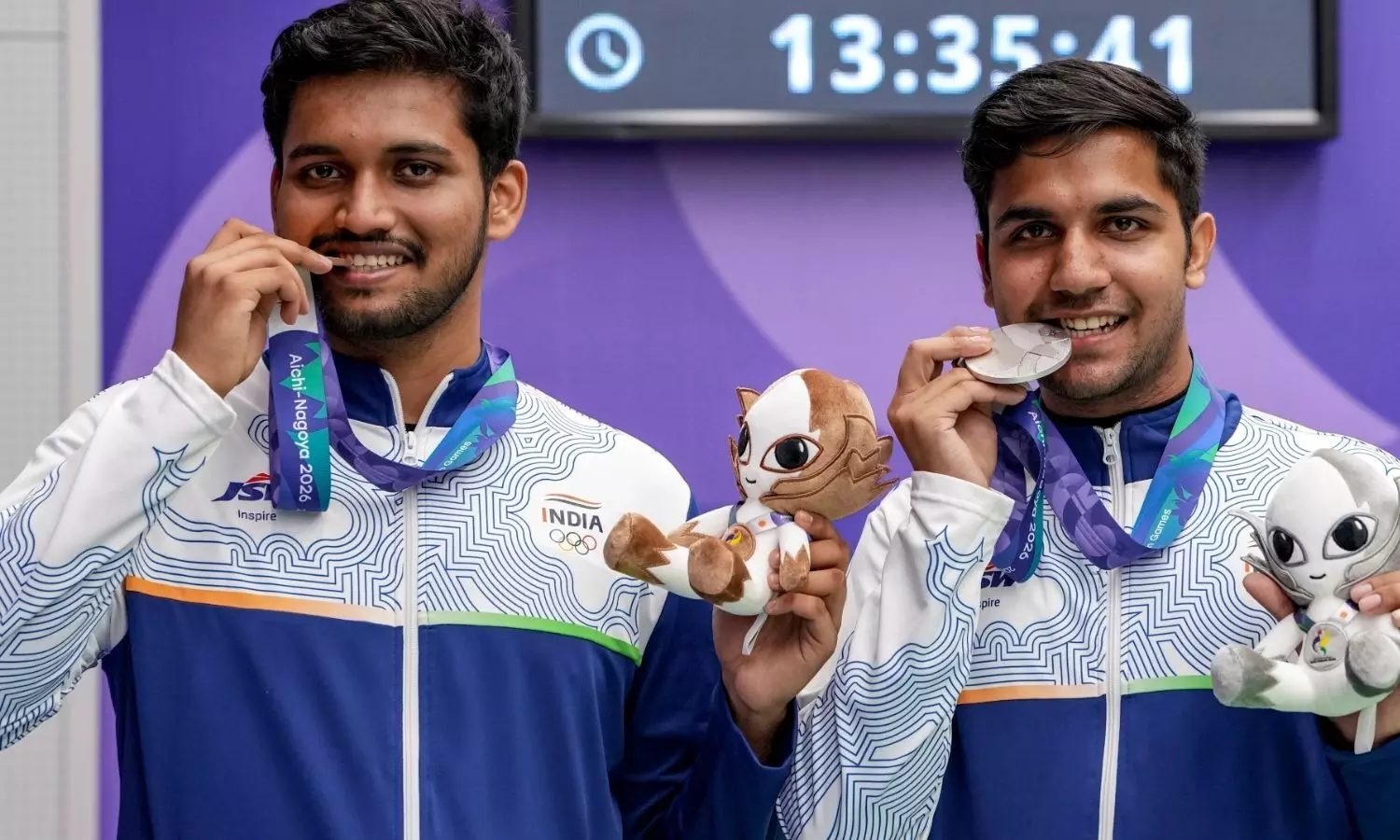
Rudrankksh Patil won bronze in the 10m air rifle at the Asian Games 2026 (Photo credit: PTI)
Rudrankksh Patil’s road to the Asian Games 2026 was anything but straightforward. An emergency landing, hours of road travel, a long transit through Hong Kong and accommodation problems preceded the Indian shooter’s bronze medal-winning performance in the men’s 10m air rifle.
Travelling from Bhopal to Delhi, Patil’s flight was forced to make an emergency landing in Jaipur. The shooting contingent then continued by road before flying from Delhi to Hong Kong, where they had a seven-hour halt, followed by another five-hour flight to Japan.
“While we were going from Bhopal to Delhi and from Delhi to Japan via Hong Kong, it was a long trip for us. From Bhopal to Delhi, our flight had some issues, and we did an emergency landing in Jaipur. From there, we took a car to six hours bus, and then we went to Delhi,” Rudrankksh said during a media roundtable arranged by NRAI after winning two medals on Monday.
The journey did not get easier from there. The team flew from Delhi to Hong Kong, where they had a seven-hour halt, before taking another five-hour flight to Japan.
“After reaching over here, within five minutes everything was cleared. We went to the welcoming centre, it took us three hours to wait for the bus over there. At 1 or 2, 2 or 3 AM we started leaving for the hotel,” he said.
The shooters then discovered another problem upon reaching their accommodation.
“After reaching the hotel, we realised that the hotel which we had booked was not our hotel. We only have a couple of rooms over there, and that was supposed to be the best hotel,” Rudrankksh said.
He said the coaches questioned the organisers over the accommodation, before deciding to put the shooters in single rooms because of the limited space.
“Our coaches promptly decided that these rooms are too small to have it on double occupancy, so we'll give each and every shooter single occupancy. And that's what they did. And that made our stay much more comfortable,” he said.
Transport to the venues also became a concern, with buses taking considerably longer than the promised journey time.
“Japanese are known for their time efficiency, but it was very difficult to see that the buses are coming on time; it was taking two hours to reach rather than the 70 minutes which they had promised, two and a half hours to reach. So that was a big problem,” he said.
The issue was eventually addressed with additional buses and private cars arranged for the shooting contingent.
“I think, you know, even though the things are not that well, I like how it was handled, promptly handled,” Rudrankksh said.
Despite the disrupted preparations, Rudrankksh produced a strong performance in the men's 10m air rifle individual final, winning bronze with 230.9. Teammate Himanshu Dhillon won silver, giving India its first-ever double podium in the event at the Asian Games.
Rudrankksh admitted he was disappointed by his 9.7 on the 21st shot, which left him just 0.1 behind Himanshu.
“I feel very bad that I missed out on gold because of that. If I had continued with a good number of shots after that, it would have resulted in a gold medal,” he said.
“I was too excited for that shot. I could have been a bit more patient. That could have resulted in a better shot, that could have gotten me a better medal. But again, two flags on the podium. I'm happy with that.”
The bronze also represented an improvement from his fourth-place finish at the previous Asian Games. Rudrankksh said the pressure increased as he stayed in gold-medal position during the final.
“I had a strong start which gave me confidence that today is my day; I'm doing really well,” he said. “But as I was climbing up, knowing that I am at the gold medal position, it's going very well, so that started building up a bit of nervousness inside of me.”
Rudrankksh also revealed that Indian shooters had worked specifically on handling pressure, using heart-rate monitors and breathing exercises during their preparation.
“We knew that this is a high-pressure match and we get a lot of heart rate variability issues during that time. A lot of heart rate is going up and down suddenly, and it is our responsibility as an athlete to at least settle down our body,” he said.
The shooter said the medal was particularly satisfying after a difficult period in training and insisted that there was still plenty of room for improvement.
“I personally feel like my personal best is 633.9 in a tournament. I have shot that twice, thrice now, but I haven't shot above it. The competition, the world record is three points more than me. Of course, there is a lot of improvement which can be done, and that is a huge inspiration for me,” he said.
Rudrankksh will next compete in the 50m rifle 3P event, his first Asian Games where he is participating in both disciplines.
“What our coaches have said is you have shot a certain score and that led to your selection. You don't have to shoot anything extraordinary; you have to just shoot your daily thing and that is just going to be enough,” he said.
For Rudrankksh, the journey from a difficult six-month period to an Asian Games double-medal performance has reinforced his belief in patience and persistence.
“Believe in miracles is the first thing which comes to my mind. Even if you have long nights, a day will always come, the sun will always rise. Keep on moving forward, be patient, trust the process,” he said.