
Shooting
From village fairs to Olympic quota: Jaypal Malviya's remarkable shooting journey
The 31-year-old farmer from Madhya Pradesh bought his Olympic quota-winning pistol with a loan from friends and discovered competitive shooting by chance.
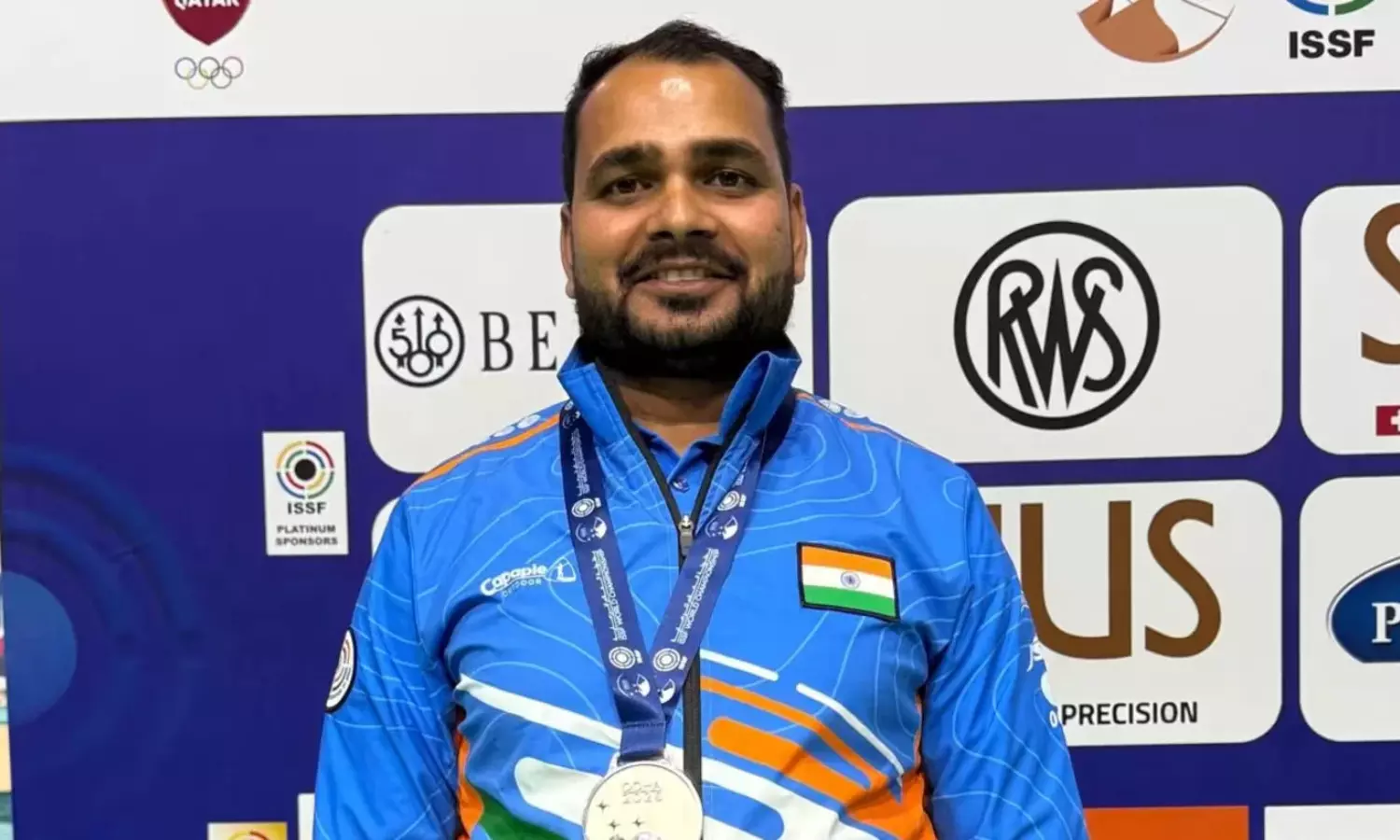
Jaypal Malviya (Photo credit: NRAI)
At 31, Jaypal Malviya has achieved what many shooters spend years chasing, becoming the first Indian shooter to secure an Olympic quota for the country for the 2028 Los Angeles Games.
The Madhya Pradesh marksman's journey to the milestone has been anything but conventional. A farmer from a small village in Chhindwara, he comes from a family of idol-makers and knew little about competitive shooting when he first walked into a local academy.
Even as Malviya celebrated his breakthrough at the ISSF World Championships in Doha, his family back home was busy making idols of Goddess Lakshmi for the festive season. Idol-making, after all, is the family's traditional occupation and a major source of livelihood.
"We are Prajapati Kumhars. Our main occupation is making statues and idols of Durga, Lakshmi and Ganesh. Most of my family members were busy making idols of Goddess Lakshmi because of the festive season. This is our livelihood," Malviya said.
Farming is the family's other mainstay. The youngest of eight siblings, comprising five brothers and three sisters, Malviya also works on the family's small piece of land, where they grow wheat, millet and seasonal vegetables. The soil used to make the idols comes from their own fields.
Malviya's introduction to the sport was rather modest. Shooting, until then, meant the balloon-bursting games at village fairs, where people tried their luck with pellet pistols and rifles. He had no idea that it was a competitive sport with a structured pathway from state-level events to the international circuit.
"I didn't know anything about the future of shooting, how one grows in the sport or where it can take you. I didn't even know that there were state-level competitions. When I used to visit village fairs, I liked the shooting game where people burst balloons with pellet pistols and rifles," he recalled.
"When I went to the academy, I felt it was just like the shooting game I enjoyed at fairs. I thought it was something I could do for fun."
The academy in Chhindwara, barely five kilometres from his village, was where things began to change. Malviya, however, had first handled firearms during his National Cadet Corps (NCC) training between 2016 and 2018 as he completed his graduation in political science and economics. He earned the NCC 'C' certificate with Alpha grading and topped his battalion.
His performance impressed the Army officers training the cadets, who encouraged him to consider joining the armed forces.
"The Colonels who taught us at NCC said they wanted to see me in the Army within two years. But then Covid happened. Recruitment was frozen and I could not prepare for the Army examinations. Things didn't materialise," he said.
With that plan falling through, Malviya completed his B.Ed after the pandemic and began preparing for the Madhya Pradesh Public Service Commission examinations. Shooting, meanwhile, was gradually turning into something more serious.
It was friends at the academy who first told him that he could compete at the state level. He took their advice and won a bronze medal at the state championships in 2021. A year later, he competed in the GV Mavlankar pre-national championships in Kerala and qualified for the national championships in Delhi, securing a place in Group B National squad.
But the selection process remained unfamiliar territory.
"I gave a few trials, but I didn't know the concept of trials or how one gets selected for the team. I was absolutely clueless. I just kept shooting. I didn't have a coach either," he said.
Shooting is an expensive sport, and finances were a major concern. Malviya considers himself fortunate to have learnt the basics without spending much, thanks to the NCC grounding. When he wanted to buy a second-hand pistol in 2022, friends from his village came forward with a loan of around Rs one lakh.
"I borrowed money from friends and I was lucky they chipped in. It is the same second-hand pistol I bought in 2022 with which I shot and won silver and the Olympic quota for the country in Doha," he said.
In 2025, he completed a six-week NIS (National Institute of Sports) coaching course, partly to create another source of income by coaching aspiring shooters. He continued appearing for shooting trials even during the course, keeping his options open.
His international exposure came only this year. The World Cup in Hangzhou in July was his first overseas assignment. He finished among the top eight but could not compete in the final after learning that he was entered in the Ranking Points Only (RPO) category.
The experience in Doha also introduced him to the finer details of international shooting, including the distinction between winning an Olympic quota for the country and earning selection for the Games.
"I have come to know only in the last three or four days that the shooter who wins a quota for the country does not necessarily represent the country at the Olympics. There are trials to select the Olympic squad," he said.
The flight to Hangzhou in July was the first time Malviya had boarded an aircraft. His trip to Doha for the World Championships was only his second international assignment.
For a man who once walked into a shooting academy out of curiosity, the journey has been extraordinary. The Olympic quota is secured, though a place in the Indian team for Los Angeles will depend on the selection trials. Back in Chandan, his family will continue farming and making idols.
(Except for the headline, this story has not been edited by The Bridge Desk. It is published from a syndicated feed)