
Others
Throwball: Why 4 international gold medals couldn't land Amardeep Kumar a job in Jharkhand
A viral video capturing Amardeep weighing vegetables at his roadside stall at Argora Chowk in Ranchi went viral.
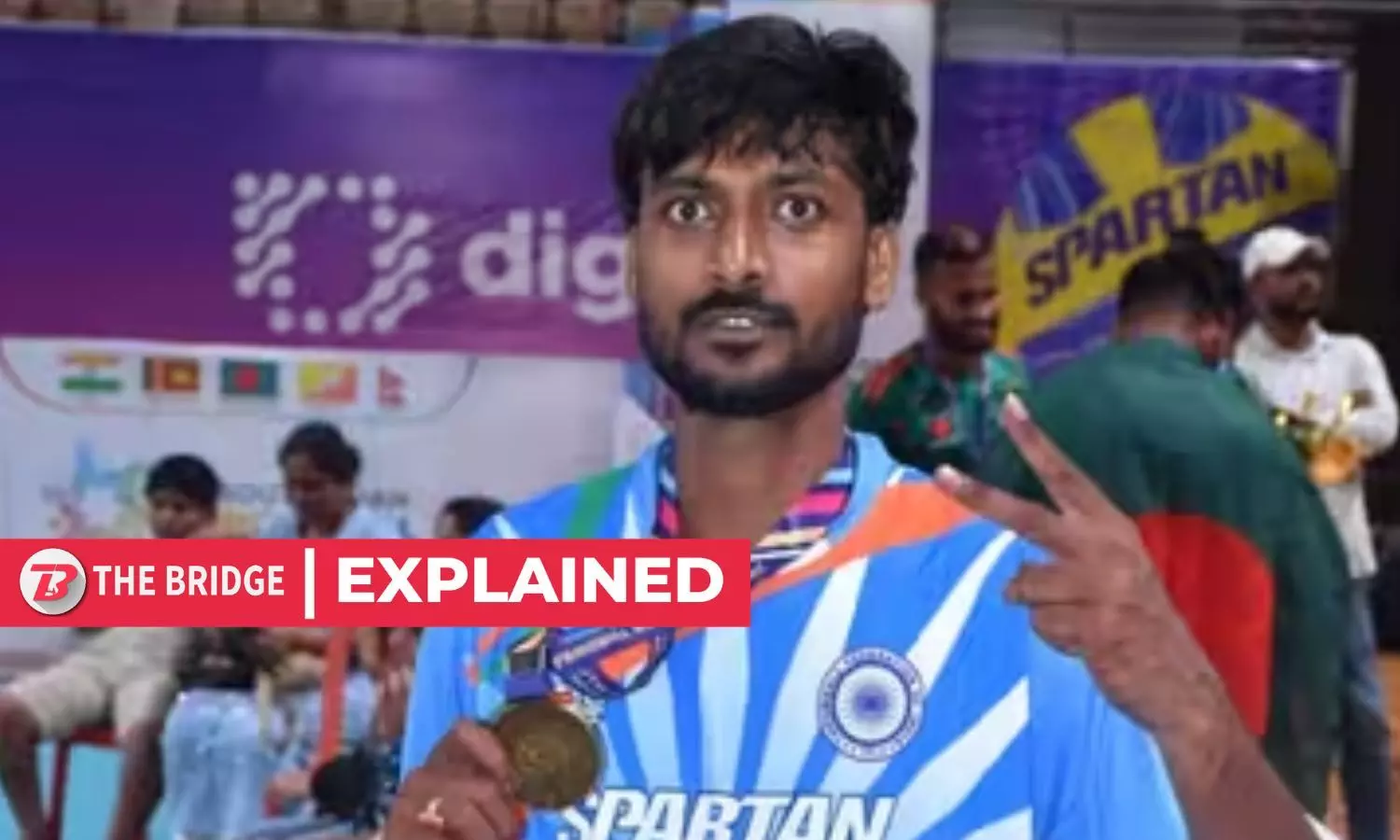
Amardeep Kumar, a 29-year-old throwball athlete based in Ranchi, Jharkhand, secured four international gold medals representing India between 2015 and 2026.
A viral video capturing Amardeep weighing vegetables at his roadside stall at Argora Chowk in Ranchi, set against a backdrop of international medals hung on a raw brick wall, brought intense public scrutiny to the structural safety nets of Indian sports administration over the last two weeks.
Amardeep’s athletic development followed an informal trajectory typical of talent identification in semi-urban India. Spotted at the age of 13 during a summer break at Ranchi’s Jaipal Singh Munda Stadium, he received pro bono coaching from a local athlete and chose throwball over more traditional disciplines.
His progression through district, state, and national age-group competitions culminated in his selection for national squads, yet every competitive milestone placed severe financial pressure on his household.
Year | Event | Hosts | Medal | Administrative and Financial Realities |
2015 | Asian Junior Throwball Championship | Kuala Lumpur, Malaysia | Gold Medal | Financed via personal loans of ₹65,000; ~50% subsidised by the state association. |
2017 | Indo-Nepal Throwball Championship | Kathmandu, Nepal | Gold Medal | Self-funded travel and logistics through informal family borrowings. |
2019 | South Asian Throwball Championship | Bengaluru, India | Gold Medal | Domestic staging; training and logistical costs borne entirely by the athlete. |
2026 | 2nd South Asian Throwball Championship | Ranchi, Jharkhand | Gold Medal | Staged in home state; yielded national accolades without statutory financial returns. |
The financial reality of Amardeep’s family relies entirely on the unorganised informal economy. His father sells vegetables in the local market, his mother undertakes door-to-door vegetable sales carrying loads of up to 35 kilograms on her head, and his elder brother manages a small food kiosk.
To service the debt accumulated from international tournament travel and sustain the household, Amardeep divides his day between operating the vegetable stall and driving a commercial cab late into the night.
Following widespread media reporting and public intervention by political figures, Jharkhand Chief Minister Hemant Soren directed the Department of Tourism, Art, Culture, Sports and Youth Affairs to investigate Amardeep’s circumstances.
While state officials and quasi-governmental bodies like the Jharkhand State Cooperative Milk Producers' Federation (Medha) initiated inquiries regarding alternate employment based on his commercial driving license, formal athletic rehabilitation under the state sports quota remains legally stalled.
The impediment is regulatory. State sports policy conditions cash incentives and direct public employment on participation in disciplines recognised by national apex bodies, a criterion that throwball cannot satisfy under current administrative arrangements.
Administrative history & factional divide in Throwball Federation of India
Throwball was codified in India during the early twentieth century, originating in 1925 through the efforts of Dr. Harry Crowe Buck and Mrs. Buck at the Young Men’s Christian Association (YMCA) College of Physical Education in Madras.
Initially organised as an educational and non-contact competitive sport for women and school students, formal regulatory playing rules were published decades later in 1955.
The national administration of the sport emerged in 1978, when Jagat Singh Chauhan, who also established the Handball Federation of India, founded the Throwball Federation of India (TFI) at the Madan Mohan Malviya Stadium in Allahabad.
The organisation was formally incorporated under the Societies Registration Act XXI of 1860 at Jind, Haryana, on May 5, 1982.
The administrative framework deteriorated in 1989 due to an internal leadership dispute. On April 13, 1989, T. Ramanna, who had been serving as the Honorary Secretary General of the national federation, registered a parallel entity under the identical title – "Throwball Federation of India" – before the Registrar of Societies in Bengaluru, Karnataka.
This parallel registration split the governance of throwball in India between the original Haryana-registered parent body and the Bengaluru-registered society.
Timeline | Administrative or Judicial Action | Governing Authority | Institutional Outcome / Finding |
May 5, 1982 | Registration of TFI under Societies Registration Act | Registrar of Societies, Jind (Haryana) | Formal legal establishment of the national parent body (Reg. No. 113/82-83). |
April 13, 1989 | Registration of parallel TFI entity | Registrar of Societies, Bengaluru (Karnataka) | Emergence of rival southern faction under T. Ramanna (Reg. No. 38/89-90). |
May 24, 1989 | Grant of National Sports Federation (NSF) status | Ministry of Youth Affairs and Sports (MYAS) | Initial central government recognition granted prior to factional litigation. |
February 9, 1991 | Injunction in Civil Suit No. 229/1989 | Senior Sub-Judge / Civil Court, Jind | Permanent injunction restraining Bengaluru faction from operating under the TFI name. |
January 21, 1992 | Formal suspension of Secretary General | TFI Executive Committee (Parent Body) | T. Ramanna expelled from parent body; led to parallel tournament circuits. |
May 6, 2003 | Central Inquiry Report (TEAMS Division) | Sports Authority of India (M.P. Ganesh Panel) | Verified dual registration; concluded factions operated jointly during 1989 recognition. |
May 21, 2005 | Registration of Criminal Case (FIR) | Upparpet Police Station, Bengaluru | Investigation initiated under IPC Sections 420, 468, and 471 for alleged record forgery. |
February 2008 | Complete suspension of central financial grants | Ministry of Youth Affairs and Sports | All funding halted following formal legal notices and high court writ filings. |
May 13, 2009 | Administrative De-recognition Order | Ministry of Youth Affairs and Sports | Both factions barred from claiming government recognition; grants-in-aid frozen. |
June 18, 2010 | Joint Conciliation Hearing | Director (Sports), MYAS | Conciliation collapsed; MYAS formally refused recognition until judicial resolution. |
2011–2026 | Ongoing Title and Recognition Litigation | Delhi High Court (e.g., CS No. 58153/2016) | Courts held NSF recognition is an executive prerogative; sport remains derecognised. |
The conflict led to protracted civil and criminal proceedings across multiple forums. In 1991, the civil court at Jind granted a permanent injunction restraining the Bengaluru faction from organising tournaments in the federation's name.
By May 2005, criminal proceedings were initiated through an FIR at Upparpet Police Station in Bengaluru, alleging document fraud, cheating, and unauthorised representation under the Indian Penal Code.
A central fact-finding inquiry conducted in May 2003 by M.P. Ganesh, Executive Director (TEAMS) of the Sports Authority of India (SAI), revealed that while both factions originally shared leadership during the 1989 recognition, their subsequent dispute produced irreconcilable governance structures.
Recognition status under Ministry of Youth Affairs and Sports
The Throwball Federation of India was recognised by the central government in the past, but this recognition was subsequently revoked, leaving the sport currently de-recognised.
The Government of India, through the Ministry of Youth Affairs and Sports (MYAS), formally recognised the Throwball Federation of India as an apex National Sports Organisation on May 24, 1989.
Under this initial framework, the TFI was eligible for financial assistance to host senior, junior, and sub-junior national Championships, and received travel clearances and administrative funding through the Scheme of Assistance to National Sports Federations.
Despite growing disputes between the Haryana and Bengaluru factions, MYAS continued intermittent engagement, resuming event grants in July 2005 to support athlete development. Official ministry expenditure records document central funding distributed to the federation through the 2007-2008 fiscal cycle.
This relationship ended in 2008 following a legal notice issued by the Haryana faction in December 2007 and subsequent judicial scrutiny under a writ petition in the Delhi High Court.
In an administrative order issued on May 13, 2009, the MYAS also directed both factions to immediately cease claiming government recognition and suspended all grants, subsidies, and administrative support.
The Bengaluru faction challenged the order in the Delhi High Court via a writ petition, which was dismissed on November 4, 2009. In a subsequent appeal, the court ordered the central government to hold a fresh administrative hearing.
On June 18, 2010, the Director (Sports) convened a joint conciliation meeting with representatives of both factions to form a unified administrative body.
When the talks collapsed, MYAS adopted a firm policy position that because throwball was not an Olympic, Asian Games, or Commonwealth Games discipline, they will not expend additional executive resources to mediate the internal dispute.
MYAS maintained that neither faction had provided sufficient documentation to prove undisputed national standing, and ruled that central recognition would remain suspended until the governance dispute was resolved by a competent civil court.
Throwball remains entirely absent from the Ministry’s annual roster of recognised National Sports Federations until now because the factional divide within the TFI remains unresolved.
Affiliation Status: Indian Olympic Association
The Throwball Federation of India is currently not recognised by or affiliated with the Indian Olympic Association (IOA), although it held affiliation for a period in the past.
During its national expansion, the TFI sought inclusion in the Olympic movement. On December 14, 2001, the IOA granted formal recognition to the Throwball Federation of India.
This gave the sport temporary legitimacy within domestic multi-sport discussions, though it was never integrated into the competition roster of the National Games of India.
Following the 2008-2009 governance crisis and MYAS's withdrawal of recognition, the IOA removed the federation from its member rosters.
Under the IOA Constitution and the Olympic Charter, membership is restricted to National Sports Federations governing sports featured in the Summer Olympic Games, Winter Olympic Games, Asian Games, and Commonwealth Games, alongside recognised State Olympic Associations. Non-Olympic disciplines are admitted only under specific circumstances as non-voting Associate Members.
Official IOA institutional directories confirm that throwball is absent from both the Voting National Sports Federations list and the Associate Members register.
This disaffiliation has created significant difficulties for athletes like Amardeep. When the Jharkhand Sports Directorate evaluated Amardeep’s petitions for state employment and monetary awards, it stated on public platforms that state benefits are legally restricted to sports recognised by the IOA.
The directorate subsequently asked the Jharkhand Olympic Association to advocate for the sport's administrative rehabilitation, highlighting the structural gap that leaves non-Olympic, unaffiliated athletes without access to state support.
International governance & global Olympic hierarchy
The international events where Amardeep won his gold medals were conducted under the auspices of regional bodies: the Asian Throwball Federation (ATF) and the World Throwball Federation (WTF).
The Asian Throwball Federation was founded in 1996 with nine member nations, concentrated primarily in South Asia and Southeast Asia. The World Throwball Federation was established during a general assembly on June 22, 2019, in Kuala Lumpur, Malaysia.
The WTF elected an executive committee representing nations including Malaysia, India, Sri Lanka, and selected African and Asian members, establishing its registered headquarters in Kuala Lumpur.
Despite this formal apparatus, throwball faces significant governance and recognition limitations at the international level.
The primary international bodies governing throwball lack affiliation with the International Olympic Committee (IOC). They are absent from the Association of Summer Olympic International Federations (ASOIF) and the Association of IOC Recognised International Sports Federations (ARISF).
Furthermore, throwball is excluded from the continental programs of the Olympic Council of Asia (OCA)as well as the Commonwealth Games Federation (CGF) calendar.
Consequently, championships organised by the ATF or WTF operate as independent, single-discipline invitationals rather than recognised multi-sport events.
Without IOC or OCA accreditation, international throwball medals carry no statutory obligation for financial awards or public sector recruitment under Indian sports regulations.
Policy bottlenecks
The challenges faced by Amardeep illustrate significant policy gaps in how central and state governments administer sports quotas, manage public sector recruitment, and provide athlete welfare.
Regulatory Entity | Past Recognition Status | Current Recognition Status | Primary Factor Governing Current Status | Impact on Athlete Welfare and Benefits |
Ministry of Youth Affairs and Sports (MYAS) | Recognised (May 24, 1989 – May 13, 2009). | Not Recognised (Revoked May 13, 2009). | Factional split between Haryana and Bengaluru societies; failure to meet National Sports Code standards; non-Olympic status. | Disqualification from central sports development funds, cash awards, and national pension schemes. |
Indian Olympic Association (IOA) | Recognised / Affiliated (Granted December 14, 2001). | Not Affiliated | Exclusion from Olympic, CWG, and Asian Games programs; compliance failures; removal from member registries. | Disqualification from state policies that condition sports quotas on IOA affiliation. |
School Games Federation of India (SGFI) | Recognised (Inducted into calendar in 2000). | Recognised (Retained on active sports calendar). | Broad adoption across secondary school physical education curricula nationwide. | Academic admissions quotas available at junior and secondary school levels. |
Department of Personnel and Training (DoPT) | Included in the historic schedule of eligible sports for sports quota. | Functionally Inaccessible | Verification rules require certificates signed by an MYAS-recognised NSF Secretary, creating a procedural barrier. | Rejection of Form-1 and Form-2 applications for central government employment. |
Under consolidated instructions issued by the Department of Personnel and Training (DoPT) on November 12, 1987, and subsequent revisions, up to 5% of direct recruitment vacancies in Group C civil service posts may be reserved for meritorious sportspersons.
Throwball has historically been included in the consolidated roster of eligible disciplines, which covers between 43 and 64 approved sports.
The primary barrier for athletes lies in the verification process. Central recruitment rules mandate that an athlete applying under the international competition category must present a Form-1 certificate signed by the Secretary of the recognised National Sports Federation.
The rules require that this federation must be actively recognised by MYAS at the time of the event, or that the squad was cleared by the government.
Because the TFI lost its recognition in 2009, certificates issued by either faction failed administrative verification, preventing Amardeep, who started winning medals in 2015, from accessing central government employment quotas.
These central barriers are compounded by variations in state-level sports policies. Amardeep noted that teammates from Haryana, Bihar, and Chhattisgarh secured public sector employment and cash awards for the same podium finishes. The Bridge hasn’t been able to independently verify this claim.
But states such as Haryana do operate broad incentive frameworks that extend financial rewards to non-Olympic and regional disciplines.
In contrast, the Jharkhand Sports Policy 2022 sets restrictive criteria for direct recruitment into Class II, III, and IV state positions, as well as for the Jharkhand Players' Pension Scheme.
The policy limits direct appointments and pension benefits to medalists from the Olympic Games, World Championships, Asian Games, and Commonwealth Games, or to sports recognised by the IOA.
Because throwball lacks IOA recognition, Amardeep's applications could not be processed under the standard framework, forcing state authorities to consider ad-hoc employment options like commercial driving rather than sports-quota appointments.