
Karate
Governance crisis forces Indian karatekas to miss second straight Asian Games
Commonwealth champion Akshay Booshanam says India's unresolved karate governance dispute is leaving athletes without a pathway to major events and risking another lost Asian Games cycle.
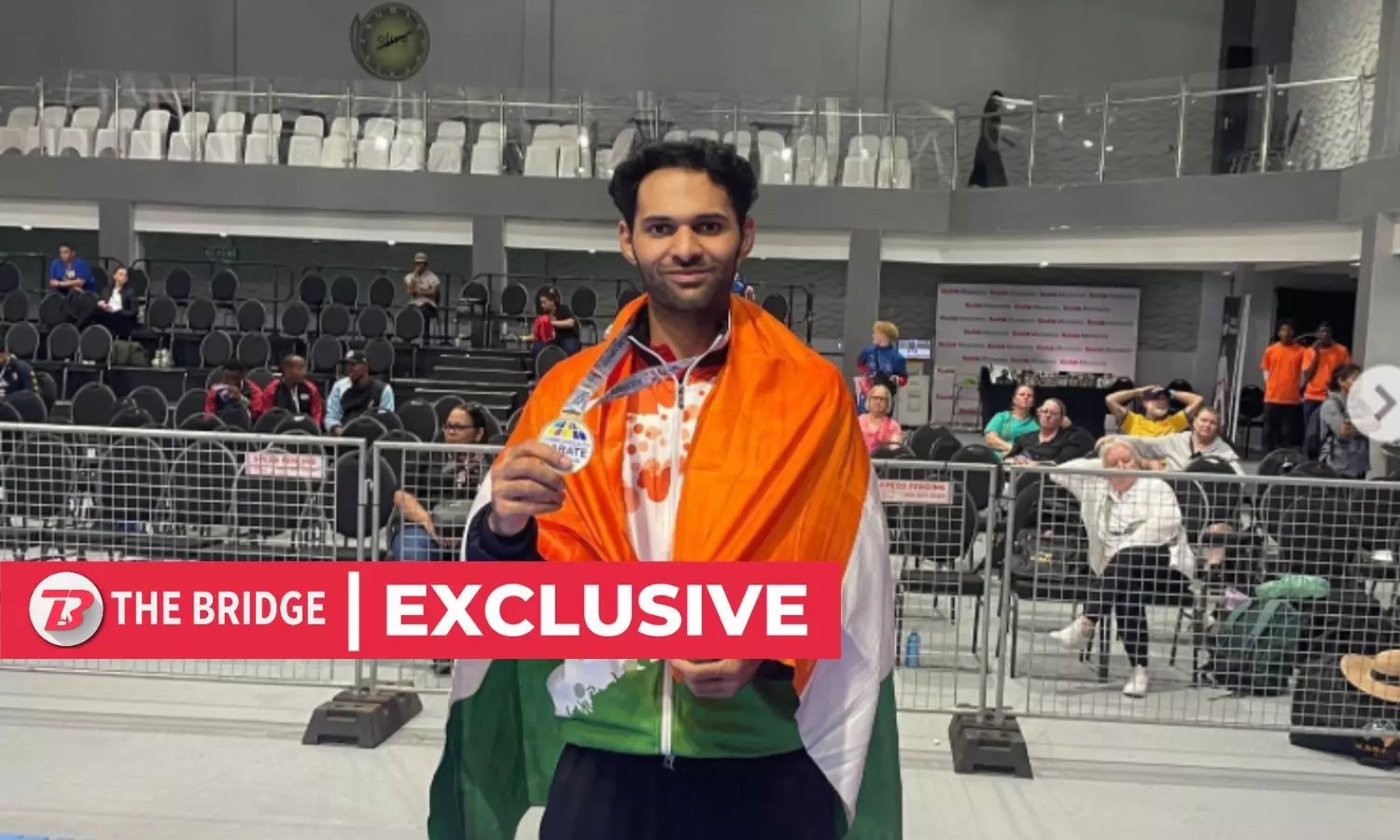
Commonwealth Karate Championship gold medallist Akshay Booshanam (Photo credit: Akshay Booshanam/ lG)
Having recovered from Stage II lymphoma after undergoing months of chemotherapy and radiation treatment last year, international karate player Akshay Mahara Booshanam should be focused solely on preparing for the biggest competitions of his career.
Instead, the Commonwealth Karate Championship gold medallist finds himself fighting for something far more basic: the opportunity to represent India.
Indian karate remains mired in a long-running governance crisis, with multiple bodies claiming authority over the sport and no federation currently recognised as the National Sports Federation (NSF). The uncertainty has left athletes fearing they could miss a second consecutive Asian Games cycle.
"We are losing eight years of our careers waiting to play in these major events," Akshay told The Bridge.
"The similar thing happened in the last Asian Games cycle, and the same thing is happening in this edition as well. We are waiting for an opportunity to play in these major events, and unfortunately, again we're going to miss out on this opportunity."
For athletes whose careers are measured in Olympic and Asian Games cycles, the prospect of missing successive editions is particularly difficult to accept.
A sport without a clear pathway
The crisis has already reached the courts. Akshay himself approached the Delhi High Court seeking relief. In an order dated May 29, 2026, the court recorded submissions that no players' names had been sent and that the relevant deadline had already expired, and directed respondents to place affidavits on record before the next hearing.
For athletes, however, the legal battle is only part of the problem.
"There are multiple federations claiming to be the genuine ones, but the dilemma for athletes is that we don't know where to go," Akshay said.
"Because on one side, we have a pathway to international competitions, but then there is no government support in that. And in major competitions like the Asian Games and National Games, karate has been overlooked."
The uncertainty has persisted despite intervention from the Ministry of Youth Affairs and Sports.
In a February 2026 order, the ministry acknowledged that no federation was recognised as the NSF for karate and noted that the sport was facing governance deficiencies, multiple claimants, uncertainty for athletes and repeated litigation. The ministry subsequently requested the Indian Olympic Association (IOA) to constitute an ad-hoc committee to oversee karate affairs until a recognised federation is established.
However, athletes argue that the intervention has not translated into a clear pathway for participation at the Asian Games, with concerns continuing over entries, selection and representation.
Chasing an Asian Games dream
For Akshay and many others, the issue is no longer about administrative recognition but about lost opportunities.
"Those major opportunities hold a different prestige for us as athletes," he said.
"We get the blazer, we are able to bring a medal in the Asian Games, that changes a lot of things for the country in the sport."
"There are a couple of athletes who have left everything they were doing. Be it jobs, be it their health, they have compromised everything with only one goal, to be able to represent India at the Asian Games and bring India's first medal in karate," Akshay said.
The financial strain, he says, has become increasingly difficult for athletes to bear. "There is a lack of government support, there is a lack of funding in this sport, and we are literally resorting to loans or doing whatever we can to make ends meet and go for competitions."
"Our only goal is that we want to win a medal for India. We don't want to represent a federation. We don't want to represent IOA. We just want to represent India," he added.
According to Akshay, athletes attempted to seek intervention during the previous Asian Games cycle as well.
"Last time as well, I had filed with a few players. We took it to the court to demand opportunities," he said. "These opportunities are virtually for a player to be able to play in one or two Asian Games. This happens once in four years. It's a very important, very prestigious event for us."
"We did go to court, and even then, when our names were sent, it missed the deadline. Post that, nothing came about. No reforms were made, no accountability was shown by anybody," he added.
'We don't know what we are training for'
Asked what comes next, Akshay admitted that athletes currently have few answers.
Many continue to train daily despite not knowing whether a clear pathway to major international events exists.
"As an athlete, we are quite helpless. We don't know where to go."
He compared the current situation to being told to avoid one route without being offered another.
"Even with the recent order asking us not to compete in events that are not recognised, there is no alternative. There is no roadmap for the international competitions that they are showing."
"Virtually, it is like you are asking me not to go and eat at one shop, but you have to provide another alternative for me to go to. There is no alternative. It's just a blank path for us now."
The uncertainty has inevitably raised questions about the future for athletes who are expected to continue training and competing without knowing where those efforts will lead.
"Even if I train for the next four years with the aim that in the next Asian Games cycle I will be there, firstly, that is very uncertain, and secondly, we still don't know that even in the next Asian Games the same thing will happen."
The emotional toll of that uncertainty is becoming increasingly apparent.
"How do I convince myself? How do the other players convince themselves to go out and train again?"
"As athletes, the only thing that we have in our hands is to train and become better. But at this point, it feels that we don't know what we are training for."
Beyond medals and participation, Akshay believes the governance vacuum is affecting athletes' livelihoods and futures.
Many competitors, he said, come from modest backgrounds and invest everything they have in pursuit of sporting success.
"A lot of players come from very humble backgrounds and they even resort to loans, they sell off land, properties, whatever they have, with only one hope that they want to take India to the top of the podium on the world stage."
The absence of recognised structures, he argues, can also diminish the value of athletes' achievements when it comes to employment and career opportunities.
"Ultimately, they don't even have a job to fall back on because if the competition is not recognised by a government-approved body, then those certificates or achievements are not valid," he concluded.