
Kabaddi
Commonwealth Kabaddi C'ship: How Indian-origin players are shaping the sport beyond India
India dominate the inaugural edition but India-origin players in foreign teams are taking the sport beyond South Asia.
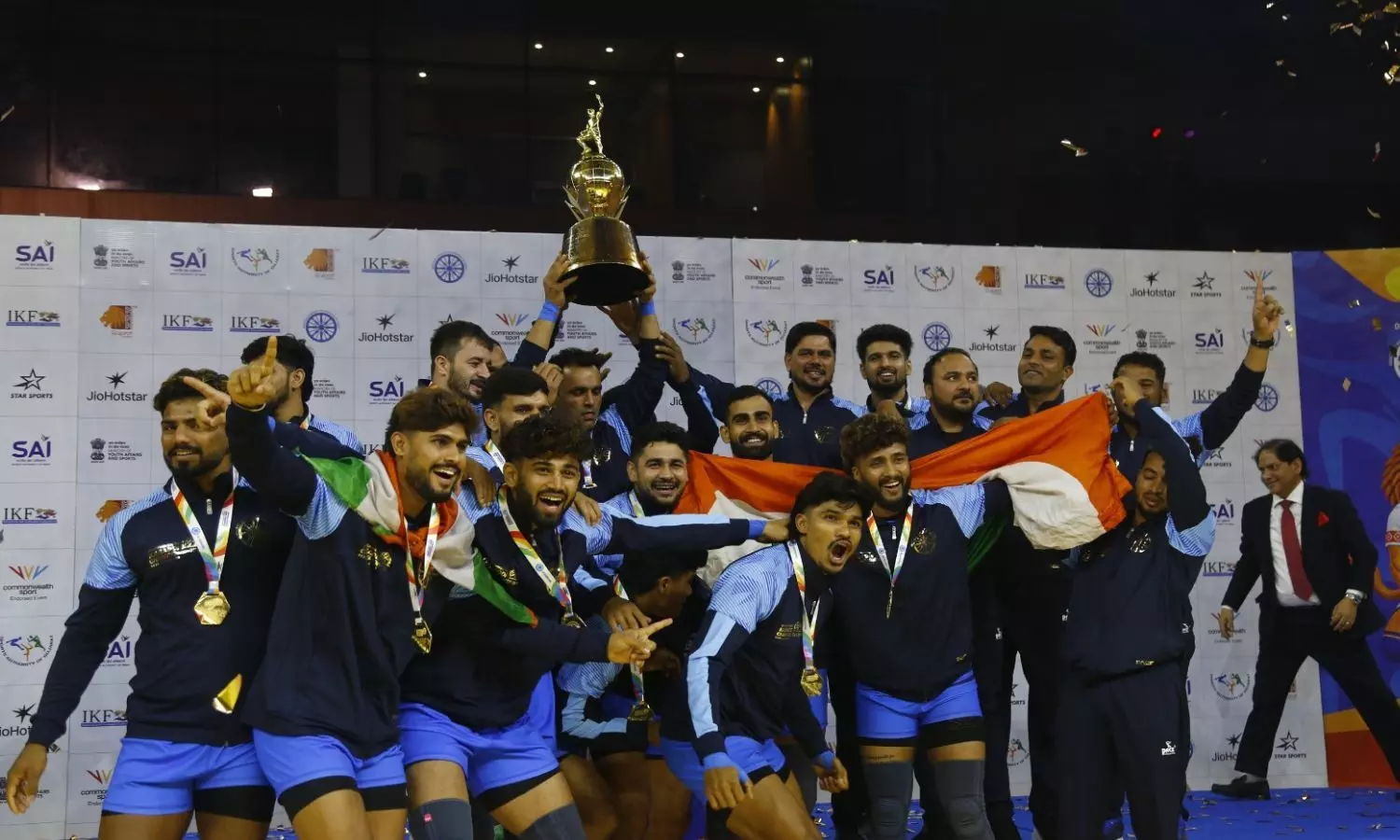
India's men's team celebrate their win. (Photo credit: Commonwealth Kabaddi C'ships)
Nigeria's Edem Wisdom Ita walked up to the mid line and shook hands with the Ugandan raider as the clock struck 0:00s during their Group A match at the Veer Savarkar Sports Complex in Ahmedabad.
In kabaddi, a match isn’t called off even if the clock winds down if a raider hasn’t crossed back to his own half.
The Ugandan raider gleefully gobbled an extra point for his team to close out what would be the final match in the competition for both the teams.
On any other day Wisdom’s blunder could have cost the tournament to either his team or anyone else in Group A. But here, Nigeria were trailing 29-71, having lost all their previous five matches and Uganda were also all but out of contention for the semi-final spot already. So, it didn’t matter.
The Nigerian coach, deputed by All India Kabaddi Federation (AKFI), had to enter the mat post match and explain the blunder to Wisdom, who just smiled in return.
This, unfortunately, was level of the field at the 2026 Commonwealth Kabaddi Championship, where India went unbeaten in both men’s and women’s competition to be crowned the inaugural champions.
Long road ahead for Kabaddi
With India granted the hosting rights for the 2030 Commonwealth Games in Ahmedabad, the first Commonwealth Kabaddi Championship is widely seen as the nation’s attempt to include the sport in the centenary edition of the quadrennial games.
While teams like Kenya, Uganda, and Tanzania’s raider Juma Sultani displayed that kabaddi does have serious takers outside the sub-continent, there’s still a long way to go before they challenge even a second string team India had fielded in both men’s and women’s tournaments.
A majority of the 12 teams which flew down to Ahmedabad didn’t have long drawn out training camps.
The Tanzania men’s team led by a kabaddi crazy captain Masudi Omary, for example, only had a two-week stint back home before they landed in India.
Canada, on the other hand, struggled with their visa processes initially and only reached India three days before the commencement of the competition after intervention from higher level authorities in the Indian government.
Elsewhere, the Australians have barely had any exposure since they last played at the 2016 Kabaddi World Cup in Ahmedabad.
Nigeria’s Collins Joseph Eyo and Scotland’s Jack Leckie, meanwhile, started playing kabaddi for the first time six and three months ago respectively. The Commonwealth Kabaddi Championship, for them, was their first-ever international tournament in a new found sport.
How to get players like Collins and Leckie, who is an MMA trainer, to stick to the sport even after the tournament ends and not let the momentum slip like after the 2016 Kabaddi World Cup a decade ago, is an area the International Kabaddi Federation (IKF) has to find answers to.
Indian origin players galore
The African nations in contention in the tournament — Kenya, Uganda, Tanzania, and Nigeria — competed with their native players. As did, India’s South Asian neighbours Bangladesh and Sri Lanka.
However, the remaining six teams were filled with Indian origin players.
The entire 13-member Canadian team, for instance, was Indian origin, also indicative of the country’s immigration policy.
Australia had five players of Indian origin, while England had at least nine athletes of colour in men’s and eleven in the women’s team.
The situation was similar across both teams from Scotland, Malaysia, and Singapore, highlighting the defining role played by the Indian diaspora in popularising kabaddi across the globe.
Till the end of the group stages, neither the top five raiders nor defenders featured anyone from the Indian team in both men’s and women’s competitions, showcasing the rise of talents from the other countries.
The world order
The 2026 Commonwealth Kabaddi Championship just reaffirmed what we’ve known for years. India remains the force to be reckoned with and that Kabaddi, very much, remains a South Asian dominated sport.
Among the eight semi-finalists across men’s and women’s events were India and Sri Lanka (both men’s and women’s), and Bangladesh (men’s).
Kenya (both men’s and women’s) and Uganda (women's) were the other three teams in the semi-finals, clearly demarcating an order, at least at the Commonwealth level, where the Africans are evidently the second best to South Asia.
The south east nations like Singapore, Malaysia and teams like Australia, Canada, and England which consisted of a handful of Indian origin players are further behind.
The takeaway for the IKF from the tournament could not be more clearer: invest in the African continent right from the grassroots and watch kabaddi’s popularity skyrocket in the coming few years.
Players like Juma Sultani, Masudi Omary, and Hafidi Ali (Tanzania), Lavenda Odiambo, Joy Onyango and Mary Oteki (Kenya), Dennis Udeme (Nigeria) deserve all the professional guidance they can get to develop their game further.
AKFI deputed coaches
One of the better developments at the 2026 Commonwealth Kabaddi Championship was the concept of deputed coaches.
Sensing the need for professional insights for their opponents to improve, the AKFI assigned their own coaches to ten teams.
These were experienced Indians, who’ve earned kabaddi coaching certifications of their own. They worked closely with the teams once they landed in India, passing down their technical knowledge of the sport in a bid to help them improve.
Nitin Kumar, India’s strength and conditioning coach for the 2026 Asian Games, was one of the AKFI deputed coaches, taking over the role for the Canadian team. He had to undergo a rigorous interview process two months ago to secure the role.
Canada, who missed out on the semi-finals by a whisker, finishing third in men’s Group B were greatly impressed by Kumar’s inputs.
“The president of the Canada federation is here,” Kumar told The Bridge. “They were happy with the strategies and skills I brought in and want me to continue with the team.
“They have asked me if I’m willing to go down to Canada sometime in February 2027 ahead of the World Cup to help them further,” Kumar added.
With India aiming to elevate kabaddi to the Olympic programme, dispatching coaches to these foreign nations for longer stints could very well be the way to go.