
Hockey
From divided dressing room to Asian Games gold: How Sjoerd Marijne transformed India
Sjoerd Marijne returned to India in January and helped transform a struggling women’s hockey team into Asian Games champions and Olympic qualifiers.
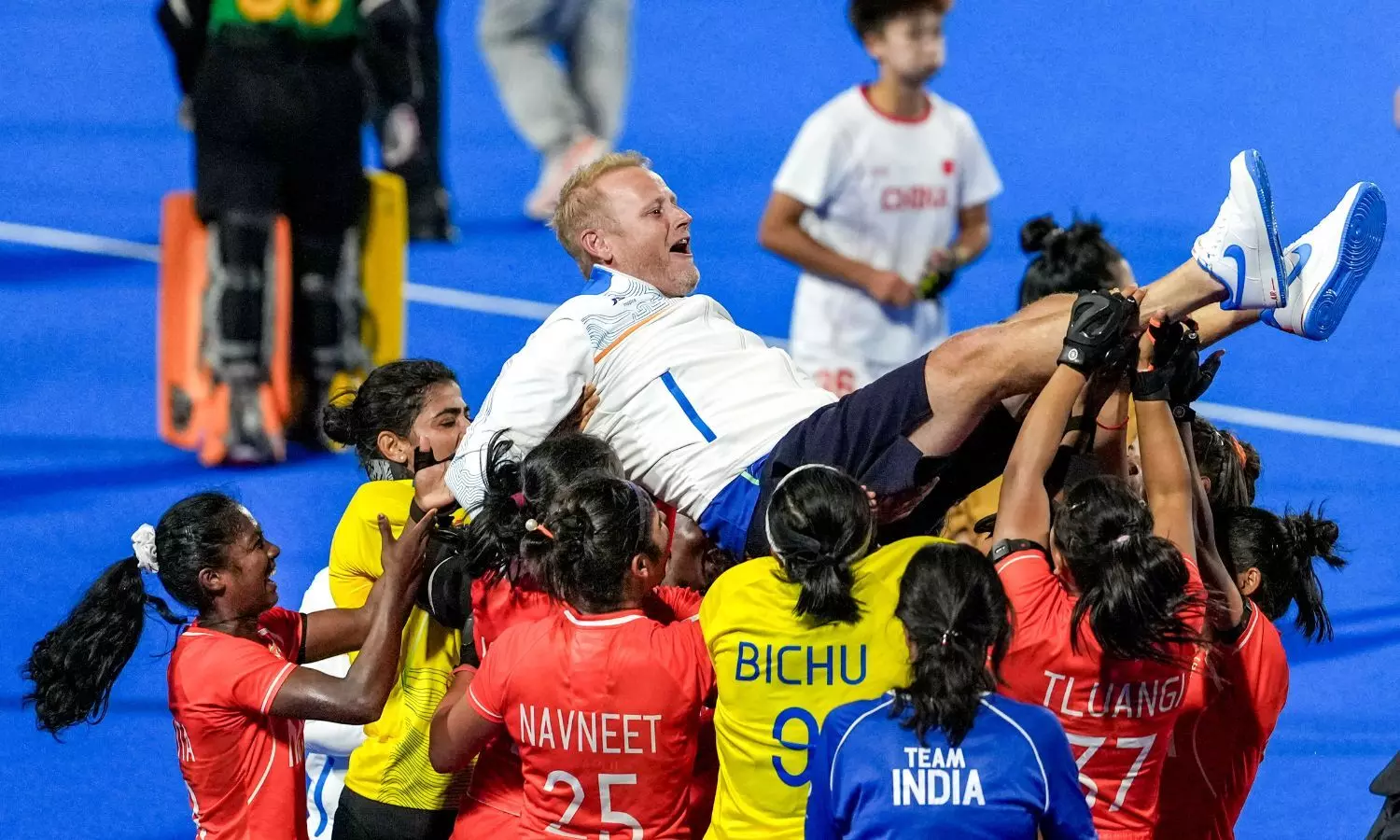
When the Dutchman returned as India’s head coach in January, he inherited a squad that had been knocked out of the FIH Pro League (Photo credit: PTI)
“The job is not done yet.” Sjored Marine sounded typically understated when midfielder Neha explored the head coach’s reaction on India’s entry into the Asian Games final.
But a day later, India ended a prolonged 44-year wait, grabbing the women’s hockey gold beating Paris Olympic silver medallists China 1-0 in the final.
The team also secured qualification for the 2028 Los Angeles Olympics.
Soon, Marijne settled into a well-deserved celebration time with his players in the locker room.
But the Dutchman, who returned as India's head coach in January, inherited a divided dressing room short on confidence and disrupted by injuries.
However, nine months later, he transformed that group into a fearless, united side that produced its best World Cup finish — fifth — in 52 years before adding an Asian Games gold.
Marijne struck an immediate chord with the players, giving instructions, mostly in Hindi: “thoda aage,” “peeche ja,” “Deepu, bhag,” “Shilpi pass.”
There have been no elaborate ’70-minute' speeches before important matches, as he believed in his players.
The players too think that Marijne has given them clarity and freedom, allowing them to express themselves on the field.
That approach has worked from young defender Sakshi Rana to veteran goalkeeper Savita Punia.
But a year ago, such a turnaround was difficult to imagine.
An inconsistent India were eliminated from the FIH Pro League and injuries had further unsettled the squad.
Marijne gradually turned the wheel.
India returned to the Pro League after winning the FIH Nations Cup, then finished a historic fifth at the World Cup despite 11 players making their debuts in the tournament.
However, his rebuilding process was not entirely about tactics. He eliminated divisions within the group and created a sense of collectiveness, resorting to methods like tying unity bands around the players' wrists.
The support staff too played an important role in that process, with scientific advisor Wayne Lombard, drag-flick consultant Taeke Takema, assistant coach Mathias Villa and other performance specialists working closely with the players.
The results were evident at the World Cup, where India lost only once— to co-hosts and eventual champions the Netherlands — with both goals coming from penalty corners.
Prime Minister Narendra Modi also acknowledged Marijne's contribution while addressing the Indian diaspora at The Hague during his visit to the Netherlands in May.
“Dutch coaches have also contributed significantly to improving Indian hockey. Our women’s hockey team has been performing exceptionally well for some time now. Coach Marijne has played a key role in this,” Modi had said.
But deep inside, Marijne will know that the Asian Games triumph still constitutes only the first step, however glossy it is.
The road to the Los Angeles Olympics begins now — for him and the team.
(Except for the headline, this story has not been edited by The Bridge Desk. It is published from a syndicated feed)