
From The Grassroots
The Bridge goes beyond digital with Upstart
In association with The Amaatra Academy and Sporthood, Upstart brought children, parents, and stakeholders together on National Sports Day.
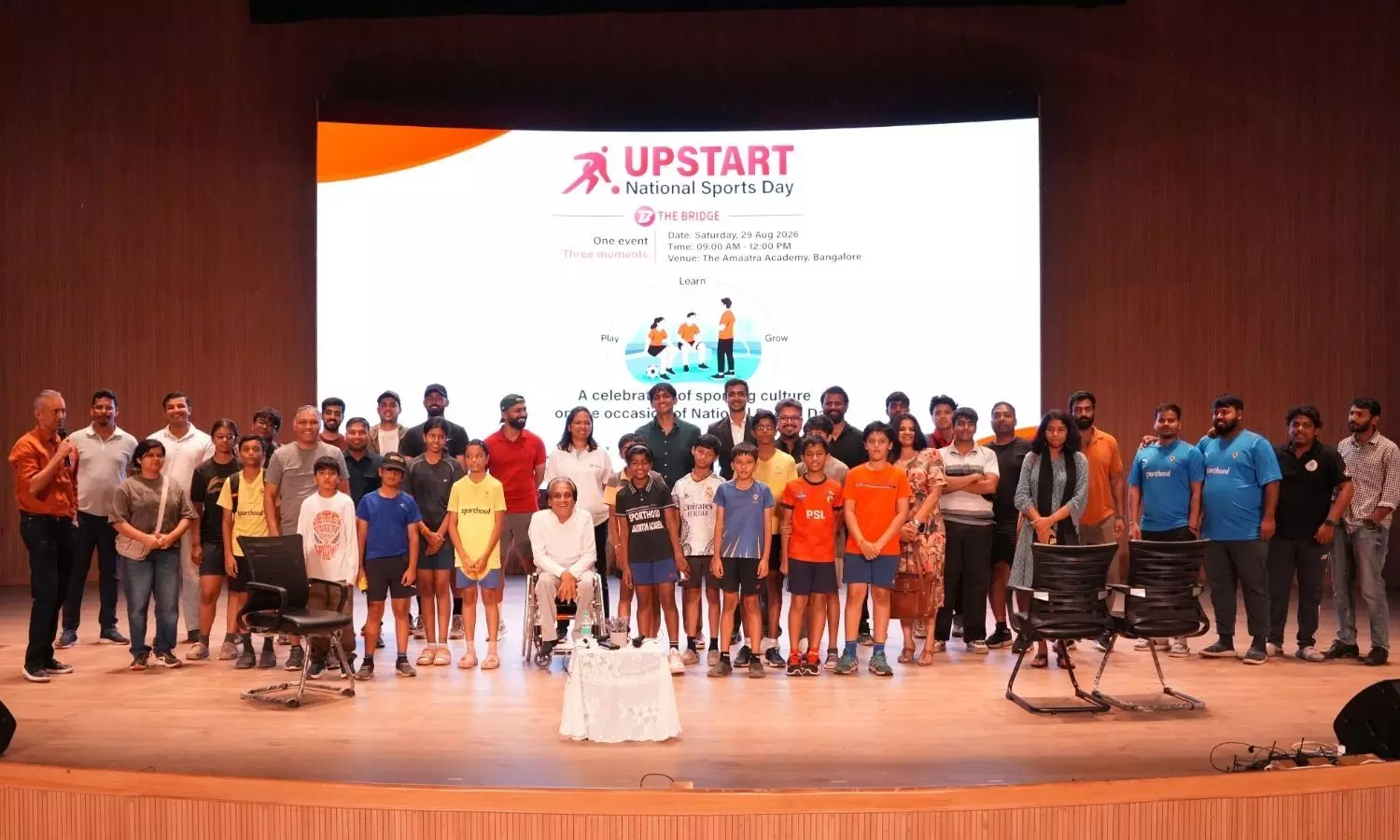
Tangible change at the grassroots requires people to come together on the ground. (Photo credit: The Bridge)
The children came ready to test their fitness. Their parents came ready to support them. By the end of the first challenge, the roles had already reversed.
It's not everyday that parents play sport alongside their children, but when they do, it is a sight for sore eyes.
And it was this unexpected parent-child rivalry that lit up Upstart - The Bridge's first-ever on-ground event.
For years, The Bridge has been telling the stories that make up India's sporting landscape, from Olympic sports that struggle for recognition to athletes whose journeys remain largely unknown beyond their immediate communities, from emerging sporting talent to the people working behind the scenes to build India's sporting ecosystem.
On National Sports Day, that relationship with sport took a different shape.
For the first time, The Bridge stepped beyond the screen and onto the ground with Upstart, an event designed to bring together three groups that do not often get the opportunity to interact in the same space: children who want to pursue sport, the parents trying to navigate that journey, and the stakeholders who can help them understand what comes next.
Held in Bengaluru on August 29, Upstart, organised in partnership with Sporthood and The Amaatra Academy, combined fitness, football, a sports quiz and two panel discussions into a morning built around a simple idea of building a stronger sporting culture by blending action with conversations.
For Arshi Yasin, founder and CEO of The Bridge, the answer begins much closer to the ground than what the headlines and medals might suggest.
“With Upstart, I believe that we are truly bridging the gap. We have been a digital media organisation, and now this is an attempt to bridge the online and the offline world. True tangible change will come when we can mobilise people on the ground.”
That philosophy shaped the event.
Arshi Yasin, founder and CEO of The Bridge. (Photo credit: The Bridge)
“The idea to bring children, parents and coaches together was because these are the fundamental building blocks for any sporting nation, and they are the ones who are at the forefront of grassroots sports development,” Arshi said.
And that grassroots focus is critical to the larger ambition.
India's sporting conversations often gravitate towards elite athletes, medals, international competitions and the infrastructure required to produce champions.
But the journey towards becoming a sporting nation begins much earlier, with whether children have opportunities to play, whether parents understand how to support them, and whether coaches and sporting institutions have the ecosystem to develop that interest.
“No matter how much we talk at the bigger level, if the grassroots are weak, then the entire system will be broken,” Arshi said.
That gap between aspiration and the practical realities of grassroot sport was one of the key ideas behind Upstart.
For many parents, seeing a child develop an interest in sport is only the beginning. The questions that follow can be far more complicated: What next? Where should my child train? How do I identify the right pathway? When should sport become more serious? Who do I speak to?
For Kunal, a parent who came with his son, Upstart was a forum that offered fun and learning.
“Upstart was a really nice experience for us. The fitness challenge was fun, especially competing with the kids, and the sessions also gave us a chance to ask questions and understand more about how we can support our children in sport,” said Kunal.
The morning began with the Performance Five Fitness Test, led by strength and conditioning coach Arsalan and his team, allowing children and parents to put themselves through a series of physical challenges.
The 'Performance Five Fitness Test' handed parents and their children a realistic performance-based fitness report card. (Photo credit: The Bridge)
And the session produced surprises aplenty.
"It was a very interesting experiment. Most of the parents beat their kids. A lot of the kids see their parents being active, and that's why they also want to be active. It's a big role the parents are playing in the kids life," said Dev, a coach that conducted the fitness test.
The competitive spirit continued with a football bootcamp conducted by Sporthood, where coaches worked with children and parents on the field. Goals were scored and denied as parents and children pushed each other on the turf.
And as the participants made their way across to the panel discussion session, a sports quiz brought plenty of cheer.
Community-building around the child
A question that often pops up on the topic of grassroots sport is this: how do we create an environment where children don't just get the opportunity to play, but also have the support to continue their sporting journey?
And a panel featuring Agni Jasthi, GM of The Amaatra Academy, and Ajit Wijetilekk, former player and founder of the Ajit Wijetilekk School of Badminton (AWSB) had plenty to say on the topic.
“For kids, we don't look at medals. The medal for them is joy. We want them to play, and we want to give them the chance to play. At three or five, they don't need medals: we want to see whether they enjoy physical activity and sport. We are not looking at a world champion at the age of nine. At that age, it should be about the pure love and joy of sport, ” said Ajit Wijetilekk.
That environment, however, cannot be created for children in isolation. As children get older, the community around them, particularly their parents, becomes increasingly important.
Agni Jasthi pointed to the challenge of building that community around parents of young children, especially when sporting aspirations can begin to become more serious.
“For children between 9 and 16, one of the biggest challenges is building a community around their parents. We try to regularly interact with the parents of our football squad, and building communities like that is where The Bridge and Upstart can help. We need to educate parents that it is not all about pressure or medals. The first 10 years of a child’s life should be about developing a joy for sport.”
From left: Arshi Yasin, Agni Jasthi and Ajit Wijetilekk speak on the topic of Community building in sports. (Photo credit: The Bridge)
The right pathway
A sporting culture is not created overnight and needs to be nurtured. “Pathways to Becoming a Champion,” therefore, was the obvious topic where Sunil Jain, Chairman of the Indian Wheelchair Tennis Tour; Amit Bikkannavar, Director of Sol Sports; and Dipankar Paul, Head of Marketing at Sporthood, shared their experiences.
For Jain, development of a champions means looking beyond the idea of innate talent altogether. He believes that the right environment can give people the confidence and opportunity to discover what they are capable of.
“When we create a safe space, people can show up, perform and develop. Last week, we were in Hubli. I was in an auto, and the driver asked me what we were doing there. When I told him we were developing an ecosystem, he said his sister had a son who couldn't leave the house. He asked me if I could come to their house. I said no, because the parents have to be willing to take the opportunity. Eventually, he brought the child to us. The child had never even sat in a wheelchair. By the evening, we had him moving, he was happy, and the first thing he asked me was, ‘Sir, when can I play next?,” Sunil Jain said.
From left: Sunil Jain, Amit Bikkannavar and Dipankar Paul during the panel discussion at Upstart in Bengaluru. (Photo credit: The Bridge)
The story was a powerful illustration of what can happen when access comes before assumptions.
“At our academy, we start with a lot of fun games, not just tennis. We see if the kids have hand-eye coordination, but most importantly, if they are having fun. We want them to feel like they are destressing. We don't want to put a burden on them without making them feel like they are having fun,” Amit Bikkannavar said.
Emphasis was laid on enjoyment and Dipankar Paul spoke about the importance of granting exposure.
“What we do at Sporthood is, we are not in the business of building a champion. The importance we place is on actual grassroots development. We look at player development and personality development, and as they move up age groups, we look at other areas as well. We look at player development first, not as a career option. What we try to do is give them all the exposure and help them choose the sport,” said Dipankar Paul.
The perspectives offered a different way of looking at the sporting pathway. Before a child can become a champion, they first have to become a participant. Before they can specialise, they need the opportunity to explore. And before parents can make decisions about their child's future in sport, they need access to the right information and people.
That holistic approach is precisely what The Bridge hopes Upstart can represent.
“Upstart is an effort to bridge the gap in totality. We are trying to be a little more holistic in terms of how we see sports, or how India can truly become a sporting nation,” Arshi said.
For The Bridge, the significance of Upstart goes beyond hosting an event on National Sports Day. It represents a shift in how the organisation sees its role within India's sporting ecosystem.
The digital world can tell a story, amplify an athlete and bring an overlooked sport to millions of people. But tangible change at the grassroots requires people to come together on the ground.
And Upstart was The Bridge's first step towards bringing those pieces together.