
Football
Explained: Why women’s football is India’s best bet at playing in a FIFA World Cup
Ranked 67th globally, India are within reach of the AFC Women’s Asian Cup knockout threshold that can secure a maiden senior World Cup berth.
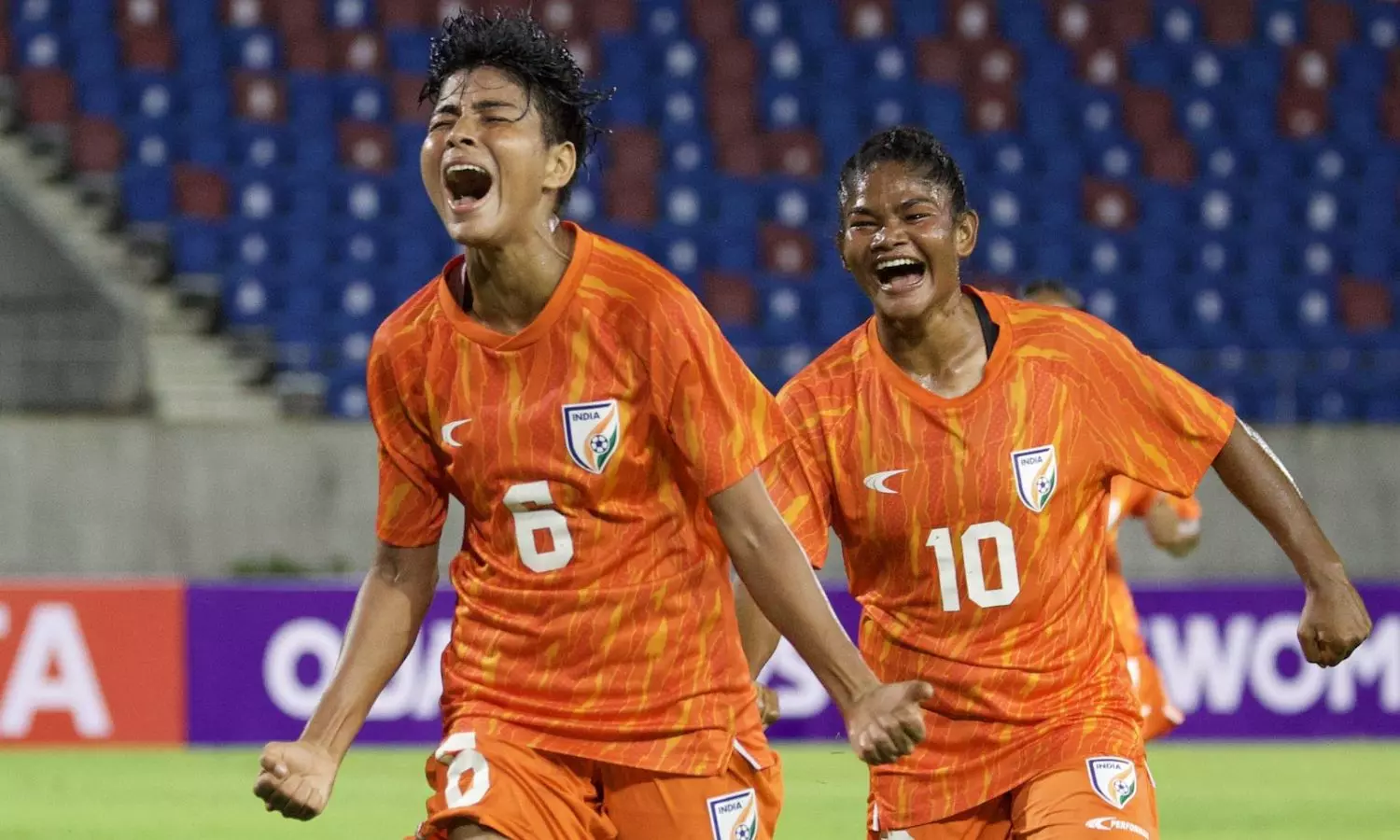
Sangita Basfore brace powers India to historic AFC Women’s Asian Cup Qualification (Photo credit: AIFF)
For decades, the World Cup in Indian football belonged to a sentence that began with someday.
For most of Indian football’s modern era, the country’s structural investment, professional leagues, commercial partnerships and sustained qualification cycles developed primarily around the men’s game.
The women’s team had none of that.
There was no national league until 2016. The national team disappeared from the FIFA rankings in 2009 after 18 months of inactivity. Entire generations played without contracts or a stable competition structure.
And yet, as the 2026 AFC Women’s Asian Cup begins, the team closest to reaching a FIFA World Cup is not the one that received the investment. It is the one who spent decades without it.
In Australia, it belongs to a fixture list. Three group matches. A quarter-final. A play-in if required. That is the distance between the Indian women’s national team and its first senior FIFA World Cup.
India does not need to become Asia’s best. They need to become Asia’s eighth.
The pathway is not theoretical.
The 2026 AFC Women’s Asian Cup offers six direct World Cup berths and two intercontinental playoff routes. From a 12-team field, eight reach the quarter-finals. One quarter-final victory can be enough to enter the final qualification pathway.
India’s ranking, 67 in the world and around 13 in Asia, places it within reach of that threshold.
Japan, Australia, China and South Korea form the continental summit. The World Cup race, however, is decided below it.
Vietnam, Chinese Taipei, Philippines, Uzbekistan, Iran and Thailand are the teams India must match across 90 minutes.
Results against Thailand, Uzbekistan and Iran over the last cycle show a side operating within the same performance band as those final qualification places. The first win over Thailand in 2025 during the Asian Cup qualifiers recalibrated the competitive distance.
The World Cup equation in the women’s game is not about scaling the summit. It is about entering the top eight.
What makes this moment different from every previous cycle is not a golden generation. It is the presence of a structure.
The Indian Women’s League now runs as a longer competition with central contracts. Youth teams have qualified for the U-17 and U-20 Asian competitions for the first time in two decades. The national team camp operates for most of the year.
For the first time, continuity has reached the technical area as well. Amelia Valverde arrives with World Cup experience and inherits a side that scored 24 goals in qualification.
A core in its early and mid-twenties, Shilky Devi, Astam Oraon and Soumya Guguloth, sit alongside experienced internationals such as Grace Dangmei and Sangita Basfore.
Eight players return from the 2022 Asian Cup. Six arrive uncapped.
It is a side constructed for multiple tournaments rather than a single push.
The overseas footprint, once a symbolic breakthrough, is now a pipeline — from Bala Devi’s move to Rangers to Manisha Kalyan in Peru and Aveka Singh in Denmark. The national team now draws from players who train inside professional ecosystems year-round.
In the women’s game, those are developmental pathways.
The contrast with the past is not historical nostalgia. It is competitive physics.
Long before television deals, leagues and central contracts, Indian women were playing for continental titles. The runners-up finishes in 1980 and 1983 and the bronze that followed placed India inside Asia’s competitive elite.
What followed was not a sporting decline but a disappearance in the institutional sense. Between 2003 and 2026, there was no qualification for the Asian Cup on merit.
This is the first time the team returns through a pathway rather than a hosting slot. Across Asia, the route has already been mapped.
The Philippines reached the 2023 World Cup through the Asian Cup knockouts. Vietnam followed through the playoff path. Neither required domination of the confederation. They required structure at the right moment in the qualification cycle.
India now sits at that same curve.
For the first time, the distance between Indian football and a World Cup is measurable in matches rather than imagination.
Even the preparatory results in Perth and Türkiye reflect a side preparing for knockout football rather than participation.
Interest in women’s sport in India already touches more than a third of the population. Five-figure crowds at the U-17 World Cup, packed SAFF finals, dedicated broadcast windows and digital spikes around qualification campaigns indicate a shift from novelty to habit.
Women’s football in India is no longer waiting for relevance. It is generating it.
For decades, the World Cup dream in Indian football belonged to memory. This is the first time it belongs to a tournament in front of us.