
Football
“How can any Indian League be complete without Kashmir?”: Real Kashmir Football Club review
A review of SonyLIV’s Real Kashmir Football Club, exploring identity, hope, football’s unifying power, and Kashmir’s place in Indian leagues.
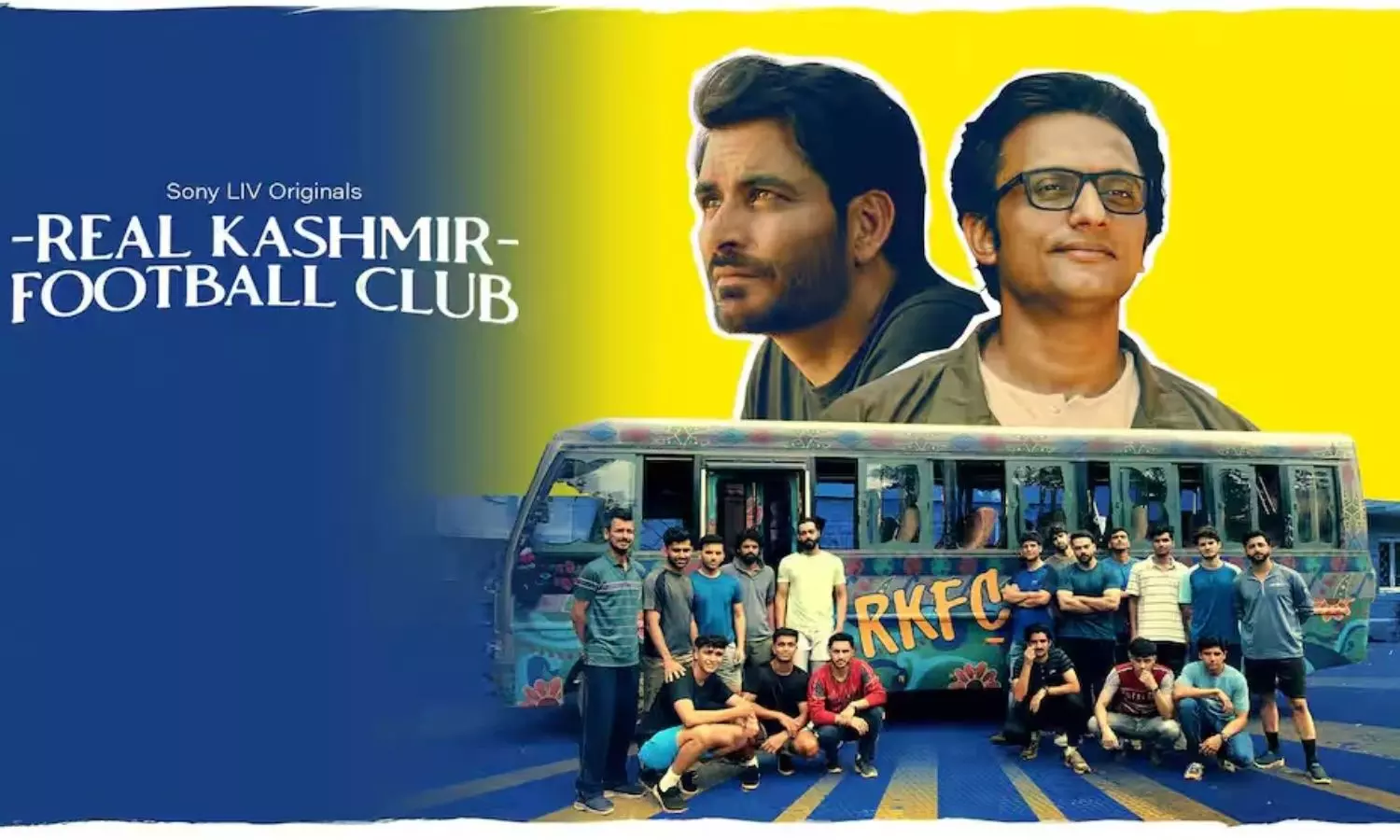
Real Kashmir Football Club Review: A Kashmir Story on SonyLIV (Photo credit: SonyLIV)
“How can any Indian league be complete without a team from Kashmir?”
It’s a simple question, almost naïve in how plainly it’s asked.
But in SonyLIV’s Real Kashmir Football Club, this question becomes an emotional compass of an eight-episode web series.
It’s the line that drives journalist-turned-manager Sohail (Mohammed Zeeshan Ayyub); the line that exposes the region’s absence from the national sporting map, and the line that tugged at viewers' hearts as an Indian watching this story unfold.
Real Kashmir Football Club, directed by Mahesh Mathai and Rajesh Mapuskar, opens with an image that is at once frightening and strangely tender.
A grenade tossed into a crowded protest by Aman sends people scattering in panic, until a policeman discovers it’s fake, and a young boy casually kicks it away like a football.
This moment, absurd and poignant in equal measure, captures the paradox in which the story of Real Kashmir FC is rooted: a region accustomed to fear, still finding ways to play, dream, and claim space.
At the centre of this eight-episode series is Sohail, who stumbles upon a news segment about the Indian Super League and asks the question that becomes the ideological spine of the show.
“How can any Indian league be complete without a team from Kashmir?”
The series keeps returning to this question, not as rhetoric, but as a yearning for representation, belonging, and dignity. It is also the conviction that compels Sohail to quit his job, forgo a salary, and gamble his life on an idea that even he can barely articulate at first.
His unlikely partner is Shirish (Manav Kaul), a Kashmiri Pandit businessman whose investment turns the dream into a fledgling club. Their pairing is inspired by the real-life figures behind the actual team, Shamim Meraj and Sandeep Chattoo, and refreshingly, the show resists sensationalising their Hindu-Muslim dynamic.
Identity is present, always, but never exploited; it exists in glances, in unsaid discomfort, in the way Aman, the same boy from the opening scene who threw the grenade, asks Sohail, “Why are you working for that Pandit?”
The series understands Kashmir well enough to let the politics breathe through texture rather than speechifying.
When Sohail and Shirish announce the club’s first trials, everything goes wrong in ways that could only happen in a place like Srinagar. A printing error lists the time as 7 PM. The trial ground is a dumping yard of seized vehicles.
These early episodes are by far the show’s strongest, raw, unpredictable, and grounded in the lived reality of Kashmiri life.
Once the team is selected, the series widens its lens. A privileged goalkeeper whose parents balk at him playing with “boys from low areas of Kashmir," and a local superstar whose ego tests the patience of his coach.
The financial constraints of Indian football are laid bare; contracts begin at ₹10,000, and the club survives on stubbornness more than resources. These portraits give the show warmth, even when the writing occasionally slips into cliché.
The narrative does lose plot midway. Player power-trip issues with the coach clashes stretch longer than necessary, and the introduction of a Scottish coach brings with it an overly polished “outsider transforms from cynic to believer” arc that feels somewhat contrived. Certain subplots, marital tensions, and bureaucratic dead ends lack finesse and dilute the momentum built in the earlier episodes. The football matches that should be the life of the series themselves are filmed with an enthusiasm that doesn’t always translate into convincing execution.
But sincerity counts for a lot, and Real Kashmir Football Club has that in abundance. The performances, particularly Manav Kaul’s understated gravitas and Zeeshan Ayyub’s weary idealism, keep the emotional spine intact.
Most of the supporting cast delivers performances with the rough edges that make fictionalised sports dramas feel real.
Above all, the cinematography is a revelation, not the predictable snow-capped postcard Kashmir, but the cramped lanes, peeling walls, football grounds carved from urban neglect, and a city that continues to function in spite of perpetual tension. It is the most textured portrait of Kashmir in recent mainstream storytelling.
What sets the series apart is what it chooses not to do. It does not fast-forward to glamorous championships. It does not pretend that the club will solve Kashmir’s problems. It does not chase the glossy adrenaline of Indian dramas.
Instead, it stays close to the mud and the mess, to the beginnings, the vulnerabilities, and the fragile hope that sport can provide. It is a bottom-to-top story that ends precisely when the club begins to feel real, resisting the temptation to romanticise what comes after.
We’ve seen Kashmir on screen so often through the lens of violence and political discourse that a story about building something, patiently, clumsily, courageously, feels almost radical.
Real Kashmir Football Club isn’t a flawless series, but it is an important one. It acknowledges the cracks, the compromises, the limitations of Indian football, yet insists on the beauty of trying anyway.
Because ultimately, it is anchored by that single question.
How can any Indian league feel complete without Kashmir?
The series gently but clearly makes a case for why football matters in Kashmir. In a place where identity is often contested and daily life is shaped by suspicion, football becomes a rare language that everyone, Hindu, Muslim, rich, poor, downtown, uptown, can speak without fear.
On the training ground, the hierarchies of the Valley blur. Rivalries dissolve. Boys who would never share a room end up sharing jerseys, victories, and failures.
It’s never sentimentalised; the unity is fragile, hard-earned, and often temporary. But it’s real. And at its best moments, the series shows how a ball moving between feet can achieve what politics and policing cannot.