
Football
Opinion: Manolo's Mumbai City exit – When the project and coach no longer align
Manolo Marquez and Mumbai City FC parted ways after just four matches.
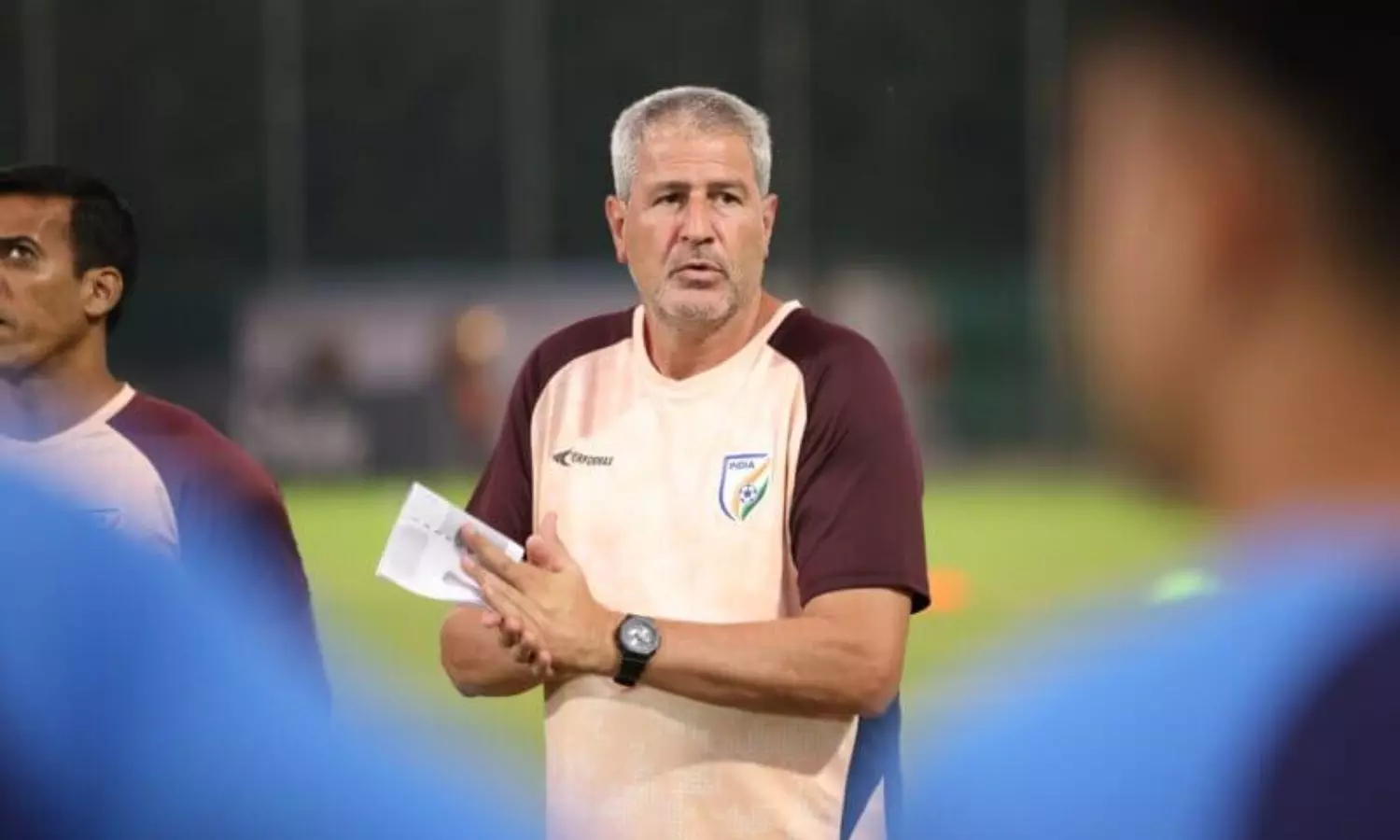
Manolo Marquez (Photo credit: AIFF)
Four matches, two defeats, two draws and no wins – that is Manolo Marquez's record at Mumbai City FC.
On paper, it makes for uncomfortable reading. But four matches offer limited evidence of what a coach can build, particularly when the circumstances surrounding an appointment, the squad and the club's sporting direction are also part of the equation.
Football often places the head coach at the centre of a project, making him the most visible figure when results fall short.
Yet a team's performance is shaped by decisions made long before kick-off.
Recruitment, squad planning, financial commitments and the relationship between the technical department and coaching staff all influence what happens on the pitch. Manolo's abrupt departure brings these responsibilities into focus.
Manolo arrived in India in 2020 to take charge of Hyderabad FC. He built a competitive side, trusted young players and guided the club to its maiden ISL title in 2021-22.
At FC Goa, he continued to demonstrate his understanding of the Indian football landscape, winning the Super Cup in 2025 and the 2025-26 edition, while also taking charge of the Indian national team. His achievements make it difficult to assess his Mumbai tenure in isolation.
The recruitment question
The circumstances surrounding his departure from Mumbai have raised questions about recruitment and whether the squad reflected the coach's requirements.
Following the defeat to Sporting Club Delhi, Manolo indicated that recruitment was not his responsibility to answer and alluded to clubs citing financial constraints while continuing to sign players.
The precise details of their discussions remain private, so it would be premature to draw definitive conclusions about the disagreement.
However, the broader question is legitimate: was there a shared understanding of the playing model, the profiles required and the resources available?
At FC Goa, Manolo had an experienced overseas contingent, while Mumbai City also had several established foreign players. But comparing squads by names alone tells us little about their suitability. The more important considerations are positional balance, tactical roles, depth and whether the available players can execute the coach's ideas.
This is where sporting leadership becomes critical. The coach must communicate the profiles and requirements, while the recruitment and technical departments must translate those needs into realistic signings within the club's financial capacity. The quality of that working relationship can have a direct bearing on the team's competitiveness.
Ambition must match financial capacity
Manolo’s departure from FC Goa in 2026 offers another perspective. According to The Times of India, both parties were keen to extend their partnership, but Goa's reduced budget meant they could not agree on his salary or guarantee the level of investment required for the squad.
This was not simply a question of whether the club could retain a successful coach. It was about whether the financial resources available could sustain the sporting project both parties wanted to continue.
A club's ambitions must be supported by its ability to invest in the squad. When managerial expectations and financial resources diverge, difficult choices follow. A club may need to recalibrate its objectives, rebuild around a different squad profile or reconsider the direction of the project.
The important thing is that these decisions are understood by all parties before expectations become disconnected from reality.
The bigger question for Mumbai City
Mumbai City enjoyed one of the most successful periods in its history under City Football Group, winning two ISL League Winners' Shields and two ISL titles. CFG confirmed its exit in December 2025, with the founding owners assuming full control.
A change in ownership does not automatically mean a change in ambition or capability. However, the transition makes continuity in sporting leadership particularly important.
The Islanders must retain the processes and standards that contributed to its success while establishing a clear direction for the next phase. That means defining its playing philosophy, recruitment priorities, investment capacity and performance expectations, with the head coach involved in that process.
At Mumbai City FC, the absence of Vikram Partap Singh and Wilmar Jordan Gil tested the available attacking options. The 2-3 defeat to Sporting Club Delhi, after surrendering a two-goal lead, brought questions about squad depth into sharper focus.
Injuries are part of football, but a club's planning must account for the demands of a long season and the need for credible alternatives.
Manolo’s departure after four matches does not excuse the results, nor does it establish that recruitment was the sole reason for the split.
It does, however, raise questions about the clarity of the project, the expectations attached to his appointment and the alignment between the coach and the club.
There is an unusual symmetry to Manolo’s Indian journey. His first ISL match as a head coach in India came with Hyderabad FC in November 2020. Four years later, he marked his 100th ISL match as a coach by leading FC Goa to victory over his former club.
Now, his Mumbai City chapter has ended with a defeat to Sporting Club Delhi, the club formerly known as Hyderabad FC.
The club where his Indian journey began was also the opponent on his 100th ISL appearance, and now, under a new identity, the opponent in his final Mumbai assignment. An unexpected full circle.
A coach must take responsibility for results and performance. But recruitment, squad construction and the conditions required to compete are responsibilities that extend well beyond the dugout.
Football projects are not built by coaches alone. They require a clear vision, aligned leadership and collective accountability. And they should be judged on all three.
The views and opinions expressed in this article are those of the author and do not reflect the official policy or position of The Bridge.