
Football
AIFF’s favourite formation: Hire-fire-repeat
AIFF has decided not to extend the contract of coach Amelia Valverde. She is the fifth Indian women's football head coach in 5 years.
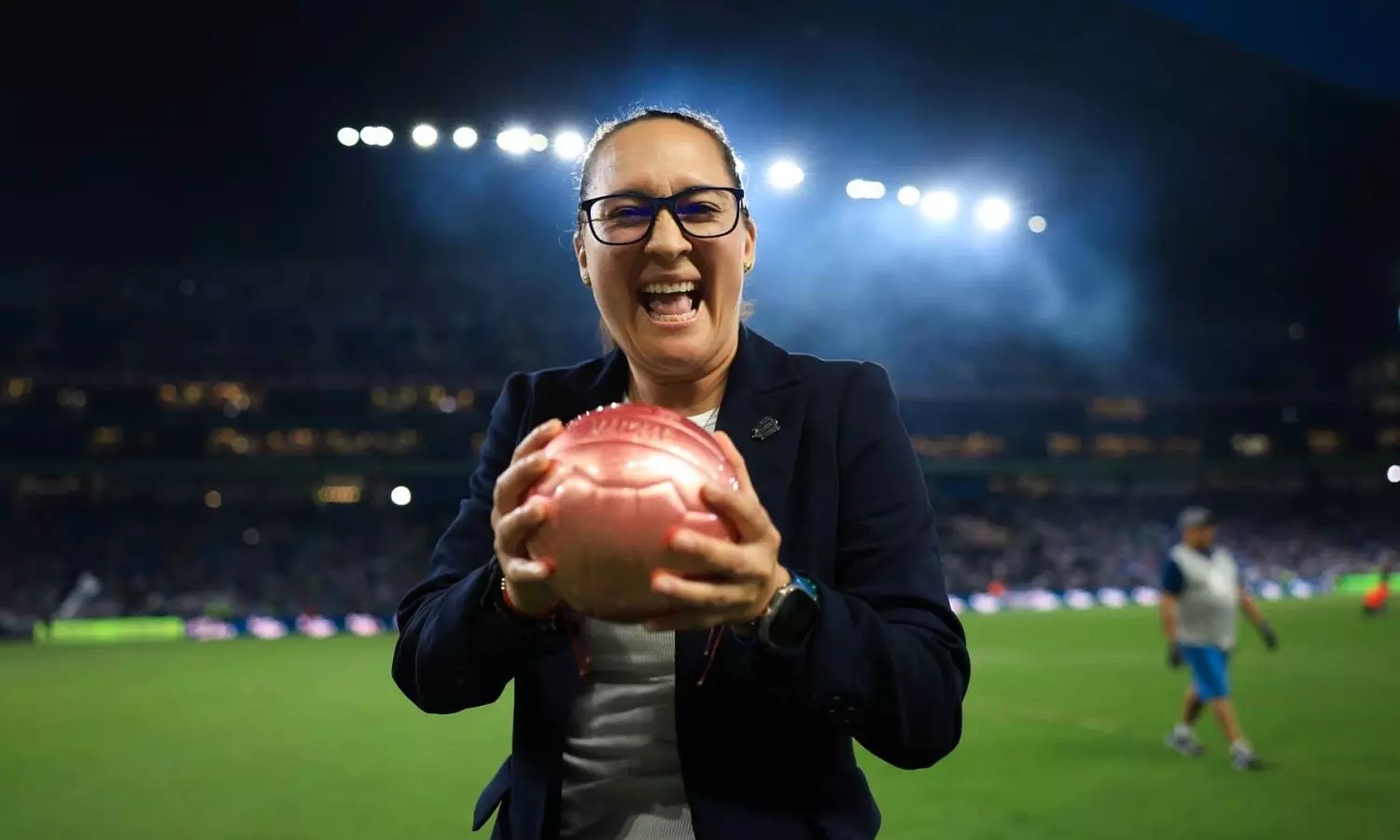
Who is Amelia Valverde, the new head coach of the Indian women’s football team? (photo credit: MBP)
There is a certain efficiency to how the All India Football Federation functions.
Decisions are made quickly, reversed even quicker, and explained with a level of confidence that almost makes you forget the results on the pitch.
Because while the boardroom thrives in abstraction, the scoreboard tends to be less forgiving. And India’s campaign at the AFC Women’s Asian Cup 2026 offered exactly that, clarity.
Three matches, three defeats, 0 points. Two goals scored, sixteen conceded. A narrow 1-2 loss to Vietnam that hinted at promise, a 0-11 defeat to eventual champions Japan that exposed the gulf, and an 1-3 loss to Chinese Taipei that ended whatever faint hopes remained.
Yet, if you follow the logic emerging from the federation, the problem appears to be something far more specific: Amelia Valverde.
The AIFF has decided not to extend the contract of head coach Valverde following India’s winless campaign at the AFC Women’s Asian Cup.
The foreign coach experiment
When Amelia Valverde was appointed in January 2026, the messaging was clear. India needed international expertise for a major continental tournament.
Here was a coach who had taken Costa Rica to two FIFA Women’s World Cups, who had worked in competitive environments, and who arrived with pedigree.
What she did not arrive with was time.
India had nine months to prepare for the Asian Cup. But their appointed head coach had barely six weeks with the squad before the AFC Women's Asian Cup.
The outcome was harsh, but not particularly surprising.
And yet, the post-tournament conclusion from the AIFF technical committee, chaired by IM Vijayan, was that expectations were not met, that India “should have at least managed a draw.”
It is a reasonable sentiment in isolation; but less so when placed against the context of preparation, opposition quality, and systemic limitations.
The tactical crime of… trying
Among the reasons cited for not extending Valverde’s contract was her use of multiple formations across the three matches. Tactical flexibility, in most environments, is either a necessity or a virtue.
Here, it became evidence.
To reinforce the point, on March 24, 2026, the AIFF technical committee met and produced what can only be described as a creative piece of football reasoning.
Among the concerns: Amelia Valverde experimented with three different formations across three matches. To drive the point home, a comparison was drawn with Manchester United, where Ruben Amorim’s rigid 3-4-2-1 was reportedly abandoned by Michael Carrick, leading to improved results.
It’s a compelling story. Just not a relevant one.
Amorim was dismissed in January 2026 after a difficult spell, and Carrick stepped in as an interim with a clean slate, his own staff, and, naturally, his own ideas.
It was a full reset at one of the richest and most resourced clubs in world football. Expecting him to continue with Amorim’s system would have been… an interesting managerial choice.
The comparison becomes even more ambitious when placed in context. One team operates in the Premier League, with elite players, constant competition, and near-unlimited resources. The other is the Indian women’s national side, still dealing with gaps in preparation, exposure, and infrastructure. Bridging that gap with a formation analogy is, at the very least, optimistic.
By that logic, perhaps the real issue behind an 11-0 loss was not tactical flexibility, but the absence of Pep Guardiola-inspired positional play.
More importantly, it sidesteps the obvious: formations rarely determine outcomes in isolation, especially when the underlying gap in quality remains significant.
The revolving door, now spinning faster
If this were an isolated decision, it might pass as a harsh but singular judgment. However, it isn’t.
Valverde becomes the fifth head coach of the Indian women’s national team in roughly five years, following Thomas Dennerby, Langam Chaoba Devi, Santosh Kashyap, and Crispin Chhetri.
- Thomas Dennerby- August 2021 – late 2023
- Langam Chaoba Devi- January 2024 – September 2024
- Santosh Kashyap- September 2024 – January 2025
- Crispin Chhetri- January 2025 – January 2026
- Amelia Valverde- January 2026 – March 2026
Five coaches. Five different approaches. One consistent outcome: no long-term continuity.
Chhetri’s case, in particular, adds an extra layer to the cycle. He led India to qualification for the Asian Cup with a notable win over Thailand, a significant achievement given the circumstances. He was then moved aside to make way for a foreign appointment ahead of the tournament.
Now, with Valverde set to exit, the federation is once again considering a return to domestic options, including ironically Chhetri and East Bengal head coach Anthony Andrews.
Lost in the churn of appointments and explanations are the performances themselves, which, despite the scorelines, were not devoid of context or nuance.
India’s two goals came through Sanfida Nongrum and Manisha Kalyan. There were credible individual displays, from Manisha’s attacking intent to Elangbam Panthoi Chanu’s resilience in goal. Even the opening loss to Vietnam showed fight.
But the broader picture was unmistakable. This is a team still building, still catching up, still constrained by gaps in domestic competition, preparation cycles, and exposure to high-level opposition.
None of those are problems that change with a two-month coaching contract.
Valverde’s tenure was always temporary, a short-term deal for a specific tournament, with two foreign assistants, and an implicit understanding that results would dictate continuity.
There were also practical considerations: a longer stay would likely have required better financial terms and a clearer long-term plan.
Instead, the plan appears to have been… the tournament itself.
And once that ended unsuccessfully, so did the experiment.
A system that explains everything, except itself
There is a version of this story where every decision makes sense in isolation. Appoint experience. Demand results. Make changes when those results don’t arrive.
But football, especially at the international level, rarely operates in isolation.
It requires continuity. Planning. Patience. And above all, alignment between ambition and reality.
At the moment, the AIFF seems to be operating in a space where those elements rarely intersect, a space where expectations are high, preparation is brief, and explanations arrive faster than solutions.