
Football
Brazil, Uruguay and Panama: What did Indian football really gain?
The Panama draw offered a blueprint, while heavy losses to Brazil and Uruguay exposed gaps in depth, possession, transitions and finishing.
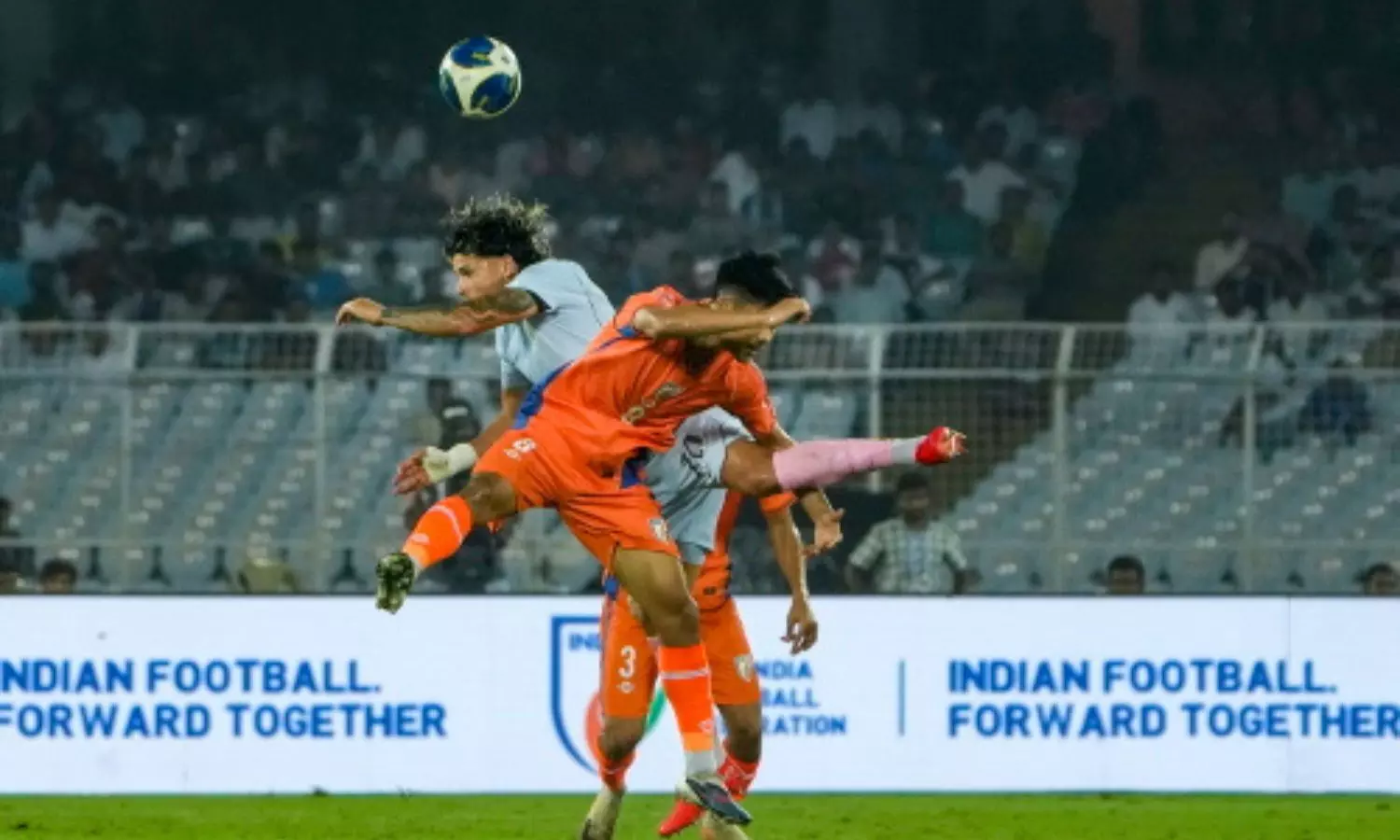
India football team in action against Urguay (Photo credit: PTI)
India's three high-profile friendlies against Panama, Brazil and Uruguay delivered almost everything a football window can offer: a morale-boosting result, a harsh reality check, individual breakthroughs, valuable exposure and, inevitably, questions about whether the exercise justified its reported cost.
India drew 1-1 with Panama, lost 0-4 to Brazil and then 1-6 to Uruguay. All three opponents were World Cup teams.
The results suggest that India can compete when well organised and fresh, but the gulf becomes significant once the intensity, speed and technical quality rise.
The bigger question, however, is what India does with that information.
Panama showed what India can be
The 1-1 draw in Bengaluru was the clearest positive of the window.
India matched Panama's intensity for long periods, took the lead through Ryan Williams and continued pushing after the equaliser. Akash Mishra provided energy from the flank, while India created more opportunities than it often does against high-ranked opposition.
There were familiar problems; poor finishing, rushed decisions and an inability to dominate possession, but this was a legitimate competitive performance against a side ranked around 44th in the world.
It offered something the other two games could not: evidence that India can stay in a contest against a significantly stronger team when its organisation, work rate and confidence hold.
Brazil and Uruguay exposed the ceiling
The two Kolkata games were far more revealing about India's current limitations.
Against Brazil, India stayed compact for roughly 25 minutes and attempted to restrict Vinícius Jr and Brazil's attacking players. They even had late opportunities.
But after Estêvão's opener, Brazil's movement and technical quality began creating problems. India struggled to track runners, retain possession under pressure and recover quickly after losing the ball.
India in action against Selecao (Photo credit: PTI)
Uruguay exposed those weaknesses even more severely.
India responded well to Darwin Núñez's early penalty, with Anirudh Thapa equalising. But the lengthy lightning delay disrupted the game, and after the restart, Uruguay quickly regained control.
India's defensive structure deteriorated as fatigue set in, while Uruguay's movement, second-ball work and finishing quality became increasingly difficult to handle.
The 1-6 defeat meant India conceded 10 goals across the two South American games.
What did India actually gain?
There is genuine value here.
For a relatively young and new-look squad under Khalid Jamil, these matches provided direct exposure to the speed of international football at its highest level. Players experienced how quickly elite opponents punish a poor touch, a misplaced pass or a slow recovery run.
Jamil also has considerably better information about his squad than he did before the window.
Williams' attacking threat, Mishra's energy, and Thapa's goal are individual positives. The defeats, meanwhile, identified precisely where India struggles: transition defending, sustained possession, physical intensity, finishing and depth.
The problem is that experience alone does not create development.
The real question: where should the next rupee go?
If the reported ₹80-90 crore scale of expenditure is used as a reference point, the most important question is not whether India should ever play Brazil or Uruguay again.
It is whether comparable resources can produce a greater long-term return elsewhere.
India's biggest need is more football, not simply bigger football.
1. Build a much deeper youth competition system
The first priority should be increasing the number of meaningful matches available to young Indian players.
A talented 14-year-old cannot become an international-level player through occasional academy tournaments. India needs stronger regional leagues, more age-group fixtures and a pathway that allows talented players to play high-quality competitive football throughout the year.
Money could support travel, competition organisation, qualified coaches, facilities and regional talent centres so that participation is not concentrated in a handful of established football hubs.
2. Invest heavily in coaching
Brazil's advantage is not simply that it produces naturally gifted players. It has an enormous football ecosystem in which players encounter coaches, competition and football culture from an early age.
India cannot replicate Brazil overnight, but it can increase the number and quality of coaches working with children.
Funding more AFC-qualified coaches, specialised youth-development programmes, coach educators and modern training methodologies would create an asset that remains in the system long after a single international friendly is over.
3. Create regional high-performance centres
India's talent pool is much larger than the players who eventually reach the national setup.
The federation and state associations could identify major football clusters and develop regional high-performance centres providing quality pitches, strength and conditioning, sports science, medical support and specialist coaching.
That would give talented players outside the traditional pathways a better chance of progressing.
4. Make domestic football stronger
The national team ultimately depends on what happens to Indian players every week.
If domestic clubs are financially unstable, competitions are inconsistent and young players struggle to get meaningful minutes, the national team will continue to face the same ceiling.
Some of the money directed towards glamour fixtures could instead support club sustainability, youth teams, reserve competitions and incentives for developing and playing young Indian players.
The objective should be simple: raise the standard of the ordinary weekend before worrying about the extraordinary international night.
5. Play more opponents closer to India's level
This does not mean avoiding elite teams.
India should continue seeking occasional opportunities against sides such as Brazil and Uruguay. But those games should sit within a broader calendar containing far more matches against teams ranked roughly 40th to 90th, particularly in Asia and other regions with comparable footballing levels.
Those matches provide a better environment for testing tactical ideas, accumulating ranking points and learning how to win rather than simply survive.
The opportunity cost matters
India also withdrew from the ASEAN Cup to accommodate this window. That decision effectively traded competitive matches against more comparable opposition for three high-profile friendlies.
The financial argument is equally important. AIFF has said the expenditure was not simply being taken from its own limited reserves and involved sponsors, ticketing partners and other arrangements. That is relevant.
But opportunity cost does not disappear because the money comes through different channels.
A reported ₹80-90 crore-scale exercise could potentially fund several years of youth competitions, coaching programmes, regional centres or domestic development initiatives.
So, was it worth it? Partly.
The Panama draw was valuable. The experience of playing Brazil and Uruguay was real. India's players and coaching staff now have a much clearer understanding of what separates them from World Cup-level opposition.
But these matches should be viewed as a diagnostic exercise, not a development strategy.
Brazil and Uruguay showed India the level it wants to reach. Panama showed that the gap is not entirely unbridgeable.
The next step is considerably less glamorous.
India needs more pitches, more coaches, more youth matches, stronger academies, healthier clubs and a domestic environment in which talented players are constantly challenged.