
Football
AFC Women's Asian Cup: How Japan, Vietnam and Chinese Taipei match up against India
A deep dive into India’s Group C rivals at the AFC Women’s Asian Cup 2026, analysing Japan, Vietnam and Chinese Taipei’s tactics and World Cup stakes.
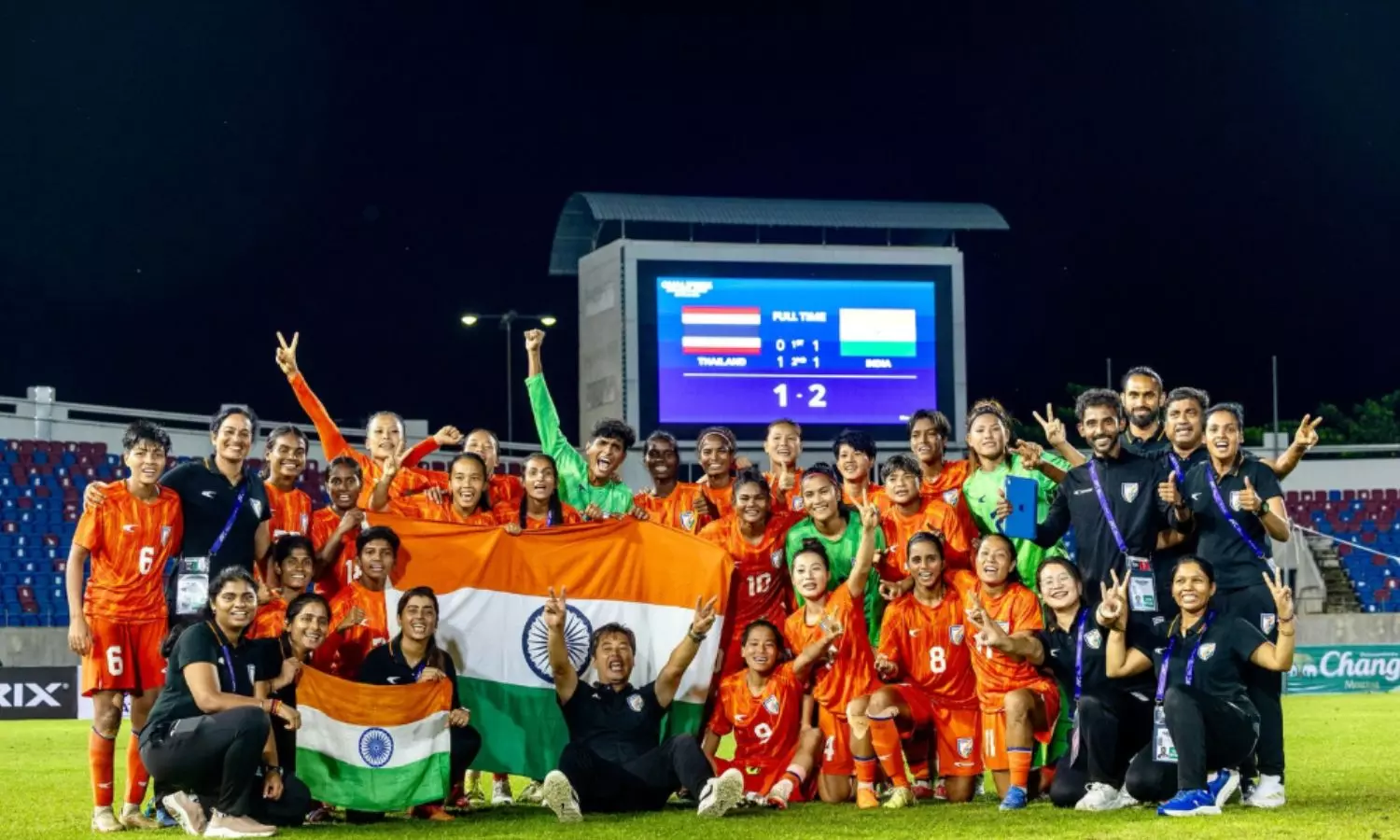
India at the AFC Women's Asian Cup- Preview (Photo credit: AIFF)
The Indian women’s football team will feature at the 2026 AFC Women’s Asian Cup in Australia from March 4, having qualified on merit by topping their group in Thailand last June.
They defeated Timor-Leste, Iraq and Mongolia before sealing qualification with a 2-1 win over hosts Thailand, courtesy of a Sangita Basfore brace.
The 21st edition of the continental tournament features 12 teams divided into three groups.
India are placed in Group C alongside Japan, Vietnam and Chinese Taipei.
The top two teams from each group and the two best third-placed sides will advance to the quarterfinals.
Ranked 67 in the world, India faces a tough challenge against higher-ranked opponents, including two-time champions Japan and World Cup participants Vietnam.
The tournament also doubles as a qualification for the FIFA Women’s World Cup, with four direct spots available and two more via inter-confederation playoffs.
Know your opponents
Vietnam
Vietnam approach the 2026 AFC Women’s Asian Cup seeking a second consecutive FIFA Women’s World Cup qualification after making their historic debut in 2023. Their breakthrough came at the 2022 Asian Cup in India, where they advanced as one of the best third-placed teams following a crucial draw with Myanmar.
That point pushed them into the playoff stage, where they defeated Thailand and Chinese Taipei to secure their first-ever World Cup berth.
Officially formed in 1990 but delayed in competitive entry for seven years due to socio-economic conditions, Vietnam quickly rose within Southeast Asia, winning bronze at the 1997 SEA Games and establishing long-standing regional dominance alongside Thailand through multiple AFF and SEA Games titles.
Heading into 2026, the stakes are significant. Qualification would make them only the second ASEAN nation to reach back-to-back Women’s World Cups, matching Thailand’s record.
However, this is a squad in transition. Several core players are now in their 30s, including captain Huynh Nhu and experienced forward Pham Hai Yen, both still key in the final third.
Tactical profile: Head coach Mai Duc Chung, who returned after the 2023 World Cup cycle, continues to rely on a compact, defensively disciplined system. Vietnam typically defend in a structured mid-to-low block, prioritising shape over aggressive pressing, and then breaks quickly through wide channels. The pace of Nguyen Thi Thanh Nha is central to these transitions, while the midfield focuses on work rate and positional balance rather than extended possession spells.
The key question is sustainability: can the ageing spine maintain intensity across three high-level group games? Younger players such as Luong Thi Thu Thuong and Ngan Thi Van Su are gradually being integrated to add energy.
For India, the March 4 opener could shape the group. Vietnam are difficult to break down, but they can be stretched physically if forced into prolonged defensive phases.
Chinese Taipei
Chinese Taipei are one of Asia’s most decorated historical sides, winning three consecutive AFC Women’s Championships in 1977, 1980 and 1981, remarkably without conceding a goal across those tournaments. For over a decade, they were the continental benchmark. However, geopolitical complications, administrative decisions, and stagnation in domestic development saw them lose that dominance. They even temporarily left the AFC for the OFC before returning in 1989, and by the 2000s had slipped from elite status.
Their modern resurgence began with qualification for the 2022 Asian Cup, where they reached the quarterfinals.
Now rebranded as the “Blue Magpies,” Chinese Taipei are no longer continental heavyweights but have rebuilt into a tactically disciplined side capable of competing with mid-tier Asian nations.
Tactical profile: Chinese Taipei operate in a disciplined mid-block and focuses heavily on defensive compactness. They rarely press high and are comfortable conceding possession, instead relying on anticipation and quick transitional attacks. The midfield pairing of Chan Pi-han and Hsu Yi-yun anchors the defensive shape and ensures vertical balance. In attack, Su Yu-hsuan is the primary goal threat, supported by runners such as Huang Ke-sin and Matsunaga Saki, who thrive in transition moments.
Their limitation lies in match control; against technically superior sides, they struggle to dictate tempo. That makes their fixtures against Vietnam and India critical. The final Group C game between India and Chinese Taipei could realistically function as a direct eliminator for a quarterfinal spot, especially if both sides drop points against Japan.
Japan
Japan remain Asia’s gold standard in women’s football. World Cup winners in 2011 and Asian champions in 2014 and 2018, they have consistently evolved tactically to remain globally competitive.
After a counter-attacking phase under Futoshi Ikeda, highlighted by a 4–0 victory over Spain at the 2023 World Cup, the Japan Football Association appointed Nils Nielsen in December 2024, making him the first foreign head coach in the team’s history.
Tactical profile: Under Nielsen, Japan have transitioned into a proactive, possession-dominant 4-3-3 system. The focus is on controlling tempo, structured buildup, high pressing after loss, and positional rotations to overload midfield zones. Captain Yui Hasegawa dictates rhythm from central midfield, while veteran defender Saki Kumagai provides leadership and defensive organisation.
The attack is stacked with proven and emerging threats. Hinata Miyazawa, a Golden Boot winner, and Mina Tanaka offer clinical finishing, while young talents like Aoba Fujino and Maika Hamano bring directness and verticality. Fullbacks Risa Shimizu and Hikaru Kitagawa push aggressively forward, often creating numerical superiority in wide areas and allowing Japan to sustain pressure high up the pitch.
With 22 overseas-based players and a recent SheBelieves Cup title in 2025, Japan enter as strong Group C favourites.
For India, the March 7 encounter is less about dominance and more about defensive resilience and goal difference management. Limiting damage against Japan could be as decisive as securing results against Vietnam and Chinese Taipei.
India Squad – AFC Women’s Asian Cup 2026
Goalkeepers: Panthoi Chanu Elangbam, Shreya Hooda, Sowmiya Narayanasamy
Defenders: Astam Oraon, Juli Kishan, Martina Thokchom, Nirmala Devi Phanjoubam, Sanju Yadav, Sarita Yumnam, Shilky Devi Hemam, Sushmita Lepcha, Sweety Devi Ngangbam
Midfielders: Aveka Singh, Babina Devi Lisham, Jasoda Munda, Sanfida Nongrum, Sangita Basfore
Forwards: Grace Dangmei, Kaviya Pakkirisamy, Lynda Kom Serto, Malavika Prasad, Manisha Kalyan, Pyari Xaxa, Rimpa Haldar, Soumya Guguloth, Karishma Shirvoikar
Head Coach: Amelia Valverde
India's Schedule
India vs Vietnam – March 4, 2026 | 4:30 PM IST | Perth
India vs Japan – March 7, 2026 | 4:30 PM IST | Perth
India vs Chinese Taipei – March 10, 2026 | 2:30 PM IST | Sydney
Where to watch the AFC Asian Cup 2026
Fans in India can watch all of India’s AFC Women’s Asian Cup 2026 matches live on FanCode.