
Commonwealth Games
CWG 2026: Patient Gulveer Singh latches on to his moment in Glasgow
Having slipped to ninth midway through the race, Gulveer Singh launched his move in the final 1,200 metres to script history.
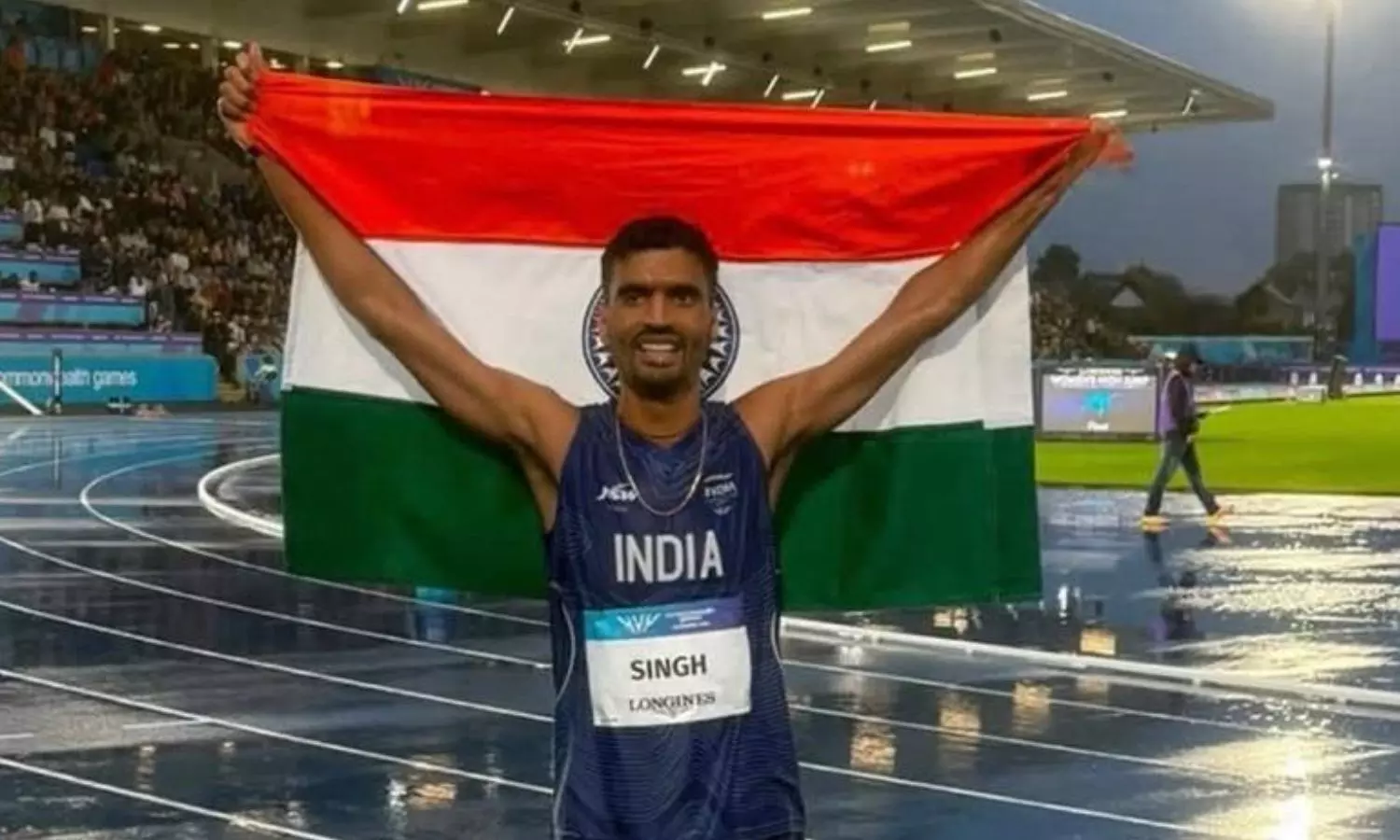
Gulveer Singh after finishing second in men's 10,000m final in Glasgow. (Photo credit: IIS)
There are silver medals, and then there are silver medals that dismantle decades of assumption and uncertainty.
On a rainy Tuesday evening at Scotstoun Stadium, Gulveer Singh delivered the latter. He became India's first athlete to win a medal in the men's 10,000m at the Commonwealth Games, in a race that closed with a finish nobody watching distance running in this country will forget in a hurry.
Gulveer clocked 27:49.78, sprinting to the finish line behind Australia's Ky Robinson (27:48.93) and just ahead of Isle of Man's David Mullarkey, who took bronze in 27:50.28.
Kenya's Edwin Kurgat finished fourth in 27:50.98 – agonisingly close to the podium, and symbolically significant. For the first time since the 1986 Commonwealth Games, no African athlete finished among the top three in the men's 10,000m.
The 1986 Games, incidentally in Scotland as well in Edinburgh, had seen a vast majority of the African nations boycott, thanks to United Kingdom Prime Minister Margaret Thatcher’s decision to maintain sporting ties with apartheid South Africa.
If you exclude that, then the last time an African athlete didn’t finish on the podium was way back in the 1970 Games held in the same city.
A race won in final 1200m
The manner of Gulveer’s silver medal finish in Glasgow was a sight to behold — patient to the point of anxiety, then explosive.
He started in second position and held a top-three spot until just before the halfway mark, before slipping to sixth.
He dropped further to ninth as the pace picked up past 5,600m, then began picking up speed in the final 1,200m, moving into third going into the bell lap before producing a tremendous kick to finish second.
He crossed the 3,000m mark in 8:39.2, remained in contention through 6,000m despite dropping to fifth, and moved back into third before the final lap.
It was not his fastest 10,000m, nowhere near his personal best and national record of 27:00.22, set in 2025, but it may be his most important. This was a title fight, not a time trial, and Gulveer understood the difference.
"The race was good, there was rain but when you win a medal it hardly matters if there is rain, sunshine, heat or anything else," said Gulveer.
The Sable parallel
Four years and one Games earlier, in Birmingham, a different Indian distance runner produced a similarly seismic result.
Avinash Sable ended a stretch of Kenyan dominance in the 3000m steeplechase that had lasted since the 1998 Commonwealth Games – six consecutive editions, 24 years, in which Kenya swept gold, silver and bronze every single time.
Sable clocked 8:11.20 in Birmingham, finishing just 0.05 seconds behind Kenya's Abraham Kibiwot to win silver, which was India's first-ever Commonwealth Games medal in the steeplechase.
He became the first non-Kenyan to win a Commonwealth medal in the event this century.
With Sable out of the Glasgow Games due to an unfortunate ACL injury, Gulveer took over the mantle on track for India.
Comparing Sable’s Birmingham run to Gulveer's Glasgow run is instructive. But the two moments are not identical, and the distinction matters.
Sable broke Kenya's monopoly on the podium; gold and bronze still went to Kenyan runners that night in Birmingham. Gulveer's silver, by contrast, came in a race where no African runner reached the podium at all – a rarer, and arguably more complete disruption of a distance-running order that has, for four decades, been treated as close to a law of nature.
Both men, though, share the same defining trait; their refusal to be intimidated by reputation.
Sable ran down three fancied Kenyans in the final kilometre in 2022. Gulveer clawed back from ninth place to hunt down the podium in the final 400m in 2026.
Neither result was the product of raw pace alone. Instead, both were built on tactical patience and a willingness to attack when the moment allowed.
What Sable started in Birmingham in 2022, Gulveer has now extended in Glasgow. It is a evident that Indian distance running's ambitions are no longer about simply making up the numbers behind the traditional powerhouses.
"I had left everything on God. Before the race I told him, ‘dekh lena (please watch over me),’" said Gulveer.
The almighty indeed did. Gulveer is now undisputedly one of India’s all-time greats.