
Commonwealth Games
CWG 2026: How Sreeshankar's advice helped Tejaswin Shankar to India's first ever decathlon medal
Tejaswin was convinced his body would no longer withstand the rigours of the decathlon, but Sreeshankar's advice came handy as he refused to let one injury write his destiny.
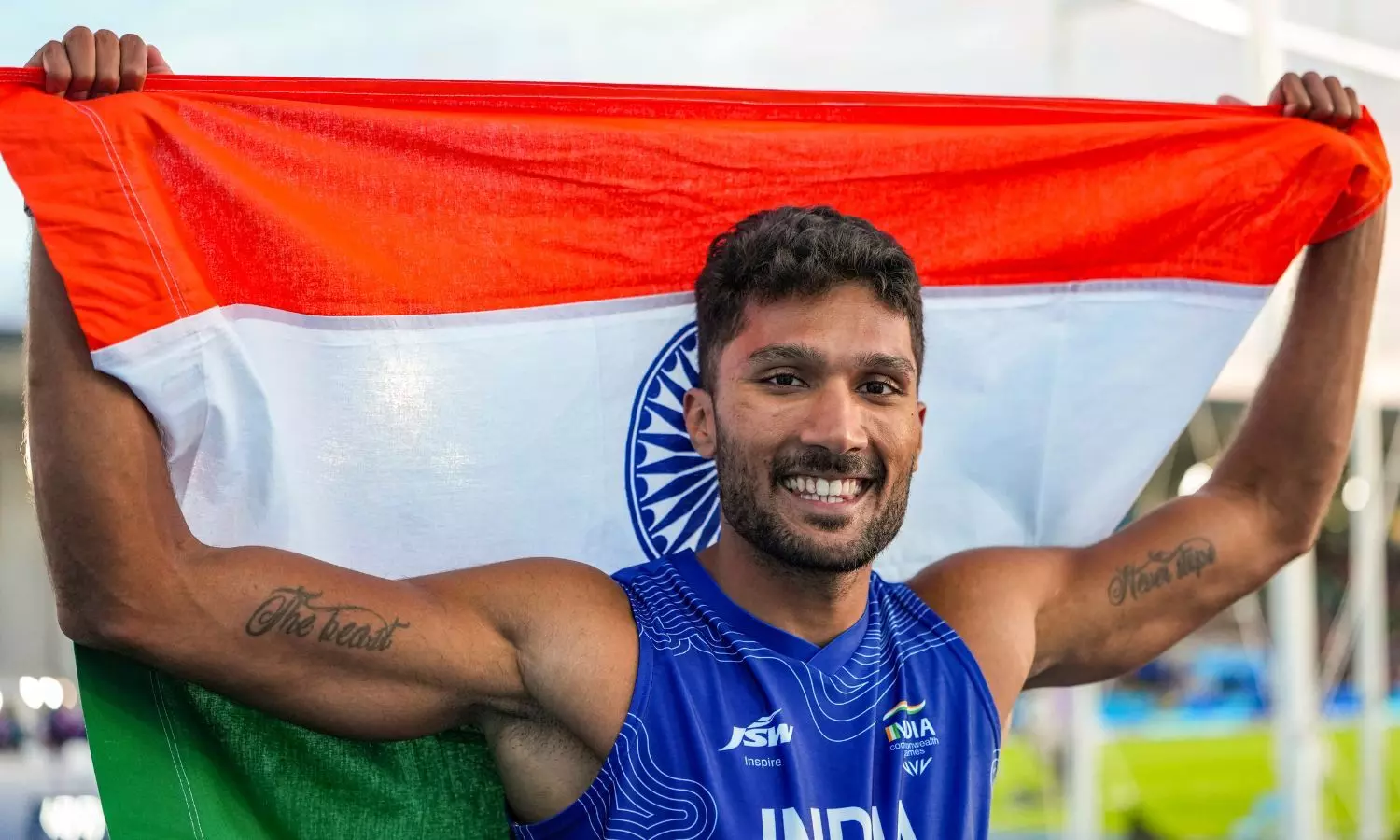
Tejaswin Shankar produced a personal-best 40.44m discus throw in Glasgow.
Three days ago, Tejaswin Shankar was in tears at the Scotstoun Stadium, walking away from the only event he calls his "bread and butter."
On July 27, warming up for the men's high jump final, Tejawsin felt a familiar, unwelcome jolt — a flare-up of the chronic patellar tendinitis that has shadowed his knees for years. He managed one competition attempt at 2.05m before the pain became impossible to compete through.
The 2022 Birmingham bronze medallist, who had arrived in Glasgow as one of India's stronger medal bets, pulled out after a single jump, visibly shaken as he spoke to reporters afterwards.
What he did next said as much about him as the medal that followed. Rather than leaving the arena, Tejaswin stayed fieldside and turned coach for the evening, feeding technical cues to teammate Sarvesh Kushare, who was still competing.
Kushare would go on to win silver, an improvement on Tejaswin’s own 2022 finish, and later credited Shankar's guidance for helping him settle into rhythm. It was a strange kind of consolation – heartbroken himself, Tejaswin had just helped engineer someone else's breakthrough.
But his own tournament wasn't finished. The decathlon began on July 30, barely 48 hours later, and Tejaswin was uncertain whether his body would hold up.
This is where the tight circle of Indian athletes he calls his friends mattered. Everyone from the Indian contingent went up to check on him.
But there was one piece of advice which stood out.
“Just take one event at a time,” India’s long jump silver medallist Murali Sreeshankar told Tejaswin on the breakfast table the morning after he pulled out of the high jump.
“All you have to do is show up for the 100m and warm up. If it goes well, great. If it doesn’t, stop after that,” he added.
Sreeshankar knew what he was talking about. He had undergone a surgery for a similar injury and missed the 2024 Paris Olympics. He, quite literally, jumped to the podium in Glasgow on a new leg.
Having watched Sreeshankar claw his way back from being told he might never compete again, Tejaswin had a living example, standing right beside him, of what competing through fear and physical doubt could look like.
That advice kept repeating in Tejaswin’s head as he headed into decathlon. By the end of Day 1, he was firmly placed in the silver medal position with 4,339 points. The medal looked closer than it ever has.
Day 2 would decide everything. Shankar ran a strong 110m hurdles, then produced a personal-best 40.44m discus throw to hold third overall. A modest pole vault of 4.30m dropped him to fourth with two events left.
Then came the response. A season-best 53.12m javelin throw hauled him back into third place before heading into the concluding 1500m, the' most unforgiving decathlon finale for a man who had begun the week unsure if his knee would survive ten events, let alone a closing middle-distance run.
Shankar clocked 4:36.19, enough to hold off England's Sammy Ball and seal bronze with a total of 7,976 points.
Grenada’s Victor Lindon, an Olympic bronze medallist, took gold with 8,096 points, while Canada’s former Olympic champion Damian Warner claimed silver with 8,036.
Tejaswin had just squeezed himself onto the podium with two of the modern day decathlon greats.
“The two people that I am sharing the podium with are the two people I’ve seen videos of every single day of my life since I’ve started decathlon,” said Tejaswin. “Sharing the podium with these legends is special to me.”
The first man he rushed to in the arena after confirming his medal was Sreeshankar.
For Tejaswin Shankar, who spent Monday night believing his Games were over, Friday's podium finish, flanked by an Olympic champion and an Olympic medallist, was a culmination of a support system built through mutual crisis, a refusal to let one injury write his destiny and, of course, sheer athletic ability.