
Commonwealth Games
CWG 2026: Indian judo's tryst with destiny despite off-field issues
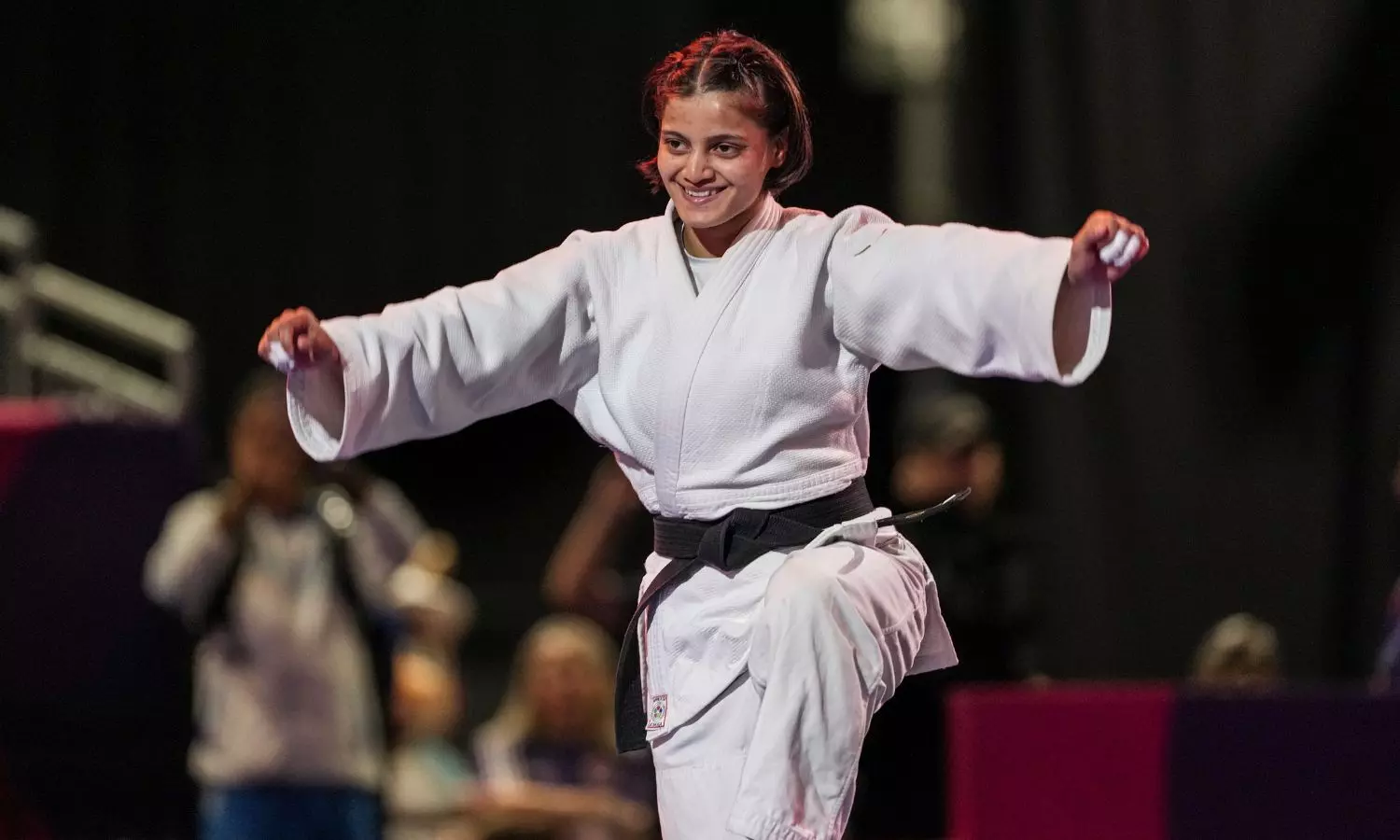
Asmita Dey won India's first-ever judo gold at Commonwealth Games (Photo credit: PTI)
For thirty four years, Indian judo stood on the Commonwealth Games podium eleven times without ever climbing to its top step. On July 31, 2026, at the SEC centre in Glasgow, that wait ended twice in the space of half an hour.
The manner in which the search for gold medal ended says as much about the athletes' resilience as it does about a federation that nearly sabotaged its own moment.
The contest
Asmita Dey, 23, from Tripura, went first. In the women's 48kg final, she fell behind early to Canada's Heidi Quach, conceding a score and a penalty inside the opening exchanges.
Trailing after conceding a yuko and a penalty early in the bout, she fought back to level the contest before holding her nerve in the golden score period, where a decisive yuko sealed a contest that was won 2-1 in a golden score decision.
It was, by any definition, the hard way to make history, and Dey became the first Indian judoka to win a Commonwealth Games gold medal.
She had not arrived in the final easily either. She had booked her place in the title bout by beating Scotland's Eva Ewing by ippon in the quarter-finals and edging home favourite Summer Shaw by yuko in the semi-finals, beating the host nation twice on the same day, in front of a partisan crowd, to get there.
Barely had the mat been reset when Harsh Singh walked out for the men's 60kg final. There was no golden-score drama required this time.
He defeated Australia's Joshua Katz by waza-ari, a statement of dominance that made him the first male judoka from India to win a Commonwealth Games gold medal.
Singh had booked his final berth by beating an Australian opponent in the semis as well, continuing a day in which India seemed to have Australia's number.
Yamini Mourya added a third medal, a silver, after a marathon bout against England's experienced Toprak that ran through regulation and nearly three minutes of golden score before a penalty ended her challenge.
Between them, the trio delivered India's best-ever judo campaign at the Games. Its finest performance since the sport was introduced at the 1990 Auckland edition with a few judokas yet to take the mat.
The chaos before the gold
What makes the achievement remarkable is not just the opposition on the mat, but the opposition off it. India's judo programme walked into Glasgow having absorbed blow after administrative blow.
The most damaging was the loss of a crucial overseas exposure block. A highly anticipated exposure camp in Japan was cancelled at the last minute following a leadership change in the Judo Federation of India.
Tulika Maan, who was expected to compete in women’s +78kg in Glasgow, summed up the athletes' helplessness bluntly: elections within the federation meant the team simply did not get the camps it had built its preparation around, and proposals, including Japan, were scrapped without warning.
For a contact sport where exposure to opponents with very different physical builds abroad is considered crucial preparation, losing that window so close to the Games was a significant setback.
The federation itself had been in flux for years. The Judo Federation of India (JFI) was run by a court-appointed administrator from 2022 before an interim body was elected only in June 2026 following a Delhi High Court order, with the Sports Ministry granting only conditional recognition and warning that any irregularities in compliance could trigger suspension.
Later the squad was hit by another crisis as Maan herself and Arun Kumar – two genuine medal prospects – were dropped from the team owing to doping violations.
While Arun Kumar tested positive for stanozolol, Maan had missed three whereabouts in a period of 12 months.
That a team stitched together through court orders, cancelled camps and doping violations still produced two Commonwealth champions and a silver medallist is precisely why Glasgow 2026 deserves to be remembered as a turning point rather than a happy accident.
For a federation still finding its administrative footing, the challenge now is obvious: give athletes of this calibre the camps, the continuity and the calm they were denied this time, and Indian judo's next thirty years on the mat could look very different from its last thirty.