
Chess
Fighting illness, blunder: Why Vidit Gujrathi feels India's 2026 Chess Olympiad silver is not underachievement
Vidit Gujrathi, who played the reserve board for India at 2026 Chess Olympiad, opens up about India's campaign, Gukesh's confidence and more.
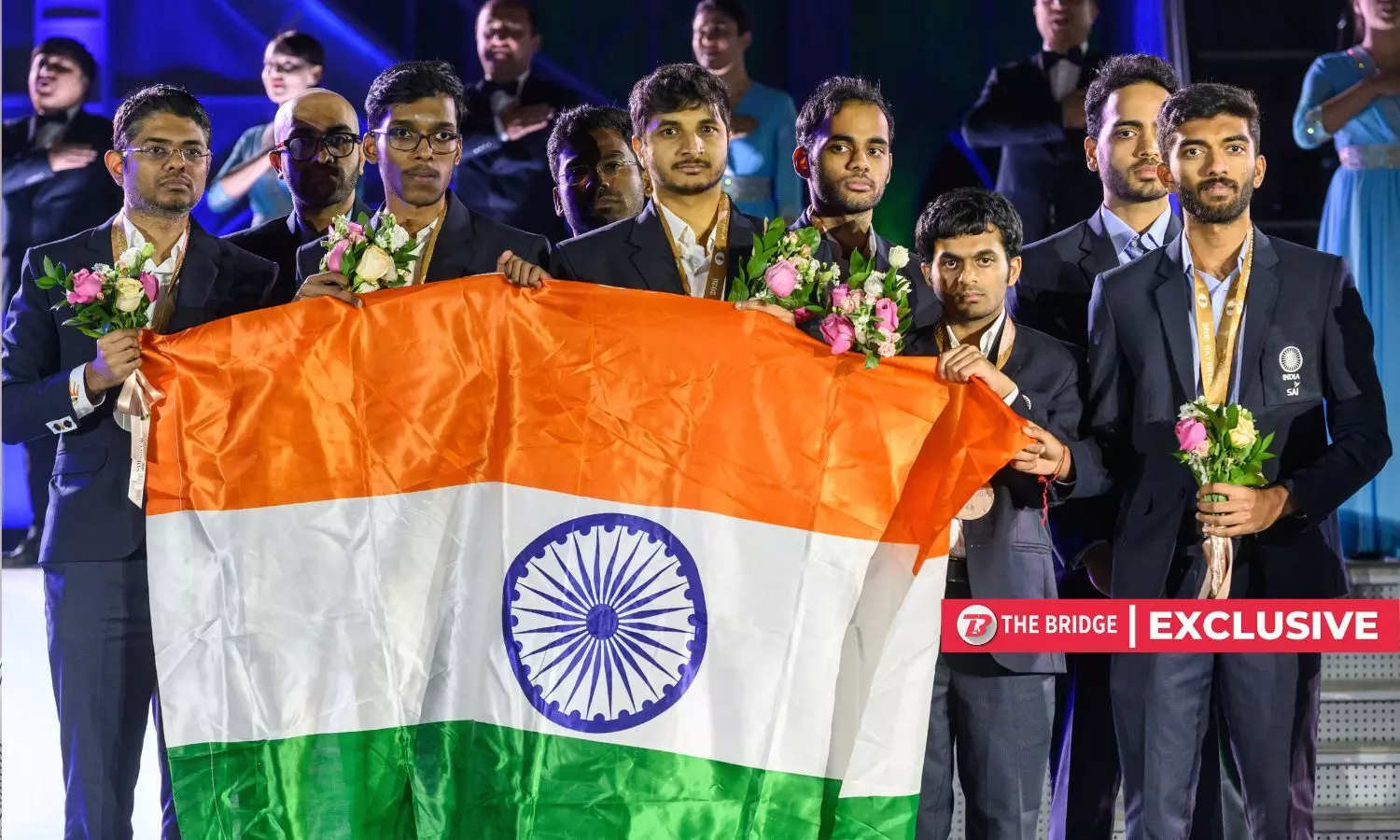
Indian open team pose after winning the 2026 Chess Olympiad silver (Photo credit: Michal Walusza/FIDE)
Vidit Gujrathi's voice carries a slight rasp when he settles down in front of a laptop screen to speak about the 2026 Chess Olympiad.
He picked up a cold in Samarkand, and he says it travelled through both Indian squads. The rasp suits the mood of a team that spent the closing days of the event running on willpower, turning up despite not being at the 100%.
India, the champions in Budapest two years ago, finished second in the open section, and hosts Uzbekistan took gold. It is easy to frame it as a title lost.
But Vidit offers a more complete story, in which sadness over the gold sits beside pride in how India reached the podium.
"Coming in as a defending champion, we were hoping to of course maintain that and win the gold again," he told The Bridge.
"Everybody in the team was very motivated, without a doubt, from both the open and the women's section. But at the same time, it was not an easy tournament at all."
"I think Uzbekistan just played better than us, and they very much deserved the gold this time," he added.
Ask him whether silver counts as a shortfall, he rejects the idea immediately.
"I don't think it's an underachievement in that sense at all. Winning silver was not easy. It was a lot of effort and there were times where we felt like we might not even finish there."
His summary carries two emotions at once.
"I'm both sad and happy. Sad that of course we missed the gold but the way we played, I think, silver was good and we are very proud of ourselves for that."
The moment the gold slipped
Every Olympiad has a hinge, and Vidit places this one in India's match against hosts Uzbekistan. The Indians had settled into a rhythm and looked comfortable until a single blunder by Nihal Sarin changed the course of the match and the tournament.
"I think that was the turning point of the tournament in hindsight, because it also dictates how you go through the rest of the tournament," said Vidit.
“A win would have shifted the psychology of the whole event. Uzbekistan was clearly the best team which we could play in terms of form, and defeating them we would get a lot of morale and confidence boost, and also knowing that head-on, had we won against Uzbekistan, we can beat any other team."
Vidit stays gentle about the error itself.
"It was a pity that at that moment there was this hallucination in Nihal's mind and he played that blunder, but yeah, it happens,” he said. “It's sport."
That indeed is what a sport is. Recovering from defeats like this and continuing to fight on. India did exactly that.
The recovery is what Vidit values most. Another slip at that stage could have dropped India from contention altogether, so climbing back to second place carried real weight.
Silver, he believes, was close to the ceiling once those points were gone, since gold also depended on results elsewhere. India still hoped until the final round.
"We were hoping that some miracle happens," he recalled.
None arrived.
Fighting through illness
The physical cost of the event surprised many who watched from home. Vidit says a bug moved through the camp, most visibly near the end, and he uses it to explain what elite chess demands of a body.
"People have a hard time understanding how stressful playing a chess game is," he said.
"You prepare for like six hours before the game and then you play for like five hours, and you have to hold that tension every single day where the cost of each move can cost India a medal."
Mental fatigue of that order leaves little defence against a virus, and yet nobody asked to sit out a round.
"The intent was so high, they showed a lot of character," said Vidit.
"Even though physically they might not be at their 100%, they were like 'no, I'll go and fight.'"
Players also took care to hide their condition from opponents across the board. That determination anchors the way he frames the result.
"What we get at the end of the day is not totally in our hands. So I'm very proud of fighting, and everybody was fighting and giving their all."
Preparation, board order and team chemistry
Ahead of the 2026 Chess Olympiad, with the players continuously playing in other tournaments, there was no in-person camp for the team. Captain Srinath Narayanan relied on online meetings as a practical solution.
The fact that India had almost the same team which bagged the 2024 title with only Nihal coming in place of Pentala Harikrishna helped.
“The team bonding already existed," said Vidit. "I really enjoyed those online meetings.”
The group settled strategy and board orders in those calls and worked on form together.
The board order drew the sharpest public debate and criticism for Srinath, particularly the decision to place reigning world champion Gukesh Dommaraju on Board 4.
“It was a unanimous call,” revealed Vidit. “Guki, in fact, had discussed with me that he wanted to play Board 4 before he went to Srinath.”
The rest followed naturally. Praggnanandhaa, who was having a great year, took board one.
Arjun Erigaisi, "very dangerous as a player, very aggressive," suited board two. Nihal went to three, and Vidit, who had played four in 2024, moved to five as reserve.
Vidit believes Srinath absorbed criticism he did not deserve.
"There are so many things which happened behind the scenes that people are not aware of, so they draw wrong conclusions," he said.
“But poor Srinath got a lot of criticism for it when it was not his fault at all,” he added with a chuckle.
Vidit also noted that the arrangement helped Gukesh score far more than a higher board would have. The world champion scored 8.5 points in 11 games and notched up seven wins as he bagged an individual silver as well.
Gukesh and weight of the crown
During the course of the tournament, Vidit grew closer to Gukesh and saw a young man carrying a burden with little precedent.
"Very few people have been World Champion at the age of 18, and to handle that pressure, there's no previous experience to take from," opined Vidit.
"There is a pressure that comes with the title and the crown, because the crown is heavy."
Samarkand brought some relief. Gukesh arrived intending to play for fun, and Vidit noticed the difference.
"Seeing him play well and also be in a good mental state as a friend was good to see," he said.
With the World Championship defence approaching, he sees that lightness as an asset.
"If he continues this happy mood there, it would put him in the best chance to play the World Championship."
The record books will list India second. But inside the camp, the memory is of a squad that fought through illness, a costly blunder, an under fire world champion and captain, and still finished on the podium.