
Badminton
What went wrong for Satwik-Chirag at the Asian Games
Three near-flawless days in the team event were followed by one loose game in the individual draw and that contrast, not the ranking gap, explains Friday's shock exit.
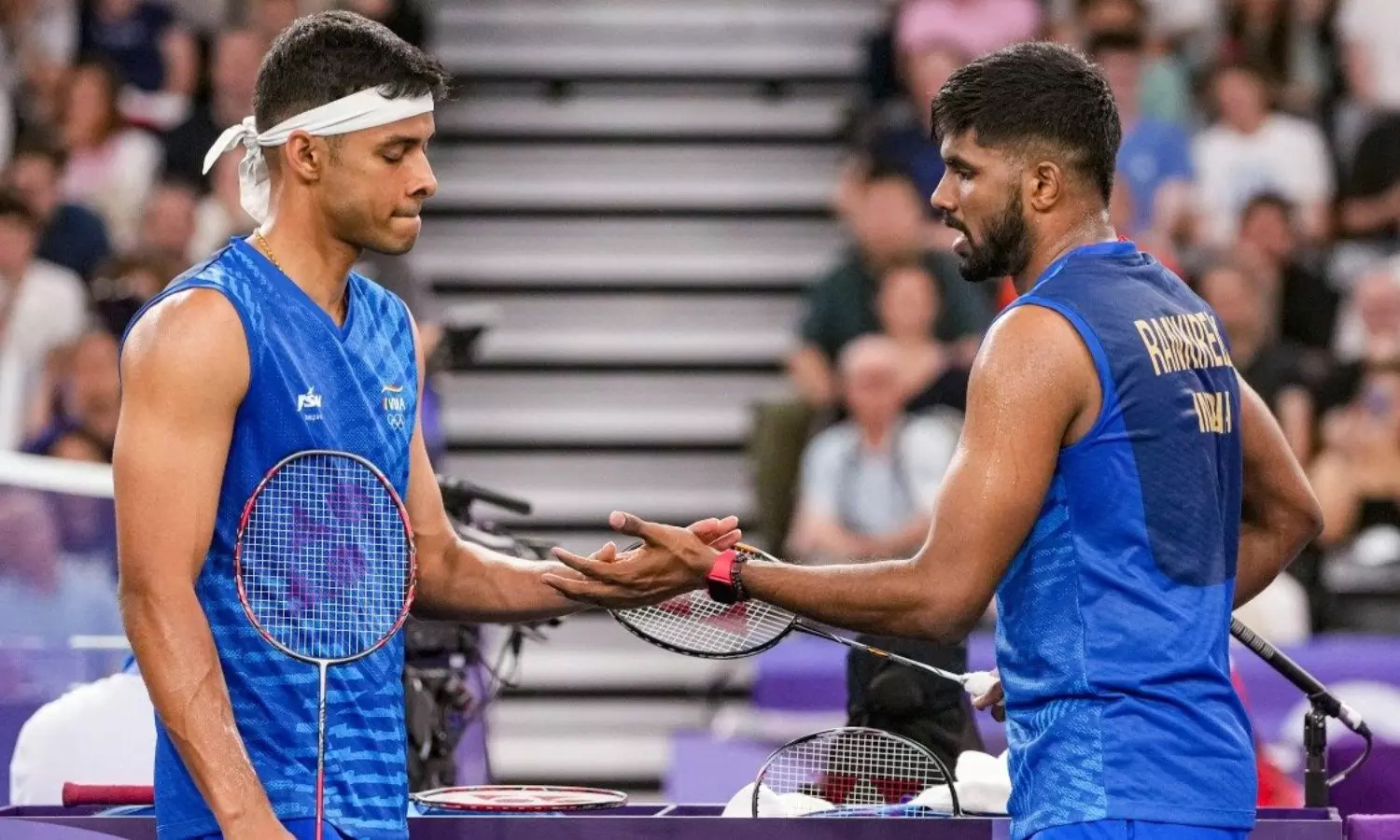
Satwiksairaj Rankireddy and Chirag Shetty. (Photo credit: Jio Cinema)
Fourth-seeded Satwiksairaj Rankireddy and Chirag Shetty, the defending Asian Games men’s doubles champions, lost 21-12, 19-21, 14-21 to Thailand’s Pakkapon Teeraratsakul and Peeratchai Sukphun, ranked No. 36 in the world, in the round of 32 at the Ichinomiya City Municipal Gymnasium on Friday. The match lasted 68 minutes.
On paper, this reads as one of the tournament’s biggest upsets. Watch the match back, though, and it looks less like an ambush and more like a team that had little left to give.
This had less to do with Teeraratsakul and Sukphun suddenly finding the game of their lives, and more to do with Satwik-Chirag having played their most demanding badminton of the Games just 48 hours earlier in the team event.
Three matches in three days
Two days before the individual draw opened, Satwik-Chirag delivered two of their most complete performances of the year in the men’s team event.
First came a hard-fought 21-18, 24-22 win over Japan’s Takuro Hoki and Yugo Kobayashi, the World No. 9 pair, in the quarterfinal.
That was followed by a statement 21-11, 22-20 win over China’s Liang Wei Keng and Wang Chang, ranked World No. 3, in the semifinal.
That win over Liang-Wang carried extra weight. The same Chinese pair had knocked Satwik-Chirag out of the BWF World Championships quarterfinal in New Delhi barely a month earlier, winning 21-18, 21-9 in just 35 minutes.
Beating them in Aichi-Nagoya, and beating them convincingly, was as much a mental correction as a result on the scoresheet.
It also meant the Indian pair had played their two most demanding matches of the tournament back-to-back, stood on the podium to collect the team bronze, and then walked into the individual draw the very next morning.
The pair pointed to exactly this after the defeat.
“We know these situations will happen. It will get tense because it will be tricky because we have been playing continuously in the team event, and we were here last night till 12 o'clock, and right away we are playing one of the good matches,” they said.
The switch that never flipped
Everything about the Thailand match suggested a team still running on the adrenaline of team-event badminton rather than the sharper, more patient game the individual draw demanded.
Satwik-Chirag opened well, as they have all year, taking the first game 21-12 off their trademark steep smashes and flat, suffocating exchanges.
But the moment Teeraratsakul and Sukphun stopped trying to out-hit the Indians and instead extended rallies, waited and let the errors come, the Indian pair struggled to find a second gear.
Where the semifinal against Liang-Wang had been won on discipline in the front court and calculated aggression, the round of 32 was lost to rushed shot selection and unforced errors.
Satwik in particular appeared to be hurrying points rather than building them, a sign of fatigue as much as nerves.
A pattern, not an anomaly
This is not the first time congestion has caught up with Satwik-Chirag. They also crashed out in the semifinals of the BWF World Tour Finals last December after a demanding run.
Teeraratsakul and Sukphun, for their part, were not complete strangers to testing this pair physically. The Thais had taken a game off Satwik-Chirag as recently as the 2025 Hong Kong Open before losing in three games.
The pair’s own explanation afterward was strikingly self-aware, and it was not about pressure.
“There was no pressure for us. It’s every day, the same matches, same players. But it’s how you mentally prepare for the tournament,” they said. “So it’s a process for us. We keep learning, learning, learning. It happens, but we’ll go back and prepare on the mental aspect.”
“I take it as a positive because these things are happening for us. It’s time for us to figure it out, do something whenever we want to play at the bigger stages. We have proved that we can play, but if you are falling down, there is a fall down continuously. There is no middle where we can stop it,” they said.
Aichi-Nagoya leaves Satwik-Chirag with a bronze medal, and homework they have already started working on.