
Athletics
Asian Games 2026: How did Shaili Singh's hair affect her long jump distance – Explained
Shaili Singh's 2026 Asian Games long jump showed how a ponytail can affect the official distance, with the nearest mark in the sand determining the result.
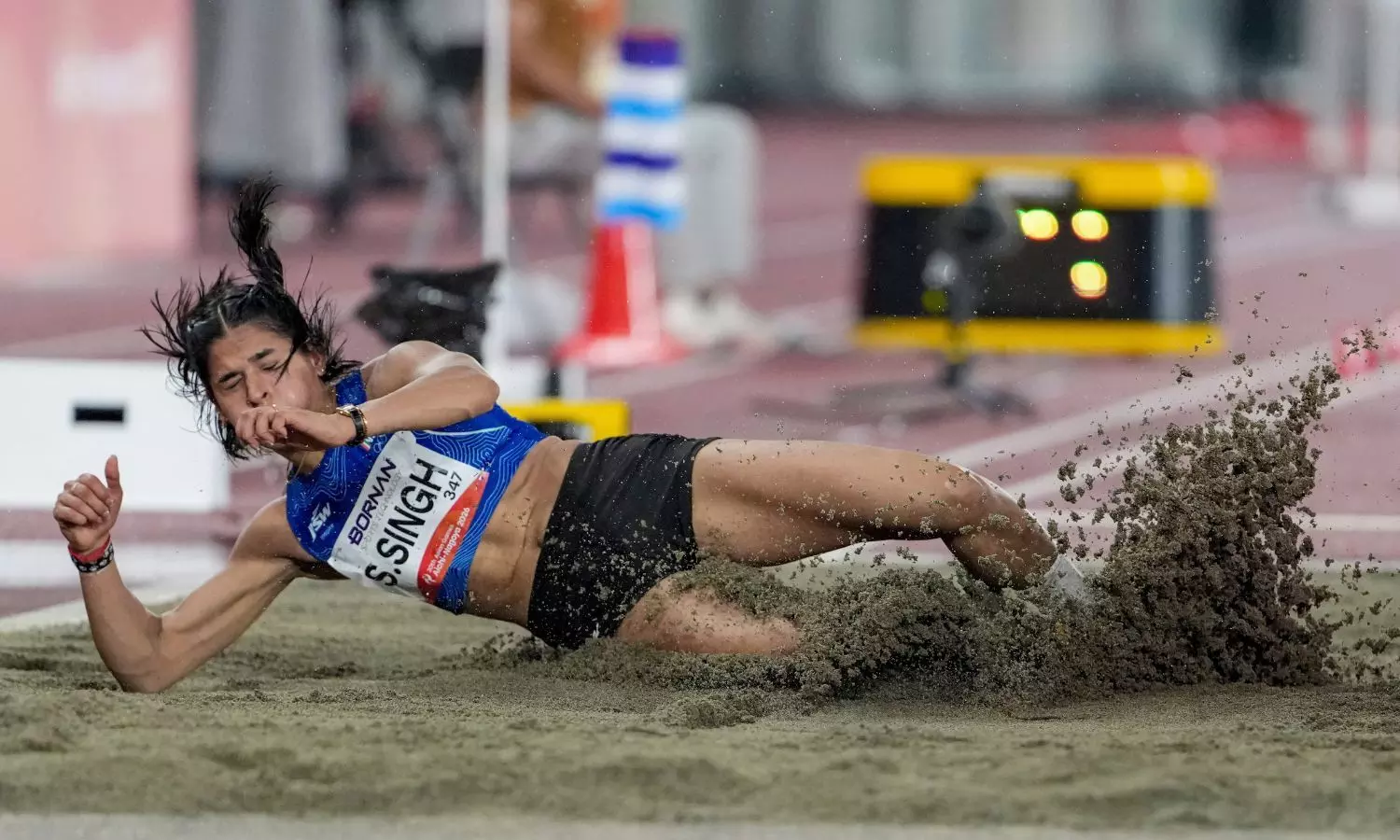
Why Shaili Singh's hair affected her long jump measurement at Asian Games? (Photo credit: PTI)
Shaili Singh appeared to have produced a big fourth-round effort in the women’s long jump final at the 2026 Asian Games in Nagoya on Sunday.
But when the distance was officially measured, the Indian athlete was given 6.41m, later finishing with a best of 6.42m.
The reason was not necessarily where her heels landed.
In the long jump, the distance is measured from the take-off line to the closest mark left in the sand by any part of the athlete’s body, or anything attached to the body. That includes hair.
That seemingly small technicality can take several centimetres off a jump, and in a sport where medals are often separated by centimetres, it can completely change the standings.
Why can hair decide the distance?
World Athletics' rules require officials to measure from the take-off line to the nearest break in the landing area made by the athlete. The measurement is taken perpendicular to the take-off line and rounded down to the nearest centimetre.
So, if an athlete lands on her heels but then sits back, the mark made by her hand or backside can become the point from which the jump is measured.
The same applies to long hair.
A ponytail that swings backwards and touches the sand can leave a mark behind the athlete's feet. If that mark is closer to the board, that becomes the official measurement, even if the athlete's heels are significantly farther down the pit.
This is why long jumpers are often taught to bring their upper body and legs forward on landing and avoid falling backwards. Athletes with long hair may also keep it tightly secured, often in a bun or close braid.
What happened with Shaili Singh?
Singh's fourth attempt at the Mizuho Park Athletic Stadium looked considerably longer than the eventual official measurement.
After the attempt was reviewed, officials measured the jump at around 6.41m, with Singh ultimately recording 6.42m as her best mark. She was briefly in the bronze-medal position before China's Mengyi Tan moved ahead with a 6.46m effort in the final round.
China's Huang Yingying won gold with 6.55m, while India's Ancy Sojan took silver with 6.53m.
Singh's case illustrates why a long jump cannot be judged simply by looking at where an athlete's feet appear to land. The decisive mark can be considerably closer to the board.
Shaili is not the first athlete caught by the rule
One of the most famous examples came at the 2011 World Championships in Daegu.
Belarusian long jumper Nastassia Mironchyk-Ivanova appeared to have produced a jump around the 6.90m mark. However, her ponytail struck the sand behind her, leaving a mark that was closer to the take-off board than the rest of her body.
Her jump was measured at 6.74m. American Brittney Reese eventually won gold with 6.82m, while Mironchyk-Ivanova finished fourth.
A similar incident involving Belgium's Maite Beernaert at the 2018 Youth Olympics also drew attention to how a ponytail can shorten an otherwise strong-looking jump.
So while Singh's attempt may have looked longer to viewers watching the landing, the officials were not measuring the point that looked farthest from the board. They were measuring the closest valid mark left in the sand.