
Athletics
A mother's marathon for her daughters reveals India's true sporting culture
Reports of a 47-year-old mother's completing a marathon is indication that sport's truest power isn't always Olympic glory.
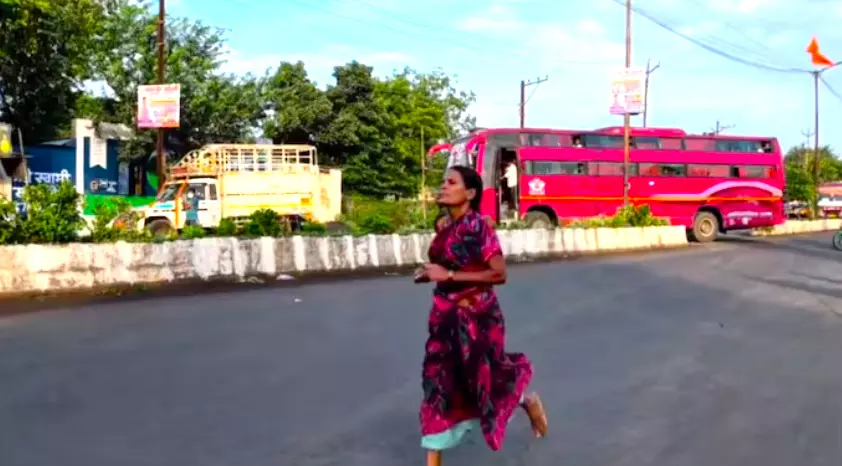
Ramabai's effort is a quiet triumph that says more about grit, motherhood, and India's hidden sporting spirit than any medal ceremony ever could. (Photo credit: X)
For decades, the verdict on India and sport has stayed the same: no medals, no culture and quite naturally, limited aspiration for sport as a way of life.
But culture is not inherited - it is built, avenue by avenue, wherever effort can be exchanged for survival.
One such example has now emerged from rural Maharashra where a 47-year-old mother from the state's Beed district reportedly entered a small-town marathon for a paltry Rs 3,000 prize, ran barefoot in a saree, and beat every younger, better-equipped runner to the finish line.
A road to conquer
In Ambajogai, a modest town in Maharashtra, Ramabai Ranveer's days are built around a single, unglamorous arithmetic: how to keep two daughters in school after their father is gone.
There is no cushion of savings, no institutional safety net, just a mother's determination and whatever work her hands can find.
So when she heard about Amrit Daud, a local marathon offering Rs 3,000 to its winner, she did not see a sporting event. She saw tuition fee. She saw her daughters' future, paid for in one go, and within reach.
She showed up with none of the trappings runners are supposed to have — no shoes built for impact, no athleisure and no packs of hydration gels. Instead, she wore a saree and a pair of ordinary slippers, and lined up beside competitors decades younger, dressed for the part in ways she was not.
It would have been reasonable to assume she was there to accept the freebies that organisers often tend to give away at such events.
Then the race began, and her slippers betrayed her, slowing her down on the very road she needed to conquer. Most people would have called it a sign to stop.
Instead, Ramabai called it an obstacle, one that she had to cross.
She reportedly bent down, pulled off her slippers, and ran on, barefoot, gripping her only footwear in her fists as the tarmac took its toll on her soles with every stride.
There was no strategy here, no biomechanical calculation, only a mother running toward her daughters' education as if it were a finish line she could physically reach by just wanting it badly enough.
And astonishingly, she did reach it - first.
Ramabai Ranveer reportedly won Amrit Daud outright, crossing the line ahead of runners who had every advantage except her reason for running.
The 'Amrit Daud' was reportedly organised as part of the Amrit Mahotsav celebrations of Kholeshwar Educational Complex of Bharatiya Shikshan Prasarak Sanstha. (Photo credit: X)
When sport becomes leverage
What Ramabai did was not a stunt or a viral moment engineered for applause. It was survival, dressed up by circumstance, as sport.
That distinction matters, because India has long carried an uneasy reputation as a nation indifferent to sport at large - a country of a billion-plus people that underperforms at the Olympics, where cricket eclipses nearly every other discipline, and where parents steer children toward competitive exams rather than running tracks.
That critique is not baseless.
Infrastructure is thin, funding is inaccessible, and sporting careers are still treated, in most households, as a gamble few can afford.
Yet Ramabai's barefoot run outshines that narrative in a way statistics never could.
When sport stops being a pursuit of glory and becomes a mechanism of livelihood — a way to pay a fee, feed a family, buy one more year of a child's schooling — Indians run, wrestle, lift, and fight with a hunger that no funding shortfall can dull.
The country's small-town marathons, its rural kabaddi tournaments, its district-level akhadas are full of Ramabais: people for whom sport is not recreation but leverage, the one arena where effort translates directly and honestly into money.
While India may lack a sporting culture built on institutions, it certainly does not lack one built on necessity.
That is precisely why Ramabai's effort deserves more than a viral moment of tribute - it deserves policy attention and scholarship support for the thousands of daughters like hers, and recognition that grassroots sport, however unglamorous, already functions as an informal safety net across the country.
In the end, sport did what government schemes and viral sympathy alone rarely manage - it handed a mother, with nothing but bare feet and resolve, a real and immediate way forward.
That is the beacon worth holding onto: sport, at its rawest, remains one of the few honest promises left - that effort, however unaided, can still outrun disadvantage.
(The opinions expressed in this article are limited to that of the writer and does not reflect those of the publication.)