
Asian Games
Explained: The accommodation controversy at 2026 Asian Games & reasons
Aichi-Nagoya 2026 will have no traditional athletes' village. Here's how cruise ships, temporary homes and hotels will accommodate athletes.
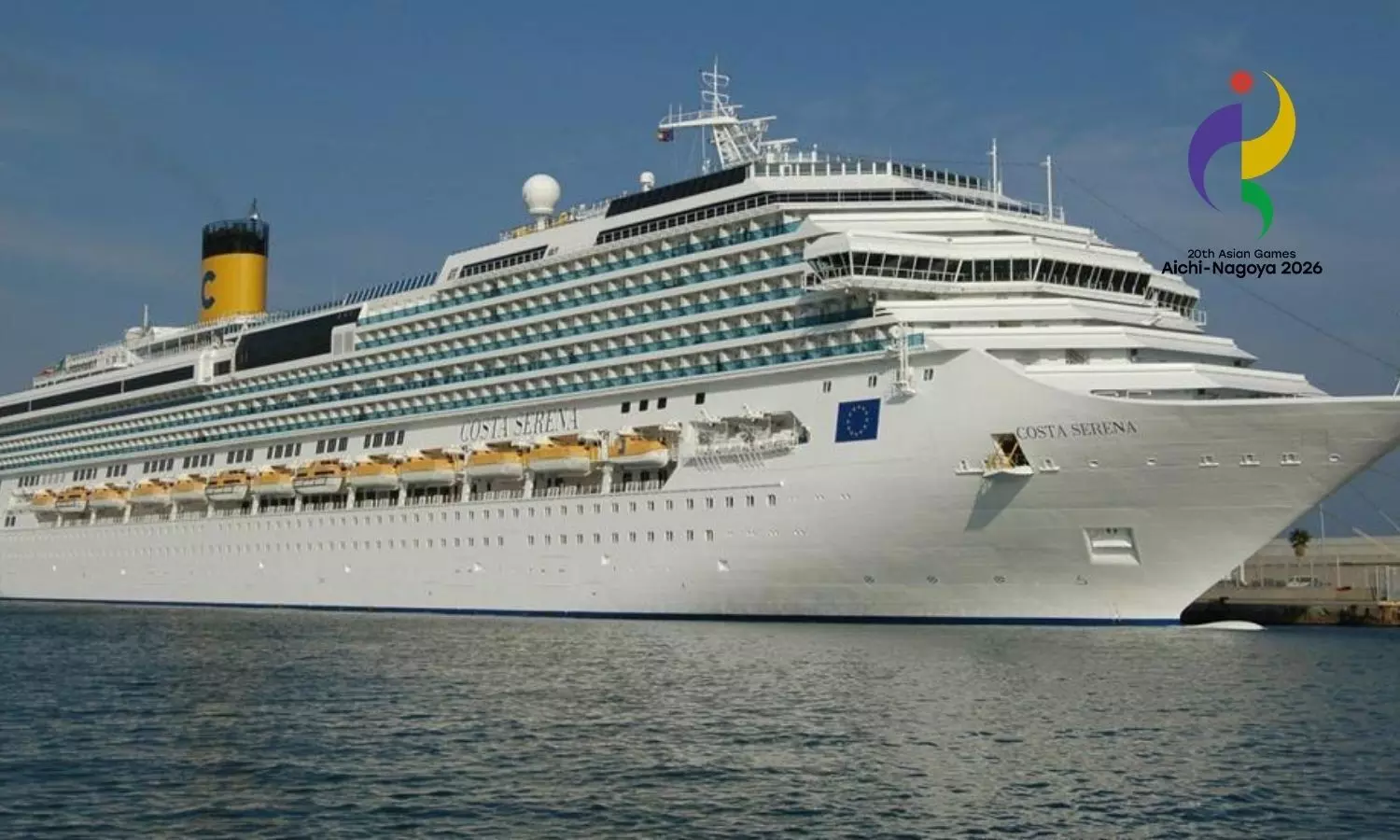
Inside the accommodation gamble at the Aichi-Nagoya Asian Games (Photo credit: Cruise Mapper)
An Italian cruise ship will become an athletes' village. Wooden modular homes will house thousands more. Others will be spread across hotels, some potentially hundreds of kilometres from where they compete.
For the first time in the history of the Asian Games, there will be no traditional athletes' village at the centre of the event.
Instead, when the 2026 Aichi-Nagoya Asian Games begin on September 19, athletes and officials will be distributed across a patchwork of accommodation, a model born out of Japan's desire to keep the Games compact and avoid the cost of building a new village, but one that has now come under scrutiny as the number of participants has climbed well beyond the original projection.
The Games village that never was
Building a dedicated village is expensive, particularly for a multi-sport event whose venues are spread across a region.
The Aichi-Nagoya organisers had already faced rising costs, and avoiding a new village was consistent with the broader push towards using existing infrastructure rather than creating another large post-Games development.
The Olympic Council of Asia (OCA) had described the absence of a traditional village as a new model for the Asian Games as early as 2024, with a cruise ship planned to accommodate around 4,000 athletes and hotels intended for others based in the Nagoya area.
That model, however, was designed around a smaller number.
The host city agreement provided for accommodation for around 15,000 participants. By August, the OCA was reporting a figure of around 17,000; roughly 11,000 athletes and 6,000 officials. The addition of sports, including padel and teqball, contributed to the increase.
Suddenly, the experiment had a capacity problem.
On August 26, Reuters reported that organisers were looking at ways to reduce participant numbers because accommodation arrangements were under pressure.
Two days later, Aichi Nagoya Asian Games Organising Committee (AINAGOC) and the OCA issued a joint statement saying all 17,000-plus athletes and officials registered before the July deadline had been provided with Games-appropriate accommodation.
The apparent contradiction is explained by the accommodation plan itself: while AINAGOC has arrangements for up to 15,000 people, certain team officials beyond that capacity were being asked to arrange their own accommodation through their national Olympic committees.
AINAGOC confirmed as much in its own August 28 statement.
So, technically, the beds are there. But the bigger question is what the Asian Games' new accommodation model actually looks like for the people sleeping in them.
Welcome aboard, athletes
For between 4,000 and 5,000 participants, the answer will be the Costa Serena, an Italian cruise ship berthed at Nagoya Port.
The ship, nearly 290 metres long, will effectively serve as a floating Games village during the event. The cruise liner has restaurants, recreation areas, pools and other amenities, while its location provides a centralised accommodation option for thousands of athletes and officials. Reports put the charter cost at roughly US$30 million.
The concept is unusual, but not entirely unprecedented.
Cruise ships have previously been used to help solve accommodation shortages at major multi-sport events. The 2006 Asian Games in Doha famously brought in cruise ships when organisers struggled with accommodation demand.
But Aichi-Nagoya is different.
There is no conventional village surrounding the ship, no single place where the majority of athletes can live, eat, train, meet and socialise.
And then there are the container homes
Around 2,000 more athletes and officials will be accommodated in temporary wooden, container-style structures around Nagoya Port.
The units have been designed as temporary accommodation, complete with bedrooms, living areas and basic facilities.
It raises the question how far can a multi-sport event go in cutting infrastructure without cutting into the athlete experience?
The answer may depend on whom you ask.
Organisers insist that the accommodation is appropriate. The OCA and AINAGOC said in their August 28 statement that all athletes and officials registered by the deadline had been provided with “Games-appropriate accommodation” and that final preparations were progressing smoothly.
The real test, however, will begin when athletes arrive.
Why cricket has become the latest flashpoint
Cricket's concerns have brought the accommodation issue into sharper focus in the final weeks before the Games.
The sport will be played at Korogi Sports Park in Nisshin, a remodelled baseball facility around 20 kilometres from Nagoya's city centre. The venue was completed in March and hosted six matches during the ICC Men's T20 World Cup East Asia-Pacific Qualifier in May, giving it its first international test before the Asian Games.
But leading cricket nations have reportedly raised concerns about both the venue and accommodation.
The hotel accommodation offered to cricket teams is around 20 kilometres from the ground, while concerns have also been raised about room sizes and space for cricket kit.
There have been separate reports questioning the distance of player facilities and washrooms from the playing area.
The Japan Cricket Association (JCA) has pushed back on some of those claims.
JCA CEO Naoki Alex Miyaji said the association was not directly responsible for all aspects of the Games' accommodation, but stressed that the ACC and AINAGOC had been discussing the arrangements for a long time.
“The participating teams in cricket are being offered hotel accommodation,” Miyaji told PTI.
“The teams are free to arrange their own accommodation if they choose to do so,” he added.
Miyaji also rejected reports that players would have to walk long distances to reach washrooms, saying toilets would be available within the player area and that both temporary and permanent facilities would be available at the venue.
The JCA has also pointed to the constraints under which the cricket facility was built.
Aichi had no cricket venue of the required standard, meaning the Korogi facility had to be developed from scratch in roughly 17 months.
The static-sport problem
India had also raised concerns months ago about placing athletes from sports such as shooting and archery on a cruise ship.
The logic is straightforward: for athletes competing in precision and static sports, even a relatively subtle difference in balance or motion can matter.
A cruise ship is an attractive solution precisely because it can house thousands of people in one place. But the very feature that makes it a ship, its movement, is not necessarily ideal for athletes whose performance depends on stability and fine motor control.
That has turned the floating village into more than an accommodation curiosity. It has become a question of whether one solution can work equally well for every sport.
The numbers tell another story
Behind the accommodation problem is a broader question about how modern multi-sport events are planned.
Aichi-Nagoya's initial projection was around 15,000 athletes and officials. The eventual figure rose to more than 17,000.
When the accommodation model is built around carefully calculated capacity — 4,000 to 5,000 on a ship, around 2,000 in temporary accommodation and the remainder in hotels — an extra 2,000 people is not a small problem.
And that is where the Aichi-Nagoya experience could become instructive for future hosts.
The Asian Games are enormous. They bring together thousands of athletes across dozens of sports, each with different competition schedules, equipment requirements, recovery needs and logistical demands.
A model that works beautifully for one sport may be completely unsuitable for another.
A cheaper Games, but at what cost?
There is a legitimate argument for avoiding the traditional multi-sport village.
Cities have repeatedly spent enormous sums building facilities for events that have little use afterwards. A smaller footprint, existing hotels and temporary infrastructure can reduce that burden.
But cost-cutting and sustainability cannot simply be measured by how little concrete is poured. They also have to be measured against how athletes actually experience the Games.
If athletes are housed efficiently, transported reliably, given adequate food and recovery facilities, and can compete at their best, then the floating village and temporary homes could become a model worth studying.
If, instead, the absence of a central village creates fragmented transport, cramped rooms, poor recovery conditions or sport-specific problems, Aichi-Nagoya could become a warning about taking the “no village” concept too far.