
Asian Games
Asian Games 2026: 85 medals later, India still has a finishing problem
India’s 85-medal haul was well above every pre-Hangzhou total, but the Aichi-Nagoya Games also exposed shortcomings across several key sports.
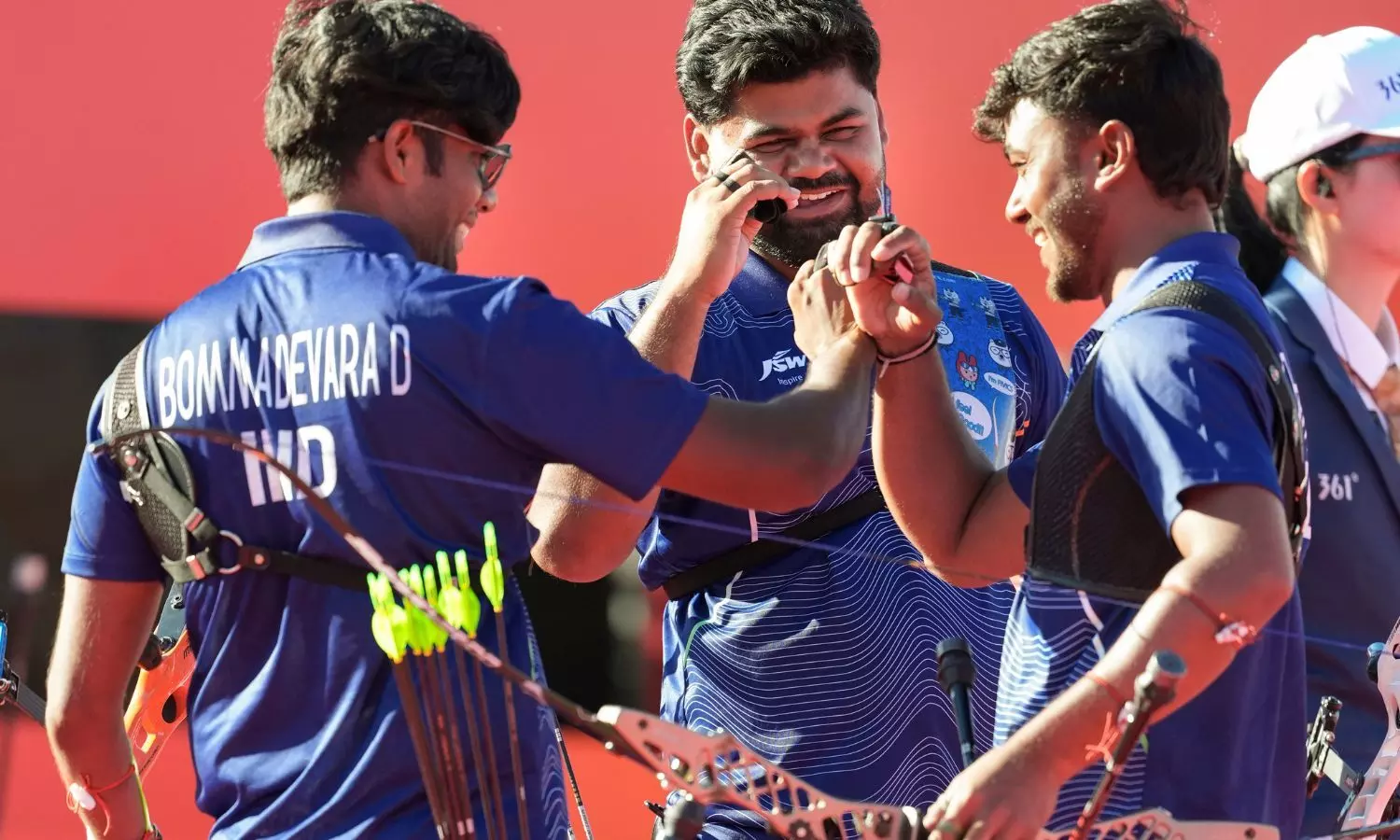
From left, Dhiraj Bommadevara, Yashdeep Bhoge and Neeraj Chauhan during the men's recurve archery team final event (Photo credit: PTI)
India finished fourth at the 2026 Asian Games in Aichi-Nagoya with 85 medals, including 21 gold, 27 silver and 37 bronze on Saturday.
Placed beside Hangzhou's 106 medals and 28 gold, the number looks like a retreat. But if placed beside any other older record, it looks like a new floor. Both readings hold, and the distance between them is the story of this campaign.
India took 65 medals in the 2010 Guangzhou Games, 57 in 2014 Incheon and 70 in 2018 Jakarta, finishing sixth, eighth and eighth respectively.
In Hangzhou, India jumped to 106 medals and fourth place. The 85 medals in 2026 Aichi-Nagoya sits comfortably above every pre-2022 total, and a fourth-place finish suggests Hangzhou did not simply happen by luck.
The gold share also complements the celebration. In 2010 India converted 21.5% of its medals into gold, in 2014 19.3%, and in 2018 22.9%. Hangzhou reached 26.2%.
The 2026 Aichi-Nagoya Games returned with 24.7% gold medals, lesser than Hangzhou but better than years before.
While the performances in early days of the 2026 Asian Games raised eyebrows, it remains a fact that India now wins far more medals than it did a decade ago.
Yet it turns them into titles at just slightly over the old rate.
Hangzhou looks like the outlier, a year in which form and fortune lined up across many sports at once.
The 27 silver medals in Aichi-Nagoya are the clearest evidence. They represent finalists who reached the last contest and lost it. Fixing that gap is a different job from building depth, and Indian sport has only recently begun to treat it as one.
Women lead the charge
Throughout the 2026 Asian Games, women carried the campaign on their backs for India.
The cricket, hockey and kabaddi teams all won gold. Neeru Dhanda in trap, Lovlina Borgohain and Parveen Hooda in boxing, Kumkum Mohod in recurve and Pranavi Urs in golf won individual titles.
Suruchi Phogat played the most vital role in the mixed 10m air pistol gold.
That pattern is a real shift from the era when men's team sports and a few male shooters supplied the headlines.
The Women's Premier League (WPL) and efforts put in by Board of Control for Cricket in India (BCCI) deserves credit for the cricket side, which has morphed into an unbeatable force in the Asian continent.
Elsewhere, Federations and sponsors should read that as an argument for matching investment in the women's programmes of those sports with what the men receive.
India's Prithika Pradeep, Chikitha Taniparthi and Jyothi Surekha Vennam after winning compound women's team archery event (Photo credit: PTI)
Sportwise breakdown
Athletics (24 medals: 1 gold, 9 silver, 14 bronze)
The largest Indian contingent at the 2026 Asian Games was also the largest disappointment relative to its quality.
2022 Hangzhou produced six gold and Nagoya produced one, the women's 4x400m relay.
Parul Chaudhary lost her 5000m title and took bronze in two events, including a national record in 3000m steeplechase.
Tajinderpal Singh Toor slipped to shot put silver, and Avinash Sable finished off the podium in what was just his second 3000m steeplechase after a return from injury.
Two other defending champions, Neeraj Chopra and Annu Rani, didn't compete in Aichi-Nagoya for completely varying reasons.
Murali Sreeshankar twisted his ankle on a rainy evening and settled for silver.
The bright spots were real. Gulveer Singh won silver in the 10,000m and 1500m and bronze in the 5000m, an unusual spread across metabolic demands that speaks of excellent recovery work.
Sawan Barwal's marathon silver in 2:11:37 ended a 44-year wait for a marathon medal along with a national record.
Kiran, Prachi, Poovama Machettira, and Vithya Ramraj after winning gold medal in the women's 4 x 400 relay final (Photo credit: PTI)
Vithya Ramraj's 400m hurdles bronze came with a national record that erased P.T. Usha's 1984 mark.
Dev Meena, although not on the podium, went over 5.50m in pole vault, while the Mixed 4x100m relay team also set a national record.
The untimely pull-outs from Jyothi Yarraji in women's 100m hurdles and Praveen Chitravel in men's triple jump after being medically cleared certainly raised eyebrows.
The squad was deep, and it peaked decently. But it rarely peaked highest, and the Athletics Federation of India (AFI) should be asked how its season is timed.
Archery (9 medals: 5 gold, 2 silver, 2 bronze)
This was the best-run programme in the Indian contingent. India won compound team gold in the men's, women's and mixed events.
The mixed final against South Korea went to a shoot-off in which Chikitha Taniparthi and Sahil Jadhav shot a perfect 20 against 19.
The pressure-simulation camps at the SAI centre in Sonepat appear to have done their job.
The 17-year-old Kumkum Mohod's individual recurve gold and the women's recurve team win over Korea suggest the gains are reaching the Olympic bow, where India has long struggled.
With compound archery debuting at Los Angeles 2028, archery should be one of India’s most dependable medal sources going forward.
Shooting (15 medals: 3 gold, 8 silver, 4 bronze)
Eight silver against three gold is the conversion problem in its clearest form. Elavenil Valarvian settled for silver, faltering with her last shot. Tilotamma Sen missed out on an individual podium in a similar way.
Kamaljeet and Suruchi did set an Asian record to win mixed air pistol gold, and Neeru added a historic individual trap title plus mixed trap gold with Kynan Chenai.
The trap shotgun group is a welcome new source of titles.
The final temperament of the rifle squad and the dip in individual pistol performances need urgent work.
While India drew lean on team gold medals compared to the delayed Games three years ago, it should not be a real cause of concern simply for the fact that those medals don't have any long term impact other than shoring up the Asian Games medal tally.
The question rather should be around why the shooters struggled in the qualification rounds and if the current National Rifle Association of India (NRAI) selection policy, focusing solely on performance at national trials need a relook.
Boxing (6 medals: 3 gold)
A strong return from a functioning federation. Lovlina Borgohain won in women’s 75kg, Parveen Hooda took women’s 65kg gold and Ankush Panghal clinched the men’s 80kg title.
Bronze medals from Narender Berwal, Priya Ghanghas and Kapil Pokhariya showed depth across weight classes.
A saving grace for the Indian campaign after a poor start and a perfect answers to the critics, who questioned the field after the 2026 Commonwealth Games success just months ago.
Wrestling (6 medals: 2 gold, 2 silver, 2 bronze)
Indian wrestling has its second-best performance ever at the Asian Games, with Sujeet Kalkal and Aman Sehrawat winning the gold medals.
While Aman was one of the title favourites, Sujeet had to get past the Olympic champion en route to his gold medal.
Sujeet Kalkal after winning gold medal in the men's Freestyle 65 kilogram (Photo credit: PTI)
Deepak Punia should have also reached the final based on his draw but lost a close 8-9 bout in the semi-final and eventually settled for bronze.
In Greco-Roman, both Nitesh Siwach and Sunil Kumar were the medal hopefuls, and they too delivered, with Nitesh even reaching the final, a first Greco-Roman final in 64 years.
The biggest disappointment was in the women's department, which was dubbed to be India's strongest. The country ended up with only one medal from the whole contingent, with Antim Panghal's winning a silver.
Dipanshi, Mansi Ahlawat and Nisha Dahiya, all three had medal chances but failed to deliver.
Tennis (no medals)
The first blank since 1986. Both men's doubles pairs lost deciding tie-breaks in the quarterfinals by two points, and Sumit Nagal was left in the last eight after failing to convert break points.
A selection dispute that kept top-ranked women's singles players out before a ball was struck was an avoidable wound.
Indian tennis, despite the recent Davis Cup success, is at its lowest it has found itself in years. The All India Tennis Association (AITA) which itself has been in turmoil in recent times needs to get its act together.
Badminton (1 bronze)
This is the sharpest letdown measured against investment. Satwiksairaj Rankireddy and Chirag Shetty went out in their opening match. Ayush Shetty surrendered late leads, and Lakshya Sen, well, was Lakshya Sen.
There were encouraging signs, especially among the women, with PV Sindhu, Unnati Hooda, Treesa Jolly-Gayatri Gopichand, and the mixed doubles pair of Tanisha Crasto-Dhruv Kapila winning against higher ranked pairs.
But a medal, apart from the men’s team bronze, remained out of reach.
Table tennis (1 bronze)
Diya Chitale and Manush Shah extended India’s medal-winning streak with a bronze in mixed doubles.
The men’s team, including Manav Thakkar, Harmeet Desai, and Sathiyan Gnanasekaran, looked out of depth, while the women did manage to pull off a surprise win to reach the quarter-finals.
Yashaswini Ghorpade, despite no medal to show for, was impressive throughout the campaign.
Squash (5 medals: 2 silver, 3 bronze)
Reliable, yet gold-less. Anahat Singh and Abhay Singh couldn’t get past the final hurdle against higher-ranked opponents in their respective singles campaigns.
The reigning champions men’s team went down in the semi-finals to Malaysia, while the women’s team lost out to Hong Kong at the same stage to return with two more bronze medals.
Cricket (2 gold)
The women's T20 side was dominant. Their 216/3 in the final against Sri Lanka rested on Smriti Mandhana's 79 off 45 balls and a quick 49 from Richa Ghosh, and Deepti Sharma's 3/6 helped dismiss Sri Lanka for 69.
The men's side reached the gold-medal match after beating Bangladesh. They too defended their title with a 19-run victory over arch rivals Pakistan, led by a stunning assault from Abhishek Sharma and Tilak Varma in the all-important gold medal match.
Hockey (2 gold)
The women ended a 44-year gold drought stretching back to Delhi 1982. Lalremsiami struck early in the final and Savita Punia anchored a resolute defence, which also secured direct qualification for Los Angeles.
The men huffed and puffed to beat Pakistan in the semifinal and reached the final. The final against a lower-ranked Malaysia was much more comfortable with a 5-1 win as India defended its Asian Games hockey title for the first time ever.
Craig Fulton, however, need to find answers to how Harmanpreet Singh and boys will hold up against the higher ranked teams outside of the continent with a 2028 LA Olympics quota already in the bag.
However, gold medals for both the men and women for the first time is worth celebrating despite the administrative mess Hockey India (HI) finds itself in currently.
Kabaddi (2 gold)
The women went unbeaten and held off Iran 37-34 in the final. The men followed suit against the same team in defending their title.
Rowing (1 bronze)
A big drop from the 2022 Hangzhou medal tally. The worst performance in 24 years. A rift within the set-up and all dirty laundry washed in the public.
Satnam Singh and Salman Khan, in men's pair, were the only saving grace, winning a bronze three days after they were booted out of the event they were slated to compete in and trained seven months for.
Who'll be held accountable for all the drama caused? The rowers? The Rowing Federation of India President? The coach? Or none?
Other sports
Manu Francis and Prince Noble won 49er silver in sailing, with bronzes for Nethra Kumanan and for Harshita Tomar and Shital Verma in the 49erFX.
Jay Meena won India's first soft tennis medal, a bronze in men’s singles.
Pincky Balhara took kurash bronze, and further podium finishes came in sepaktakraw, rowing's double sculls and mixed martial arts.
Naorem Roshibina Devi won wushu silver, the women's golf team took silver behind Pranavi’s individual gold, and Mirabai Chanu added weightlifting silver.
India's floor has risen, and its ceiling has stayed where it was. Archery, boxing and the performance of women show what purposeful preparation yields.
Athletics, shooting, badminton and tennis show what happens when talent arrives at a final without the tools to close it.
The next four years should go to sports psychology built into daily coaching, injury prevention that begins before the season rather than after the damage, and federations that keep selection and calendar disputes under control.
The 2028 Los Angeles Olympics will reward the country that wins close contests. Aichi-Nagoya's 27 silver medals say India has plenty of finalists. The task now is to teach them how to finish.
(At the time of writing this article, Uzbekistan were placed fifth in the medal standings below India. The data presented will be updated if they leapfrog India with a medal event still left.)