
Asian Games
Asian Games 2026: Three years of churn leads Diya Chitale to a medal with Manush Shah
Diya Chitale had spoken to The Bridge before the Asian Games about her medal ambitions. Now, she and Manush have assured India a table tennis medal.
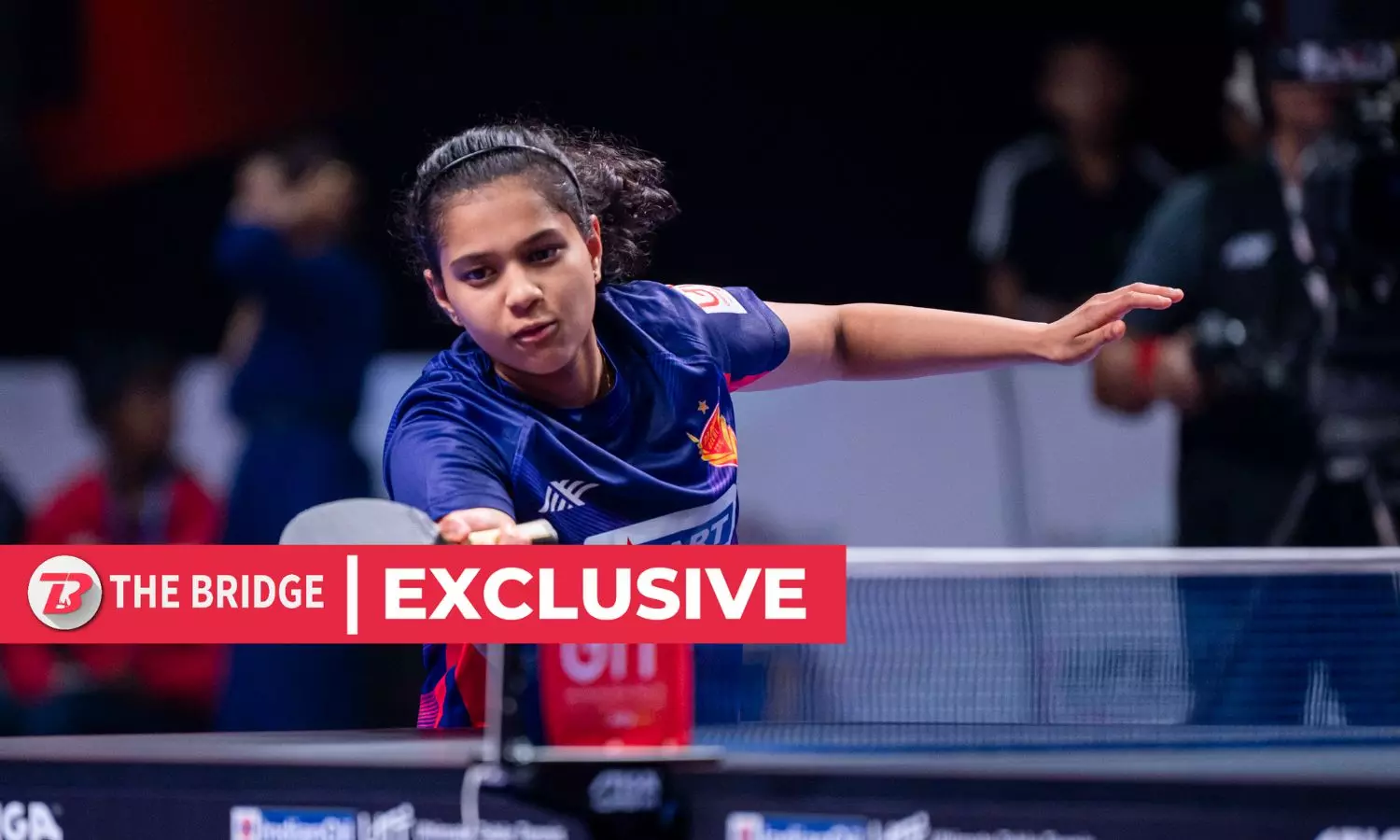
Diya Chitale in action at the Ultimate Table Tennis. (Photo credit: UTT)
"The goal is to always win a medal for India," Diya Chitale had told The Bridge before she took the flight to Nagoya.
Days later, those words now have taken on a different meaning.
Chitale is assured of a medal at the 2026 Asian Games in mixed doubles table tennis alongside Manush Shah. It will be only the second-ever medal for India in the discipline and the fourth in the sport's history at the continental games.
Chitale and Shah took down higher ranked world No 4 Doo Hoi Kem and Wong Chun Tin 11-6, 13-15, 11-9, 11-5 in the quarter-finals early on Friday.
The victory took the Indian pair into the semifinals and guaranteed India its first table tennis medal at the ongoing Asian Games.
And before she embarked on the campaign, Chitale had already made her ambition clear.
‘Preparation started from when last Asian Games ended’
For Chitale, preparing for an Asian Games was never going to be a last-minute exercise.
The 23-year-old explained that the build-up had been a continuous process stretching back to the conclusion of the previous edition, with particular attention being paid to the doubles combinations she would rely on in Japan.
"The Asian Games are something that we have been preparing for quite some time now," Chitale said.
"It happens only once in every four years, so I think the preparation started from when the last Asian Games ended."
She also highlighted the work put into developing her combinations in mixed doubles and women's doubles, with Manush and Yashaswini respectively.
That preparation has now translated into a podium finish, with Chitale and Shah one victory away from the Asian Games final.
They face China's Sun Yingsha and Wang Chuqin, the world No 2 pair and two of the best exponents of table tennis, in the semi-finals later today.
Why Manush and Yashaswini require different approaches
Chitale's doubles assignments in Japan were never going to be identical.
Manush is left-handed and plays an aggressive game, often from further away from the table. Yashaswini, meanwhile, is right-handed and uses a pimple rubber on her backhand, meaning the women's doubles pair can use a different tactical approach.
"Manush is a very, very aggressive player. He plays much more aggressively and a bit far from the table, whereas in mixed doubles I have to play closer to the table," Chitale explained.
With Yashaswini, the plan is more about disrupting the opponents' rhythm before Chitale takes control of the next ball.
"In women doubles, our strategy is more of breaking the opponent's rhythm with her rubber, and then I try to dominate the next ball and try to be more aggressive," she said.
With Manush, the objective is different: create opportunities for each other and allow the more aggressive player to take his chances.
That understanding has now taken the pair into the Asian Games semifinals.
‘India has been doing really well in doubles’
Chitale entered the Asian Games with considerable faith in India's doubles programme.
She pointed to the country's recent performances and the presence of multiple Indian combinations among the world's top-ranked pairs as evidence of the progress being made.
"We have had three pairs who were in the top 10 this year in the world ranking," she said, adding that Indian combinations had also beaten several strong pairs in recent competitions.
That confidence was not misplaced.
Chitale and Shah, ranked eighth in the world, have now produced one of the biggest results of India's campaign by knocking out Hong Kong's world No. 4 combination in the quarterfinals.
The bigger picture: LA 2028
For Chitale, the Asian Games were never an isolated objective.
Having missed out on the Paris Olympics, she had already turned her attention towards Los Angeles 2028. She described the Asian Games as an important milestone on that journey rather than the culmination of it.
"The Asian Games is the milestone and a stepping stone towards the LA Olympics," she said.
And the process, according to Chitale, does not suddenly begin or end around major tournaments.
"It's on an everyday basis we try to improve little by little," she said.
That approach is reflected in the demands of her normal training day.
There is, however, another side to Chitale away from the relentless discipline of elite sport.
While she follows a strict routine during training and tournaments, she admitted that her off days can look very different.
"Everyone thinks that I'm always very, very focused on... I always want to play, always want to eat right," she said. "But when I have an off day, it's completely the opposite."
Sometimes, she said, she simply wants to eat some junk food, switch off from table tennis and lie down without doing anything.
It is a glimpse of the person behind the athlete, but the competitive focus remains unmistakable.
Chitale also credited the Ultimate Table Tennis (UTT) for creating a valuable competitive platform for Indian players, particularly youngsters coming through the system.
"It's a great platform, especially for the young athletes," she said. "You can see so many young athletes getting a chance to play in UTT and doing really well there as well."
Before leaving for Japan, Chitale spoke about the need to enjoy the game, trust herself after defeats and keep working towards the next opportunity.
"There will always be winning and losing, but I think it's important that you try to give your best," she said. "Even after a loss, to still have that trust and belief in yourself that you can do it."
Now, with a medal already secured, Chitale and Manush have the chance to turn that pre-Games ambition into something even bigger.